To complement my post earlier today on the need for best practice guidelines to minimize plastic waste in a conservation genetics lab, I asked my labmates to save all of their consumables from a day of molecular benchwork. The above picture (Sharpie for scale) is the result. All told, we produced about 1/2 kilogram of plastic … Read More “What does a day of discarded plastic from a molecular lab look like?” »
I am, among other things, a conservation geneticist. What that means is that I use the tools of molecular ecology and population genetics to make observations about species and populations in at-risk ecosystems, assess the status of anthropogenically disturbed populations, and generate data that has direct applications to conservation and management issues. Essentially, the only difference between what I do and what a population geneticist or molecular ecologist does is the motivation—I select systems to work in that have a high conservation priority.
This motivation leads to a constant intellectual conflict at the bench. The tools of molecular ecology—PCR, gene sequencing, and, more frequently, high-throughput sequencing—are waste intensive. In order to avoid cross-contamination and practice precise, clean, technique, we use thousands of tiny plastic consumables every day. These come in the form of pipette tips, sterile packaging material, micro-centrifuge tubes, and numerous other plastic widgets. Often, because of the biohazard potential, these consumable cannot be recycled.
So we have a problem. As a conservation geneticist, we need these tools to produce the data necessary to make wise conservation and management decisions. As a sustainability minded individual, I find the massive daily accumulation of plastic waste inexcusable. Do we just accept this waste as the cost of conservation genetics? I believe that the answer is no. I think we can and should develop best practices to minimize the amount of plastic waste produced by a molecular lab while maintaining good, sterile technique. I would like to propose four guidelines, based off the principles of Reduce, Reuse, and Recycle, for minimizing waste in a conservation genetics lab.
Read More “Establishing Best Practices to Minimize Waste in a Conservation Genetics Lab” »
Communique from Southern Fried Science contributor Megumi Shimizu.
Scientists with Stories is a collaborative project by PhD students affiliated with the Duke University Marine Laboratory (DUML) and the UNCʼs Institute of Marine Sciences (IMS) to help young scientists develop the skills needed to communicate mediums of communication: digital photography, web videography, podcasts, and blogging.
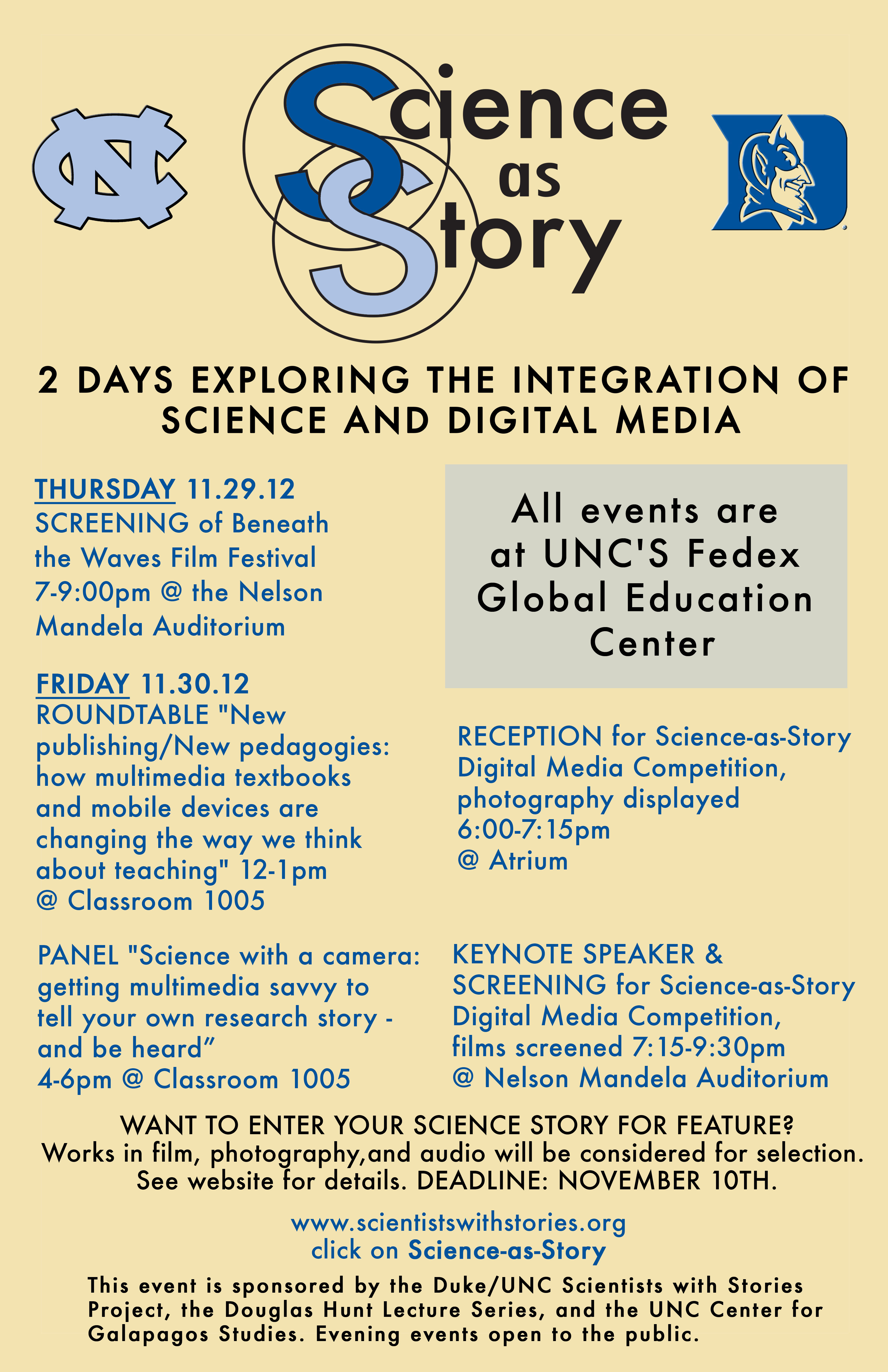
We have successfully achieved intensive filmmaking workshop in this summer, and going to have film and photography exhibition in UNC Chapel Hill on November 29th and 30th.
There are two ways to join our Festival. First, you can submit your works in film, photography and audio to our Exhibition (Duke and UNC students only). Please see our website today and contact to Rachel Gittman, one of our student leaders to tell that you are submitting. Second this event is open to public, please visit UNC’s Fedex Center for Global Education. We have keynote speakers, film screening in addition to our exhibition. Details in below.
Read More “Science as Story – two-day event exploring science, media, & the environment” »
The New England Fishery Management Council‘s Groundfish Advisory Panel (GAP) met recently in Peabody, Massachusetts to discuss plans and priorities for the coming year. NEFMC, one of 8 fisheries management councils in the United States established by the Magnuson-Stevens Fishery Conservation and Management Act, is tasked with creating management plans for local fisheries, which must be … Read More “New England Fishery Management Council calls for “legal way to kill more elasmobranchs”” »
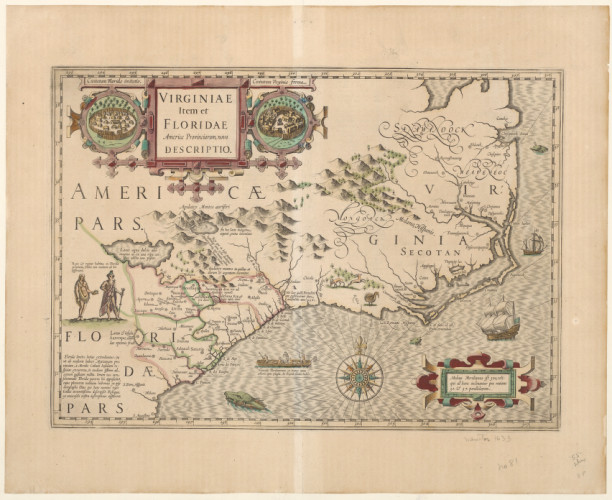
Cartographers of old produced maps that now hang in art galleries, living rooms, and libraries. They were works of art, embellished with the cartographer’s personality – from their handwriting to the fanciful borders of the page and sometimes even sea creatures. Peruse for a moment this map of North Carolina (then part of the Virginia Colony) from 1636 – the ocean comes complete with ships and large toothy fish, the land depicts the western border of our country back then (the Appalachian mountains) and each tribal territory is nicely color-coded. The map not only gets its message across but says something about the mapmaker. Today’s cartography looks very different.

Modern geographers are trained in geographic information systems, highly reliant on software and abundant data to make the required maps. GIS careers are in high demand from both sides – employer and employee – following the adage that a picture speaks 1000 words. Maps talk. But with this technological shift, much of the art is gone from cartography – but it doesn’t have to be.


On Tuesday, after what seems like an eternity of campaigning, millions of Americans will head to the polls to vote for our next President. Voters will consider numerous important issues, such as the economy, national security, and the endorsement of Lindsay Lohan. Recent polling indicates that Americans are split, and the election is expected to be very close. On an issue near and dear to my heart, the conservation of the ocean and marine life, one candidate is by far the best choice. I endorse President Barack Obama for re-election.
After promising to “restore science to its rightful place” in his 2009 inauguration speech, there are indeed many successes in conservation and science that President Obama can boast of. He has invested unprecedented amounts of Federal money in alternative energy sources, which, despite the bankruptcy of a few companies, will help reduce greenhouse gas emissions and combat climate change and ocean acidification- as will increased fuel efficiency standards. Early action resulted in conservation of wilderness rivers and trails, and Federal Everglades restoration funding has increased. Restrictions on stem cell research were greatly reduced, and mercury pollution was restricted by the EPA. Race to the top programs have improved science and math education in several states.
On ocean issues, the Obama administration has been a leader domestically and internationally. For the first time, the United States has a National Ocean Policy, which aims to reduce conflicts between different ocean stakeholders. President Obama signed both the Shark Conservation Act and the Billfish Conservation Act, which, despite being imperfect, are strong legal tools to protect charismatic and ecologically important top predators- and numerous other successes in improving the management of U.S. shark fisheries are detailed here. The Obama administration has aggressively pursued fisheries conservation internationally, at CITES, regional fisheries management organization meetings, and the Convention on Migratory Species.
The journal Brain, Behavior, and Evolution has just released a special issue on the nervous systems of cartilaginous fishes (sharks, skates, rays, and chimeras). The six research articles contained in the special issue both summarize and greatly expand what’s known about elasmobranch brains. Dr. Kara Yopak, an elasmobranch nervous system expert who served as the editor … Read More “New special issue of elasmobranch nervous systems “highlights the evolutionary relevance” of sharks and rays” »
At 450 nautical miles, Hurricane Sandy is currently tied as the second largest storm on record. Right now she’s sitting off the Carolina coast delivering massive amounts on rain to Southern Fried Science HQ, but the real trouble is going to start in a two days, when she makes landfall somewhere between Maryland and New … Read More “Hurricane Sandy Update and Open Thread” »
While my illustrious co-blogger has taken over running the Donor’s Choose challenge for Southern Fried Science this year, I decided to take up a single, worthy project to focus on. One of the challenges with Donor’s Choose is that it’s hard to fund the most expensive projects. People like to see the results of their … Read More “What if you’ve never seen the ocean? Donor’s Choose Project – In Search of Marine Diversity” »
The 2012 DonorsChoose Science Bloggers for Students Challenge is shaping up to be another big success! As of this morning, 132 people had donated a total of nearly $10,000 to help support science education in public schools, and Team Surf and Turf (Ocean and Geology Bloggers) is in the lead with over $3,000 donated. 14 Southern … Read More “DonorsChoose Update: Over $700 raised so far, 4 new projects added, 12 days to go!” »