


This Friday, tune in to National Geographic Wild for a day of sharks! Starting at noon, they will air a series of shark documentaries culminating at 9 p.m. with “Shark Attack Experiment: Live“. This show, aired live from the shark hotspot of South Africa, aims to test some common myths about shark attacks and to “to … Read More “Check out Shark Attack Experiment Live, Friday on National Geographic Wild” »

The noble turkey, a centerpiece of the American Thanksgiving supper. It looms large from its prominent position on the dining room table. The master of ceremonies – or, in my case, the guy who keeps slicing himself open with various sharp objects yet is inexplicably the one people call on when there’s knife-work needs doing – draws a set of fine, honed knives, set aside for this particular task, and carves, delicately yet firmly, into the hefty white meat of the turkey’s breast. Sure, some favor the dark, rich meat around the legs, but this white meat, soaked in gravy and topped with cranberry sauce or stuffing, that is what we crave.
“We give thanks,” the benediction may begin, “to Charles Darwin, for determining the underlying mechanism by which a theropod may, over the course of 65 million years, through a process of gradual change by means of the retention of beneficial traits through successive generations, evolve into this delicious, delicious bird.” And then, perhaps, that surly teenager, the one determined to point out the social inequalities inherent in the holiday and the colonialist attitudes which led to the wholesale extermination of America’s native peoples – every family has at least one – will chime in to quip “you know, evolution didn’t shape the turkey. The modern Thanksgiving turkey is the product of an extensive selective breeding program that began in the 1940’s. Commercial turkeys can’t even reproduce naturally, they have to be artificially inseminated.” At which point the older members of your family may blush and/or faint at such an unseemly turn of phrase.
Another day dawns and David Shiffman remains in first place, though his lead is rapidly shrinking! Go vote for David Shiffman! Go vote for sharks! Go vote for more hilariously embarrassing pictures of the man many would call Shark Whisperer!
Two pieces of good news for European sharks were announced yesterday. The European Union signed the UN Convention on Migratory Species (CMS) Memorandum of Understanding for sharks. This MOU was established last year to support the conservation of seven shark species which regularly migrate between national boundaries, a list which includes great whites and whale sharks. … Read More “European Union officials propose stronger finning ban, sign UN migratory shark initiative” »
…David has regained the first place position, with a small but comfortable lead over second place (who, by the way, also writes a fantastic immunology blog). As an added incentive to keep it that way, here’s a wholly inexplicable picture of David: Remember to vote here every 24 hours.
In case you were worried that in the wake of David’s quest for a blogging scholarship has distracted us from other philanthropic adventures, fear not, #SciFund is alive and well (and halfway done). For those just tuning in #SciFund is a month-and-a-half long initiative to raise funds for a variety of scientific research projects. Project leaders post a project … Read More “#SciFund Ocean Update” »
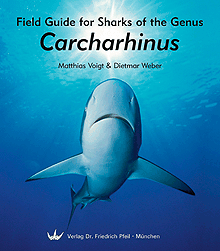
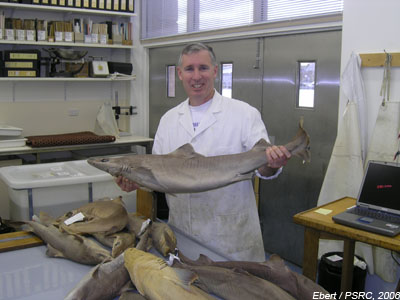
Dr. David Ebert is the Director of the Pacific Shark Research Center at Moss Landing Marine Laboratories. He is one of the world’s leading experts on shark taxonomy, and has described new species of sharks, skates, rays, and chimaeras. Dr. Ebert has written over 100 publications, five books, and dozens of IUCN Red List assessments. He generously agreed to review a new taxonomy guide, Field Guide for Sharks of the Genus Carcharhinus, for Southern Fried Science. He has provided a thorough list of citations backing up his points, but all opinions are his own.
The shark genus Carcharhinus is one of the largest and perhaps most important genera of sharks, with many common and wide-ranging species. These sharks are mostly marine occurring from close inshore to the outer continental shelf and upper slope, but a few species inhabit estuaries and freshwater rivers and lakes. This group is by far one of the most important shark genera for fisheries globally, with various species being taken in commercial and sport fisheries, and in artisanal fisheries. Given the high profile and importance of this genus and the associated problems in identifying them to individual species in the field, an identification guide to the group would be most welcomed.
The book, “Field Guide for Sharks of the Genus Carcharhinus” by Matthias Voigt and Dietmar Weber, could have been that guide, with an exceptionally nice layout, beautiful illustrations, and tooth plates, but unfortunately the text does not stand up to the same high quality of the illustrations. The book cover is quite attractive and eye-catching, and upon initially thumbing through the illustrations and layout of the individual species accounts, I thought wow this looks to be an interesting and possibly useful guide to this shark group, even though I was unfamiliar with the authors, whom to be candid I had never heard of before.
Read More “Guest Post: A review of the Field Guide for Sharks of the Genus Carcharhinus” »
…and that needs to change. If you haven’t voted for David yet today, go vote now. You know you want to see hilariously embarrassing pictures of him. Until then, enjoy this semi-fictional mini-biopic of David’s love affair with the shark: httpv://www.youtube.com/watch?v=92yHyxeju1U
Ginseng, the ubiquitous, all-encompassing darling of the alternative medicine and natural health movements, itself a stocky, unassuming root, is in trouble. Prized as a curative additive in everything from sports drinks to dietary supplements, the vast majority of commercial ginseng is farmed in two Canadian provinces and Wisconsin. While commercial stocks remain robust, it is wild ginseng that fetches the highest market price, up to $1,200 a pound, and is used in some high-end ginseng containing products and traditional and alternative medicines. The leading exporter of wild ginseng is the United States, where 85,000 pounds are legally harvested and exported primarily to Hong Kong every year.
Earlier tonight, I received an e-mail from the Blogging Scholarship organizers indicating that there have been some irregularities with the voting. In response, they have reset all votes to zero and have changed the rules. Everyone may now vote once every day, and the voting period has been extended one full week until November 30th. … Read More “Important blogging scholarship update: All votes reset to zero and you can now vote every day!” »