
It’s the Ocean Conservation Bot! @OceanCon_Bot creates new an novel ocean conservation solutions by drawing from a vast and deep archive of randomly generate ocean jargon. @OceanCon_Bot is currently capable of generating 3.2 quadrillion potential ocean conservation solutions. @OceanCon_Bot is incapable of determining whether a solution is good, bad, gibberish, or really, really gibberish. @OceanCon_Bot … Read More “A new kind of robot to save the ocean!” »
I have a new paper out today with an incredible team of co-authors: Naomi Rose, Mel Cosentino, and Andrew Wright.
Thaler and friends (2017) Lions, Whales, and the Web: Transforming Moment Inertia into Conservation Action. DOI: 10.3389/fmars.2017.00292.
In it, we look at three case-studies of online and offline reactions to the deaths of specific, charismatic animals, and discuss how preparation, planning, and tactical thinking can be used to promote effective conservation messaging in the wake of these haphazard events. We talk about how outrage, empathy, and curiosity play a role in the global conversation and how to effectively mobilize this attention into conservation action.
Conservation activism following moment inertia is a balancing act between strategic planning and a quick, tactical response. When the catalyst is moral outrage, it is important to allow people to be angry, rather than to try and curb such responses. In these circumstances, it is possible to leverage predictable moral signaling into tangible conservation gains.
Regardless of the emotional reaction—outrage, curiosity, or empathy—the general guidelines for conservationists leveraging moment inertia are the same. First, planning for pseudorandom events is essential to produce meaningful outcomes. Second, understanding the limitations of campaigning on an inertial moment will help establish and achieve concrete, realistic goals. Third, the call to action must be informed by the local context, address local cultural values, and be delivered by those who can connect with the public. Finally, it is critical to maintain a factual basis while acknowledging the emotions involved.
With foresight, a focus on concrete goals, and an understanding of the strengths and limitations inherent in moment inertia, these events can be harnessed to help achieve lasting conservation successes.
What is Moment Inertia: Moment Inertia is a phenomenon that arises from focus of attention around a single, clarifying event, or moment, which propagates, undirected, through media unless acted upon by outside forces.
Read More “Lions, Whales, and the Web: Transforming Moment Inertia into Conservation Action” »
Cuttings (short and sweet):
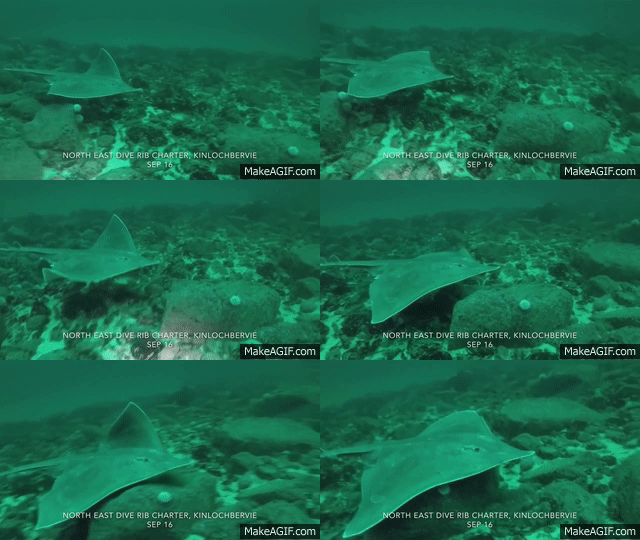
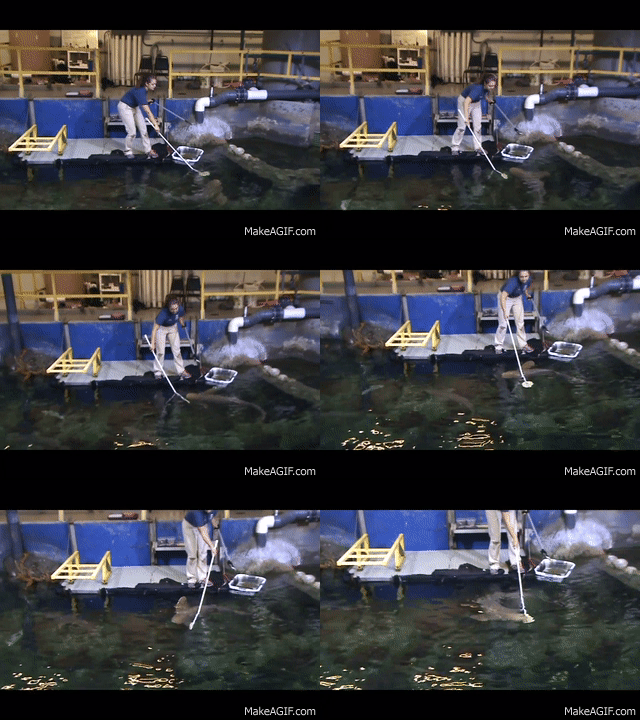
- Watch this bat ray at the Monterey Bay Aquarium

- Follow Marie Auger-Méthé, an Arctic ecologist, on twitter!
- How sea creatures change color. From Nature Research Highlights.
- Global fingerprints of sea level rise revealed by satellites. By Rachael Lallensack for Nature News.
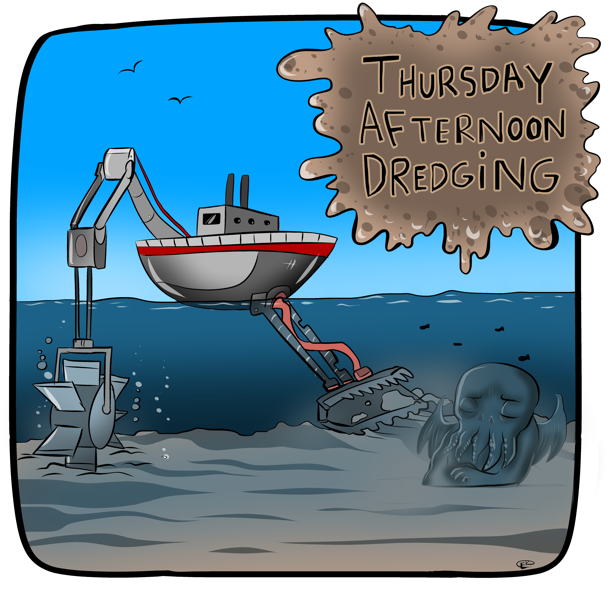
Read More “Thursday Afternoon Dredging: September 14th, 2017” »
Note: This post has been updated on 18 September 2017.
Friends, Researchers, Countrywomen, lend me your ears!
The Atlantic White Shark Conservancy and New England Aquarium are hosting a completely free two-day event, 19-20 September, featuring an amazing line-up of shark scientists and enthusiasts, including:
Keynote Speakers:
Susan Goldberg – Editor in Chief of National Geographic Magazine
Wendy Benchley – Renowned global voice for shark protection and co-founder of the prestigious Peter Benchley Ocean Awards.
Gills Club Science Team Speakers:
Dr. Michelle Heupel – Australian Institute of Marine Science
Dr. Alison Kock – South African National Parks

Fog Horn (A Call to Action)
- One week left! The OpenCTD and Oceanography for Everyone has been selected as a finalist in National Geographic’s Chasing Genius Challenge! Please help me win the People’s Choice award by voting for the OpenCTD. Visit http://www.natgeochasinggenius.com/video/776, create or sign into your Chasing Genius account, and click the yellow star to vote on my video. You can vote once per day until September 15.
- “Everyone is homeless. We can’t help each other because everyone needs help.” Ayana Johnson is working to raise funds (and the Waitt Foundation is matching donations, to help the people of Barbuda, where almost every structure on the island was leveled.
Flotsam (what we’re obsessed with right now)
- Yes, I would like to pet a giant isopod, thank you.
- We have a new expedition planned to the Commonwealth of the Northern Mariana Islands. Join us: Marine Ecology and Underwater Robotics in the Commonwealth of the Northern Mariana Islands.
- The Manatee Sheriff sends Manatee officers to rescue stranded manatees in Manatee County.

It’s been almost exactly a year since I selected the 5 best baby books to launch your child’s ocean education. Since then, our expert judge has gotten a bit more discerning and a lot more opinionated. As a family of marine scientists, our massive library of ocean-themed children’s books, some amazing, some not-so-amazing, seems to grow exponentially.
After critical review by two PhDs in Marine Science and Conservation and one very perspicacious toddler, for both scientific accuracy and pure delightfulness, here are our top 3 children’s books to get your toddler thinking about the ocean.
Read More “The 3 best ocean books for toddlers, as selected by a very ocean-savvy toddler” »

Cuttings (short and sweet):
- Watch how goblin sharks feed

- Follow the Sawfish Conservation Society on twitter!
- Sturgeon survives kidnapping, stabbing, and wildfire. By Amelia Templeton, for Oregon Public Broadcasting
- UK coast haven for seabirds becomes a marine protected area. From The Guardian.
Carlotta Leon Guerrero is a former Member of the 23rd, 24th, and 25th Guam Senate. She was also a two-term president of the Association of Pacific Island Legislatures and previously worked as a radio and television journalist in Guam and the Northern Mariana Islands.
In April 2017, President Donald Trump ordered Secretary of Interior Ryan Zinke to examine 27 protected areas established by Presidents Bill Clinton, George W. Bush, and Barack Obama using the 1906 Antiquities Act. Included in the list were four marine monuments in the Pacific Ocean, the Papahanaumokuakea Marine National Monument in Hawaii, Mariana Trench Marine National Monument in the Mariana Islands, Rose Atoll Marine National Monument in American Samoa, and the Pacific Remote Islands Marine National Monument (sometimes referred to as Pacific Remote Island Areas or PRIA), which is made up several isolated islands and atolls under American control. This should have all of us on Guam and in the Pacific concerned, because we are the people who will have to live with the outcome.

Fog Horn (A Call to Action)
- Hurricane Harvey has passed, but its impacts will continue to be felt for years to come. There’s lots of great organizations to donate to, but in the immediate aftermath,it’s often best to donate to local relief programs that already have a ground team in place, rather than national groups that will take weeks to build up their infrastructure. I’m a fan of the Texas Diaper Bank and Portlight Inclusive Disaster Strategies, both of which serve communities that tend to be particularly vulnerable during natural disasters.
- Gratuitous self promotion! The OpenCTD and Oceanography for Everyone has been selected as a finalist in National Geographic’s Chasing Genius Challenge! Please help me win the People’s Choice award by voting for the OpenCTD. Visit http://www.natgeochasinggenius.com/video/776, create or sign into your Chasing Genius account, and click the yellow star to vote on my video. Thank you!
Flotsam (what we’re obsessed with right now)
- It will take months, if not years, to fully understand the impacts of Hurricane Harvey, which already looks to be the costliest storm in US history. These drone videos give you some idea of the sheer scale of the damage. The Washington Post has an interactive map to help visualize what the equivalent deluge would look like around the world: What the Harvey deluge would look like where you live.
Cuttings (short and sweet):
- Watch these bull sharks in Beqa Lagoon, Fiji, in this video by Beqa Lagoon Resort.
- Follow marine social scientist Amy Diedrich on twitter!
- The impacts of the Deepwater Horizon Oil Spill on Gulf of Mexico shorelines. An introduction to a special issue of research, from the NOAA Response and Restoration blog.