

Skip to content

Southern Fried Science

Over 15 years of ocean science and conservation online

  • Home
  • About SFS
  • Authors
  • Support SFS

Recent Posts

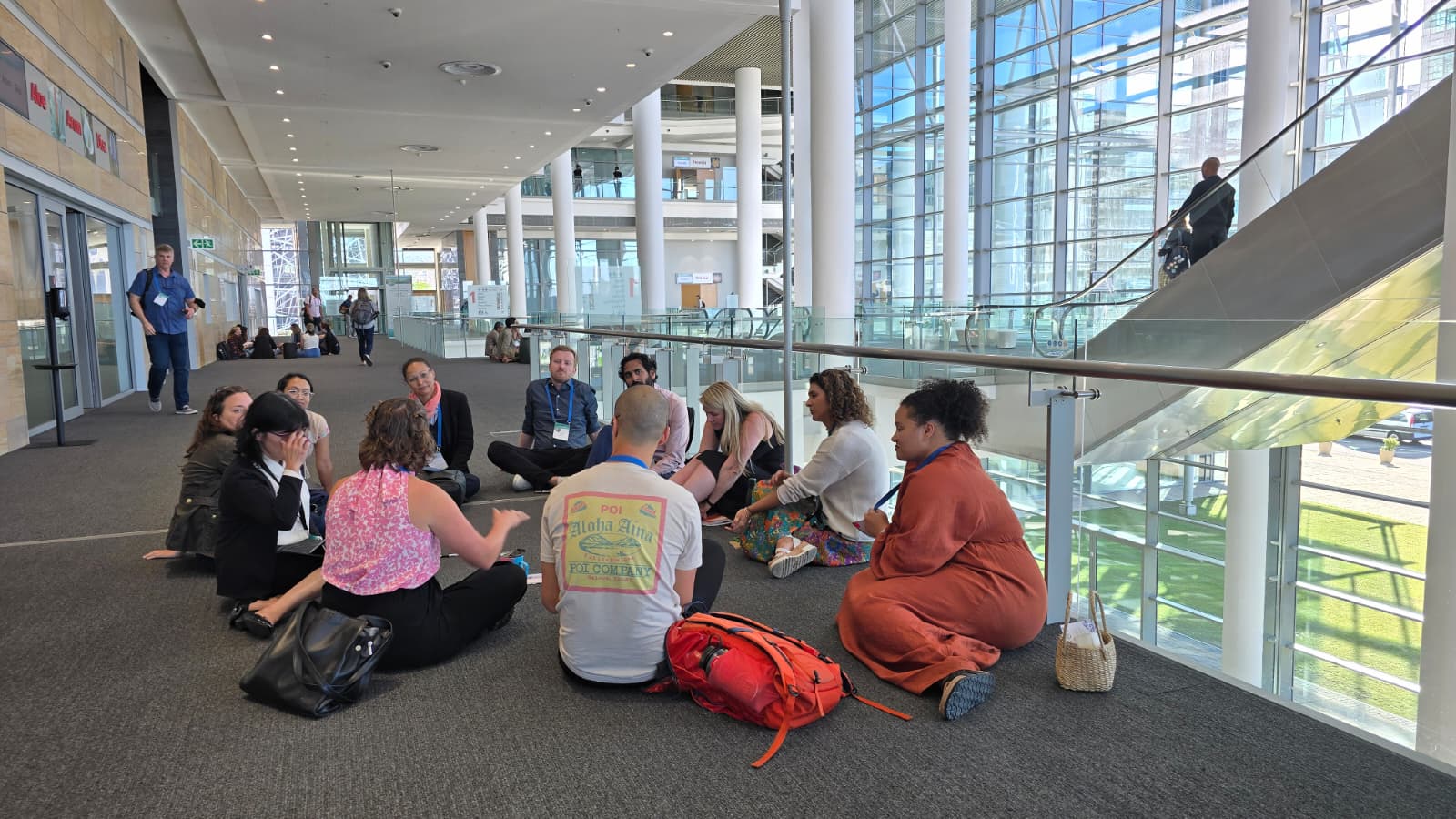
We Asked IMCC7 Attendees What Ocean Conservation Needs. Here’s What They Said.
November 5, 2026
Researching Historical Erasure on Public Lands
July 31, 2026
5 things I learned helping to reassess the global conservation status of every species of tuna and billfish
September 15, 2026
Key takeaways from my Convention on Migratory Species report on fish aggregating devices in the Mediterranean Sea
September 3, 2026
Jabberwocks and Snallygasters: teaching environmental education with monsters, mayhem, and dice.
August 31, 2026
The conservation impacts of recreational fishing
August 25, 2026

Dying for Reason in the Rational Utopia

Posted on August 10, 2016August 10, 2016 By Andrew Thaler
Conservation, Popular Culture

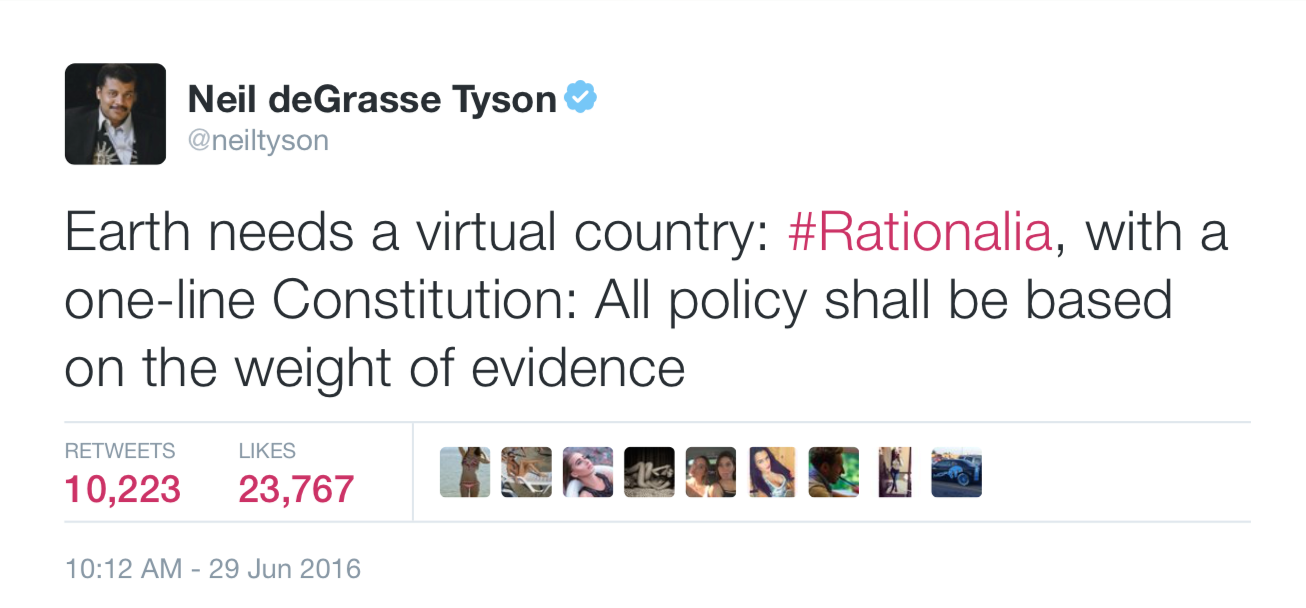
When Neil deGrasse Tyson proposed his “Rationalia” thought experiment several months ago, I thought is was cute but misguided. Now that he’s doubled down on the concept, I can see exactly why it is such a naively flawed idea. Rationalia would be a disaster for conservation. This short science fiction story illustrates why.

ration

“Oyez, oyez, oyez!  This, the 107th session of the 16th Superior District Court, is hereby gavelled to order. Please be seated.”

Cope Johns remained standing. He surveyed the crowd, an odd assortment of bystanders, tourists, and his few supporters. Chief Justice Carlsson entered the hall, climbed onto his podium, and looked down on the assembled masses. Somewhere amid the crush of bodies, an elderly lawyer took his seat. All eyes turned to him. He timidly rose to his feet.

“Today we hear Dr. Cope Johns, on behalf of the Vaquita (Phocoena sinus), versus the Free Republic of Rationalia. Make note that, as evidence suggests that timeliness is required in this decision, we have elected to expedite deliberations. The court has been briefed extensively on this case and requires no additional background. Dr. Johns, your opening statement?”

Cope approached the stand. The bailiff placed his left hand on the near-field ID scanner, confirming his identity. Cope raised his right hand to nothing and swore under his breath.

“Thank you, your honor. The Vaquita is a tiny porpoise that has been on the verge of extinction for the better part of a century. Its only remaining habitat is in the Gulf of Reason, where the Free Republic of Rationalia intends to establish the Lost Lobos tidal energy farm. This farm will displace the Vaquita breeding grounds and will likely drive the species over the brink to extinction.”
Read More “Dying for Reason in the Rational Utopia” »

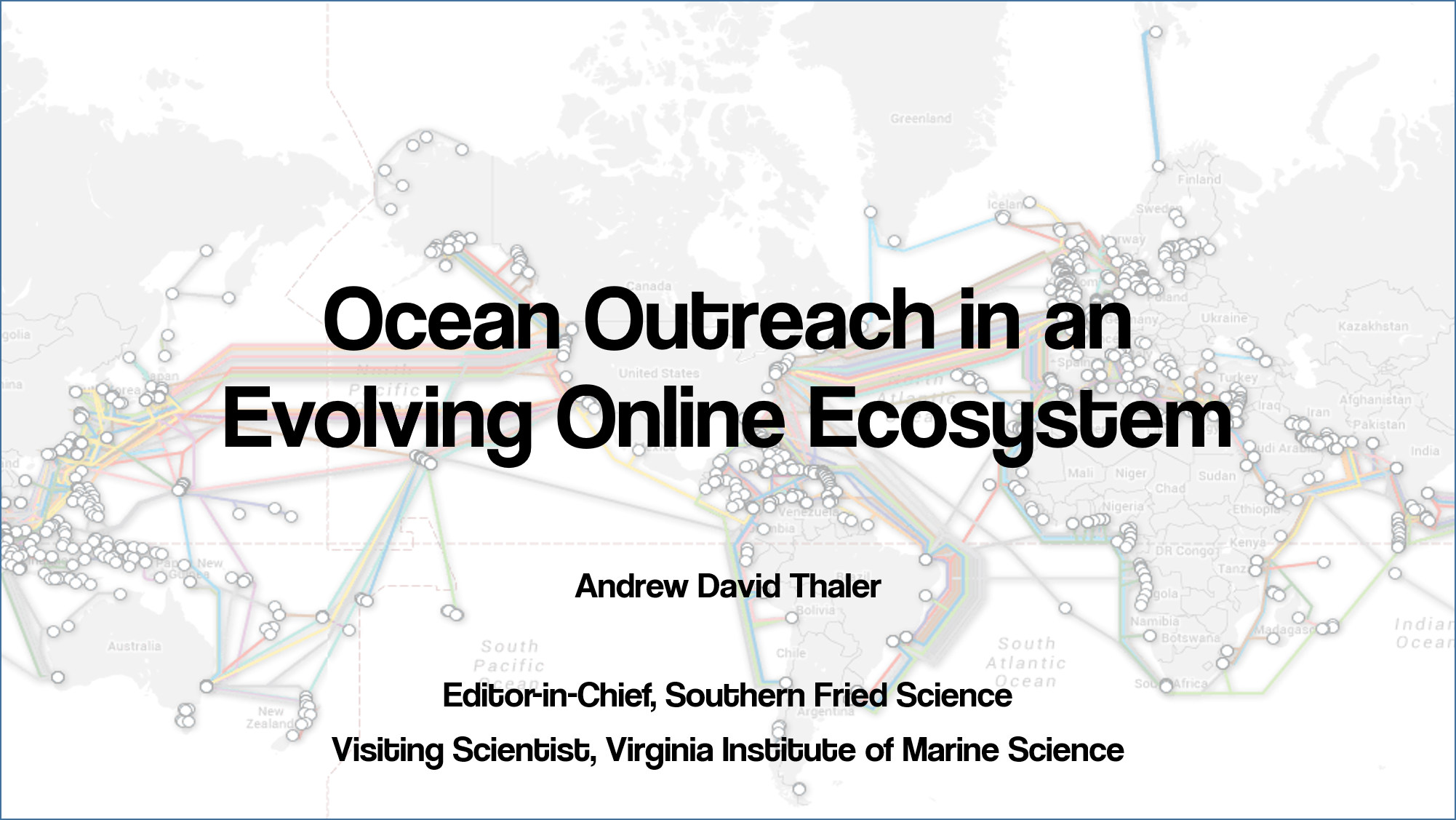
Ocean Outreach in an Evolving Online Ecosystem: Transforming the Narrative

Posted on August 10, 2016August 11, 2016 By Andrew Thaler
Blogging, Conservation

This is the transcript of the keynote I delivered at the Fourth International Marine Conservation Congress in St. John’s, Newfoundland. It has been lightly modified for flow.

Read Act I: Science is Storytelling. 

Picture17

In Act I I discussed the underlying structure that frames narrative storytelling, but now I want to talk about how we can use the tools available to us on the internet to transform that narrative into something even more potent.

But before we can do that I have to tilt at some windmills.

Picture18

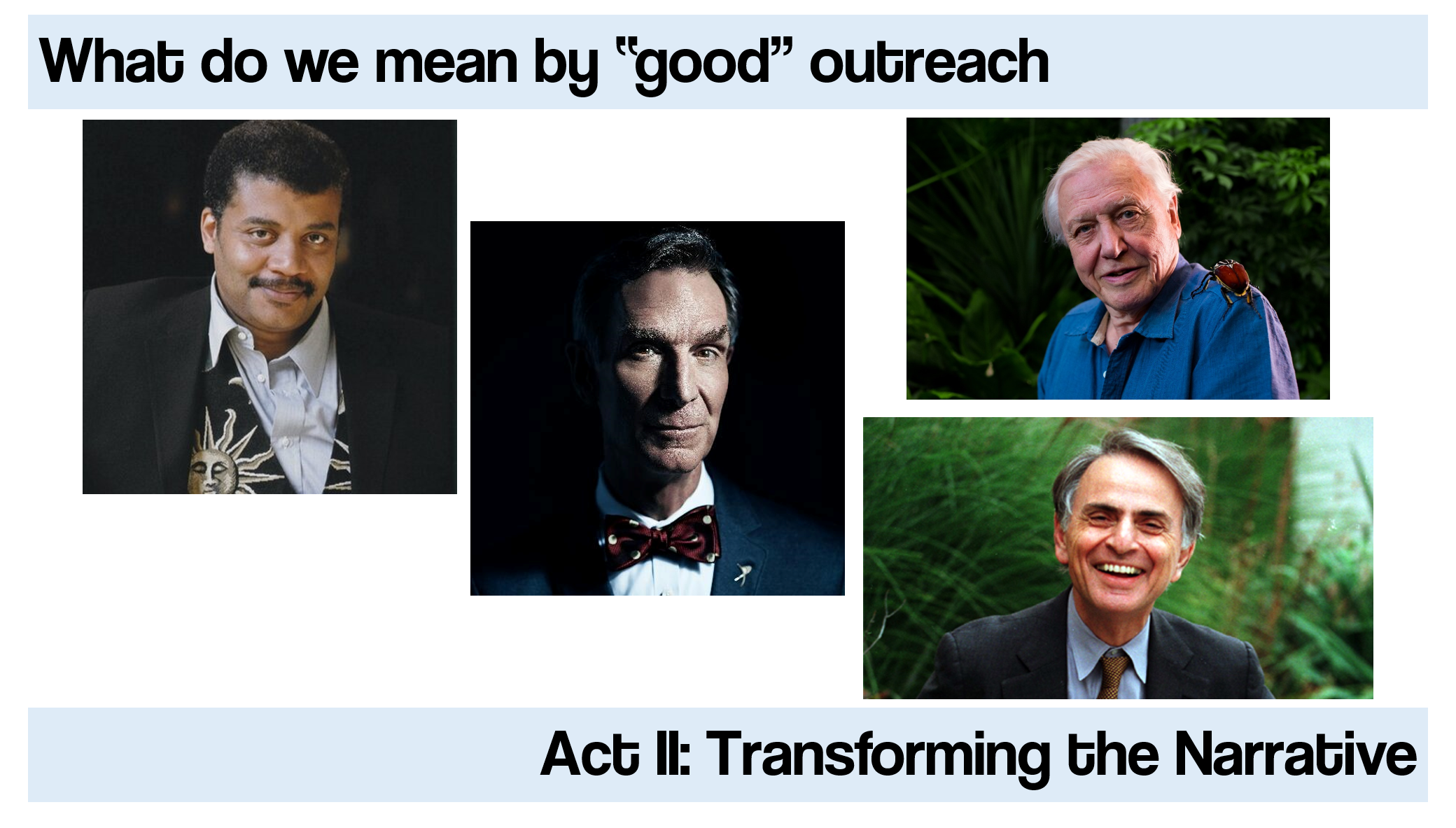
When we talk about good outreach, we often look to people like Neil deGrasse Tyson, like Bill Nye, like David Attenborough, and like Carl Sagan. These are the paragons of scientific outreach, the icons that we often hold up as examples for what constitutes good outreach. We talk about things like Cosmos, both Sagan’s and deGrasse Tyson’s, Bill Nye the Science Guy and his more recent work combating climate change, or David Attenborough and his astounding Nature Documentaries.

Read More “Ocean Outreach in an Evolving Online Ecosystem: Transforming the Narrative” »

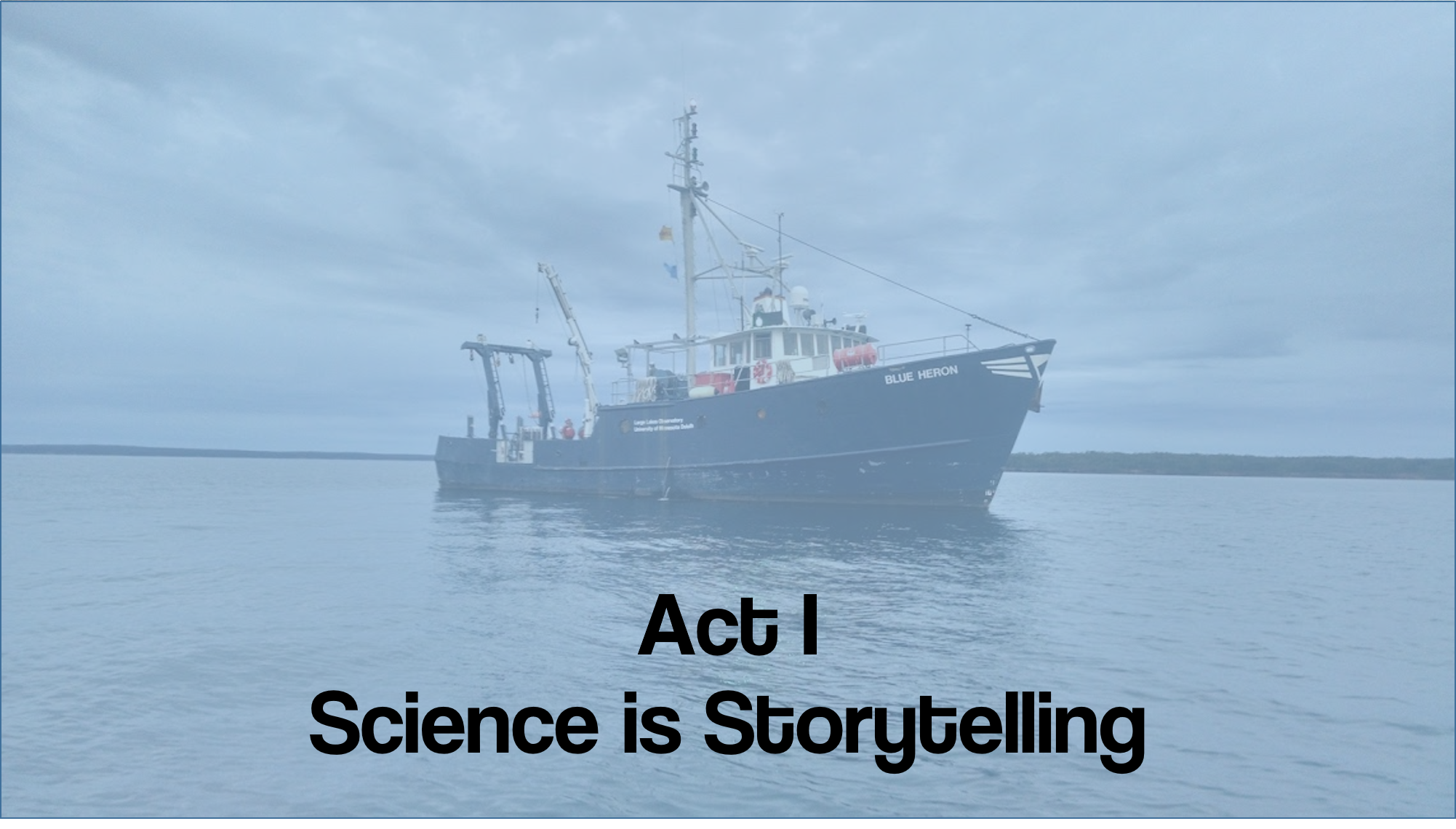
Ocean Outreach in an Evolving Online Ecosystem: Science is Storytelling

Posted on August 9, 2016August 11, 2016 By Andrew Thaler 1 Comment on Ocean Outreach in an Evolving Online Ecosystem: Science is Storytelling
Blogging, Education

This is the transcript of the keynote I delivered at the Fourth International Marine Conservation Congress in St. John’s, Newfoundland. It has been lightly modified for flow. 

Picture2

Good morning and thank you all for coming, especially this early after a long week of conferencing. What I want to do today is talk a little bit about the history of online outreach, talk about how to build effective outreach campaigns, and look towards the future to think about how new technologies are shaping and reshaping the ways in which we think about public engagement with science and conservation.

Picture3So science is storytelling. Sometimes that story an adventure. Sometimes it’s a mystery. Sometimes it’s the dense and weighty exposition of Ulysses and sometimes it’s the absurdity of Finnegan’s Wake, but it is always a story.
Read More “Ocean Outreach in an Evolving Online Ecosystem: Science is Storytelling” »

Everything you need to know about working in conservation you can learn from Game of Thrones

Posted on August 9, 2016August 9, 2016 By Guest Writer 1 Comment on Everything you need to know about working in conservation you can learn from Game of Thrones
Academic life, Conservation

Learned scholars and respected leaders of society warn that a major environmental change is coming and everyone should prepare. However, heads of state, politicians and wealthy oligarchs argue and bicker, more interested in riches and power than the imminent threat. Some realize that the oncoming change will be accompanied by a host of problems, to which no one has given the necessary consideration. Those who understand the situation try to set up systems to protect against this threat but are constantly having to argue with, and even fight, their own allies. In the end, just as some progress is being made, one of the champions of these vital preparations is stabbed through the heart by his closest colleagues, who stage a coup instead of dealing with the oncoming threat.

Sound familiar? It is of course the plot of Game of Thrones, but could also be a history of most conservation issues, whether it be the threat of DDT, ozone depletion, biodiversity loss or climate change.

Read More “Everything you need to know about working in conservation you can learn from Game of Thrones” »

Fun Science FRIEDay – Glaciers Lost in Time

Posted on July 29, 2016July 29, 2016 By Kersey Sturdivant
Uncategorized

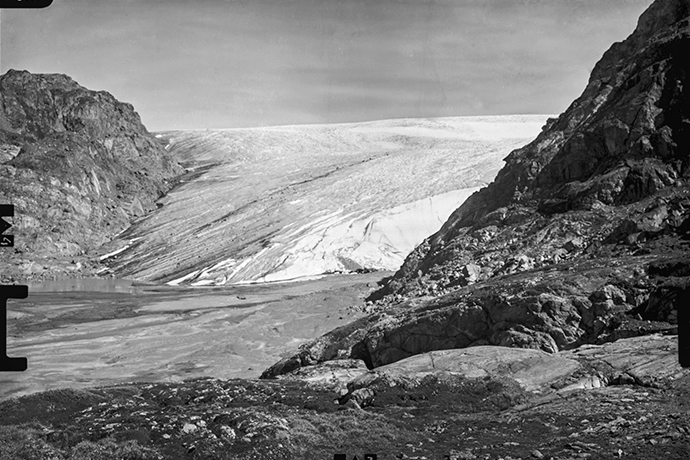
Human induced climate change is real. It feels weird that I have to say that, but the overwhelming body of evidence suggest human activity post the industrial revolution is having irrevocable damage on our environment. One of the major implications of climate change is the loss of the polar glaciers (and subsequent sea level rise).

Danish researchers from the University of Copenhagen and Aarhus University photographed glaciers in east Greenland in 2010 from the same vantage point used by scientists in 1933. Below you can contrast the images from the Mittivakkat and Tunu glaciers to see how much the two glaciers have retreated due to the warming climate (Photo Credit: Natural History Museum of Denmark; Hans Henrik Tholstrup/Natural History Museum of Denmark).

The Mittivakkat Glacier

The Mittivakkat Glacier in 1933.

The Mittivakkat Glacier in 1933.

Read More “Fun Science FRIEDay – Glaciers Lost in Time” »

Join us at the International Marine Conservation Congress!

Posted on July 27, 2016August 8, 2016 By Andrew Thaler
Uncategorized

A plurality of Southern Fried Science writers will be attending the 2016 International Marine Conservation Congress in St. John’s, Newfoundland. Expect updates to be infrequent here through early August. Follow along at the conference hashtag #IMCC4 or follow me, Amy, David, and Chris on twitter on this adventure.

An environmental educator’s field guide to Pokémon Go.

Posted on July 19, 2016 By Andrew Thaler 1 Comment on An environmental educator’s field guide to Pokémon Go.
Education

Pokémon Go is officially a thing.

In the last week, this game has outpaced even Google Maps in number of downloads. It has more daily active users than Twitter. Its user retention rate is astronomical. It is either a herald of the end of western capitalism or a huge boom for small businesses. People are going outside, exploring their neighborhoods, finding dead bodies, walking off cliffs, experiencing nature, getting robbed, making new friends, and getting shot at.

It is the best of tech. It is the worst of tech. Or maybe, it’s just tech, and people can interact with technology in as many ways as there are Pokémon to be found.

Last week, I wrote a brief introduction to this phenomenon, which I won’t rehash here.

But of course, the big question emerging within the sphere of environmental educators is “how can we capitalize on Pokémon Go to engage with the public on environmental issues?”

After spending more time with the app, and focusing on specific features that can facilitate environmental education, I have five suggestions. 

Read More “An environmental educator’s field guide to Pokémon Go.” »

Fun Science FRIEDay – Open-Acess Science for the Masses

Posted on July 15, 2016 By Kersey Sturdivant
Oceanography for Everyone, Open Science, Uncategorized

The oceans belong to all of us. With this simple statement in mind, the Oceanography for Everyone (OfE) project was launched with the goal of making ocean science more accessible. One of the biggest hurdles in conducting ocean science is instrumentation costs, and 4 years ago the OfE team began trying to make one of the most basic ocean science tools, the CTD (a water quality sensor that measures Conductivity-Temperature-Depth), cheaper… much, much cheaper!

Read More “Fun Science FRIEDay – Open-Acess Science for the Masses” »

Bill that would ban SCUBA divers from feeding sharks in U.S. waters introduced in Congress

Posted on July 15, 2016July 15, 2016 By David Shiffman 3 Comments on Bill that would ban SCUBA divers from feeding sharks in U.S. waters introduced in Congress
Blogging, Science

Some SCUBA diving operators use bait or chum to attract sharks so that their customers can get an up close and personal encounter. A new bill that would make this practice illegal in all U.S. waters has just been introduced into Congress. Section 3 of S. 3099, the “Access for Sportfishing Act of 2016,” contains the following provision:

Read More “Bill that would ban SCUBA divers from feeding sharks in U.S. waters introduced in Congress” »

Tweets from Shark Week 2016

Posted on July 3, 2016 By David Shiffman 1 Comment on Tweets from Shark Week 2016
Uncategorized

Below is a Storify of curated tweets from Shark Week 2016 shows, including fact-checking, commentary, praise, and criticism. Enjoy!

Read More “Tweets from Shark Week 2016” »

Posts pagination

Previous 1 … 77 78 79 … 277 Next

Popular Posts

Getting a sense of porpoiseJanuary 20, 2009Andrew Thaler
This is the worst academic presentation in the world ... tributeApril 23, 2015Chris Parsons
That's not a blobfish: Deep Sea Social Media is Flooded by AI SlopThat's not a blobfish: Deep Sea Social Media is Flooded by AI SlopDecember 19, 2025Andrew Thaler
Shark of Darkness: Wrath of Submarine is a fake documentaryShark of Darkness: Wrath of Submarine is a fake documentaryAugust 10, 2014Michelle Jewell
Have we found the city of Atlantis?Have we found the city of Atlantis?September 1, 2026Chris Parsons
What Ocean Ramsey does is not shark science or conservation: some brief thoughts on "the Shark Whisperer" documentaryWhat Ocean Ramsey does is not shark science or conservation: some brief thoughts on "the Shark Whisperer" documentaryJuly 2, 2025David Shiffman
Ethical Debate: Killing sharks for science?Ethical Debate: Killing sharks for science?June 1, 2010David Shiffman
The 45 most influential female ecologists alive today according to twitterThe 45 most influential female ecologists alive today according to twitterFebruary 10, 2014Guest Writer
Soon may the explainer come: Everything you’ve always wanted to know about sea shanties but were afraid to askSoon may the explainer come: Everything you’ve always wanted to know about sea shanties but were afraid to askNovember 22, 2022David Shiffman
Our favorite sea monsters – Ningen (#4)Our favorite sea monsters – Ningen (#4)September 7, 2010Andrew Thaler

squishy

Subscribe to our RSS Feed for updates whenever new articles are published.

We recommend Feedly for RSS management. It's like Google Reader, except it still exists.

Southern Fried Science

  • Home
  • About SFS
  • Authors
  • Support SFS


If you enjoy Southern Fried Science, consider contributing to our Patreon campaign.

Copyright © 2026 Southern Fried Science.

Theme: Oceanly Premium by ScriptsTown