Skip to content

Southern Fried Science

Over 15 years of ocean science and conservation online

  • Home
  • About SFS
  • Authors
  • Support SFS

Category: Blogging

Florida fisherman catches an 18 foot goblin shark, the second ever caught in the Gulf of Mexico

Posted on May 2, 2014May 2, 2014 By David Shiffman 5 Comments on Florida fisherman catches an 18 foot goblin shark, the second ever caught in the Gulf of Mexico
Blogging, Science

Last week, commercial fisherman Carl Moore was fishing for royal red shrimp off the coast of Key West Florida.  When he pulled up a net from more than 2,000 feet, Moore had caught something other than just shrimp. In his net was an unusual looking enormous fish—a goblin shark more than 18 feet long. As … Read More “Florida fisherman catches an 18 foot goblin shark, the second ever caught in the Gulf of Mexico” »

How much shark fin soup could you make from an adult megalodon?

Posted on April 26, 2014 By David Shiffman
Blogging

Carcharocles megalodon, commonly known as the megalodon, was likely the largest shark that ever lived. I say “was”, because despite claims by certain Discovery Channel “documentaries”, there is absolutely no doubt whatsoever that the megalodon is extinct and has been for millions of years.

It isn’t surprising, though, that the largest shark that ever lived has such an impact on pop culture. Recently, we watched the latest in the spectacular “mega shark vs.” science fiction series, one of my favorite movie series based on extinct giant sharks coming back to life and wreaking havoc on the modern world.  The Southern Fried Scientist, who recently calculated how much Old Bay seasoning you’d need to properly cook the latest Aquaman villain,  asked me how much shark fin soup you could get from an adult megalodon.

Based on my calculations, the answer is about 70,000 bowls of shark fin soup, more than enough for everyone who lives in Greenland to have a bowl. Explaining where this number comes from can tell us a lot abTTout one of the most important ocean conservation issues facing the world today.

Read More “How much shark fin soup could you make from an adult megalodon?” »
Watch Mega Shark vs. Mecha Shark on Netflix Wednesday at 10 p.m., and tweet along with us!

Posted on April 22, 2014 By David Shiffman
Blogging

Mega Shark vs. Mecha Shark, the third installment of the amazing “Mega Shark vs.” series, is now on Netflix streaming! In 2009’s Mega Shark vs. Giant Octopus, a megaladon and a giant octopus were accidentally released by climate change, which led to a path of destruction around the world… until a scientific team involving Debbie Gibson … Read More “Watch Mega Shark vs. Mecha Shark on Netflix Wednesday at 10 p.m., and tweet along with us!” »

My five favorite responses to the Loch Ness Debunking.

Posted on April 21, 2014April 21, 2014 By Andrew Thaler 1 Comment on My five favorite responses to the Loch Ness Debunking.
Blogging

I didn’t expect a throw-away post I made last Friday debunking an alleged image of the Loch Ness Monster to go viral, but this is the internet and these things happen. As you might expect, my inbox, social media accounts, and this website have been inundated with comments about that post, how wrong I must be, what’s really going on, and why X theory is clearly the correct one. For the record, it’s still a boat wake, but in light of the amount of attention the post received, I updated it with a bit more information about how that image could occur.

With that out of the way, here are my five favorite responses to the latest Loch Ness Monster sighting:

Read More “My five favorite responses to the Loch Ness Debunking.” »

Collecting organisms to save their species

Posted on April 21, 2014April 21, 2014 By Guest Writer 3 Comments on Collecting organisms to save their species
Blogging, Conservation, Science

 ProsantaDr.Prosanta Chakrabarty is an Assistant Professor at Louisiana State University and an ichthyologist and evolutionary biologist. He is also Curator of Fishes at LSU’s Museum of Natural Science. You can learn more about him from his website www.prosanta.net and follow him on Twitter @LSU_FISH.

A recent piece in Science (Minteer et al. 2014) titled “Avoiding (Re)extinction” advocated avoiding collecting specimens for the sake of confirming the existence of a species. In lieu of killing and collecting the animal the authors suggest using “high-resolution photography, audio recording, and nonlethal sampling.” As a natural history curator of fishes I found this to be a pretty bad idea.

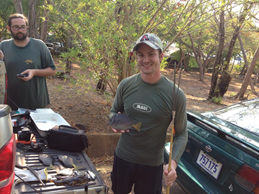
My PhD students (Bill Ludt and Caleb McMahan) in Costa Rica collecting specimens for their thesis projects. These guys better not just come back with pictures.

I don’t like killing animals, I was a strict vegetarian for 10 years (now I just eat sustainable seafood – hey, I live in Louisiana). I certainly wouldn’t want to endanger a species by over collecting it. I know of no scientific collectors who kill rare animals just so he or she can say they have it in their collections. We collect for a few simple reasons: because specimens are not available otherwise via loan, or additional specimens are needed for a comparative study, or because we need vouchers as evidence of the existence of the taxon.

I’ve collected rare species in the past, particularly some of the cavefishes I work on. For one of these species, Typhleotris mararybe, we collected the only two specimens we or anyone ever saw. We were in a very remote part of Madagascar and we were only allowed to collect two specimens from any given locality. I knew these individuals were part of a species new to science as soon as I looked at them. Did removing two samples place this species at risk of extinction? Guessing the population was much larger than what we found just at the surface, I would suppose not. What were we to do? Not collect them and just take pictures? We wouldn’t have been able to do the necessary comparative descriptive analysis to actually prove their novelty required by the ICZN (International Commission of Zoological Nomenclature). We collected these specimens so that we could formally describe this new and fantastic new species so that the world can be aware of their existence and so that measures can be put in place to conserve them and study them further.

Read More “Collecting organisms to save their species” »

Distracted by abstracts: Tips for writing a good abstract for a scientific conference

Posted on April 7, 2014September 2, 2014 By Chris Parsons 4 Comments on Distracted by abstracts: Tips for writing a good abstract for a scientific conference
Blogging, Science

ParsonsDr. Chris Parsons has been involved in whale and dolphin research for over two decades and has been involved in research projects in every continent except Antarctica. Dr. Parsons is an Associate Professor at George Mason University as well as the undergraduate coordinator for their environmental science program. He’s a member of the scientific committee of the International Whaling Commission (IWC), has been involved in organizing the International Marine Conservation Congress (IMCC) (the world’s  largest academic marine conservation conference) and is currently the Conference Chair and a Governor of the Society for Conservation Biology. In addition, Dr. Parsons has published over 100 scientific papers and book chapters and has written a textbook on marine mammal biology & conservation.

I have just read and reviewed through close to 100 scientific abstracts for a conference, and my main conclusion is that ” ‘abstract’ – this does not mean what you think it means!”

An abstract is supposed to be a concise summary of your entire paper or study. Basically a written version of the 30 second “elevator pitch”. In these days of information overload there is so much emphasis on publishing, and so many journals willing to accommodate, the number of articles in scientific fields has increased rapidly. As a result, academics are increasingly reading no further than the abstract, and often only reading the title. To test this I looked at some of my papers where the website they were hosted by kindly provided statistics on abstract page views and actual download rates. The download rates were approximately only 10% that of the abstract views across the papers (and I am naively hopeful that at least some of a downloaded paper will be read). The figures were similar for other articles, so it wasn’t just my papers. So 90% of people who see your work probably won’t go beyond your abstract. This makes it vitally important that all the information you want to convey about your work is in the abstract.

However, in a frighteningly high proportion of abstracts the key results and conclusions of studies are not even mentioned. One of the abstracts I read in this latest batch noted that the methods, results  and the conclusions of the study “would be discussed”. As an abstract this is useless. Too frequently place holder abstracts are submitted to conferences, with the assumption that results will magically appear before the meeting. But if you don’t manage to get that analysis done, you’ll be giving a presentation that will be lacking, will embarrassing you and damage your career. Moreover, a lot more people will see your abstract than will actually get to your presentation, so professional opinions may be made on you by the quality of your abstract rather than the final presentation. Plus abstract books are physical entities, whether electronic or hard copy, and will be around a lot longer than your 10 minute presentation.   So for your professional image and also for the sake of communicating your study it is in your interests to produce a good abstract.

With that in mind, here are some suggestions on abstract structure.

Read More “Distracted by abstracts: Tips for writing a good abstract for a scientific conference” »

No, harassing a shark for fun is not ethically equivalent to scientific research that helps conserve a species

Posted on March 26, 2014March 27, 2014 By David Shiffman 18 Comments on No, harassing a shark for fun is not ethically equivalent to scientific research that helps conserve a species
Blogging, Conservation, Science

Last month, I wrote an article for Scientific American that I shouldn’t have had to write. In it, I argued that riding, poking, prodding or otherwise harassing a free-swimming large predatory animal for fun is a bad idea. I do mean “argued;” believe it or not, there are people who strongly disagree with me. In my article, I was very general and diplomatic, and I took pains to avoid naming names.

However, my article was at least partially inspired by the disrespectful, potentially dangerous, and very public behavior of one person: the editor of Shark Diver magazine, Eli Martinez. Eli recently wrote an article for Medium, in which he stated that: “Look, I have no problem with touching sharks and I do not have any problem with other people touching sharks.” He also notes that ” I just think riding sharks is disrespectful to the animals .” He has also shared the following photos (and many, many more like them) on his Facebook page, photos showing behavior he does not seem to consider disrespectful.

Read More “No, harassing a shark for fun is not ethically equivalent to scientific research that helps conserve a species” »

The science of shark control (and what it means for the Western Australia cull)

Posted on March 17, 2014 By Guest Writer
Blogging, Conservation, Science

OLYMPUS DIGITAL CAMERAProf Colin Simpfendorfer is the Director of the Centre for Sustainable Tropical Fisheries and Aquaculture at James Cook University. He has more than 25 years of experience in researching sharks, and has published extensively in the scientific literature on shark biology, ecology, fisheries and conservation. He is a graduate of James Cook University where he undertook both his undergraduate and postgraduate training. After completing his PhD he worked on shark fisheries at the Western Australian Fisheries Department before moving to Florida to work at the Center for Shark Research at Mote Marine Laboratory. He returned to JCU in 2007 to lead the Fishing and Fisheries Research Unit, where he has helped build a research group focused on improving our understanding of sharks and how best to conserve and manage their populations.

Call it a shark cull, shark control or bather protection, for decades governments have been trying to reduce the risk of humans being killed by sharks – by killing sharks. New South Wales, Queensland, KwaZulu-Natal (South Africa), Hawaii, Dunedin (New Zealand), Hong Kong, Somalia (during the US military intervention) and now Western Australia have, or had, shark control programs to reduce the risk of human-shark interactions.

Western Australia’s new program has sparked huge controversy, with many calling for the government to stop and pursue alternatives.There have been a range of claims that there is no science to support shark control. Many of these have been based on the effects of removing large predatory sharks on ocean ecosystems or that there is no evidence that shark culls reduce the risk of attack.Both of these are valid scientific considerations and need to be taken into account. However, neither addresses whether there is some scientific basis to shark control programs.

So here I would like consider whether there is a scientific basis to shark control programs. To do this I’ll look first at the theory, and then if there is evidence to support it based on analysis of data from the programs in KwaZulu-Natal and Queensland.

Read More “The science of shark control (and what it means for the Western Australia cull)” »

Fun Science Friday – “Trolls Just Wanna Have Fun”

Posted on March 14, 2014 By Kersey Sturdivant
Blogging

I have to admit, I love this title, but cannot claim it as my own. It is the title of the research paper that forms the basis for today’s FSF, internet trolling.

They see me Trollin. Photo Credit: NineFiveZero
They see me Trollin.
Photo Credit: NineFiveZero

Anyone who has ever spent remotely anytime reading the comments section of pretty much anywhere on the internet has likely observed a Troll (why some of you reading may even have engaged in Troll-like behavior). While these Trolls do not physically hide under bridges and/or steal sheep, their actions parallel many of the annoyances of their fairy tale  counterparts.  As defined by wikipedia, an Internet Troll “is a person who sows discord on the Internet… with the deliberate intent of provoking readers into an emotional response or of otherwise disrupting normal on-topic discussion.”

Read More “Fun Science Friday – “Trolls Just Wanna Have Fun”” »

Southern Fried Science Has A NEW Header Image

Posted on March 14, 2014 By Kersey Sturdivant
Blogging

At least for a month. Roughly every month your beloved Southern Fried Science rotates the main header image for its site. The idea behind this format, is that it freshens up the site’s homepage, but also gives our readers the opportunity to have their pictures featured on the site. This month’s header image was provided … Read More “Southern Fried Science Has A NEW Header Image” »

Posts pagination

Previous 1 … 14 15 16 … 19 Next

Popular Posts

Shark scientists want their research to help save threatened species, but don’t know how. Our new paper can help.Shark scientists want their research to help save threatened species, but don’t know how. Our new paper can help.December 1, 2025David Shiffman
Norway and Cook Islands put their deep-sea mining plans on pause.Norway and Cook Islands put their deep-sea mining plans on pause.December 3, 2025Andrew Thaler
What Ocean Ramsey does is not shark science or conservation: some brief thoughts on "the Shark Whisperer" documentaryWhat Ocean Ramsey does is not shark science or conservation: some brief thoughts on "the Shark Whisperer" documentaryJuly 2, 2025David Shiffman
2025: My year in writing, public speaking, and media interviews2025: My year in writing, public speaking, and media interviewsDecember 3, 2025David Shiffman
What we know we don't know: impacts of deep-sea mining on whales, dolphins, sharks, turtles, and other migratory species.What we know we don't know: impacts of deep-sea mining on whales, dolphins, sharks, turtles, and other migratory species.November 20, 2025Andrew Thaler
The Trouble with Teacup PigsThe Trouble with Teacup PigsOctober 14, 2012Andrew Thaler
Urea and Shark OsmoregulationUrea and Shark OsmoregulationNovember 15, 2010David Shiffman
How tiny satellites are tracking marine wildlifeDecember 1, 2025Andrew Thaler
Shark of Darkness: Wrath of Submarine is a fake documentaryShark of Darkness: Wrath of Submarine is a fake documentaryAugust 10, 2014Michelle Jewell
Build a dirt cheap, tough-as-nails field computer in a Pelican caseBuild a dirt cheap, tough-as-nails field computer in a Pelican caseJuly 21, 2015Andrew Thaler
Subscribe to our RSS Feed for updates whenever new articles are published.

We recommend Feedly for RSS management. It's like Google Reader, except it still exists.

Southern Fried Science

  • Home
  • About SFS
  • Authors
  • Support SFS


If you enjoy Southern Fried Science, consider contributing to our Patreon campaign.

Copyright © 2025 Southern Fried Science.

Theme: Oceanly Premium by ScriptsTown