Skip to content

Southern Fried Science

Over 15 years of ocean science and conservation online

  • Home
  • About SFS
  • Authors
  • Support SFS

Category: Science

Trading blue collars for scarlet robes, my working-class experience of academic life

Posted on June 9, 2016 By Michelle Jewell
Trading blue collars for scarlet robes, my working-class experience of academic life
Academic life, Science

More people are going to college, graduate school, and obtaining PhDs in STEM fields than ever before (Figure 1), and a growing minority of these PhD candidates are non-traditional or not white affluent males. While we celebrate this change, let us not forget that academia was built by – and for – the “traditional” student. My favourite analogy to explain this type of ingrown privilege is bicycles on USA streets. Bicycles are legally allowed to be on streets, some streets even have extra space just for bicycles, but streets were designed for automobiles. You may be allowed and, in some areas, encouraged to get on the street with your bicycle, but biking a street is going to be intrinsically more difficult than if you were driving a car.
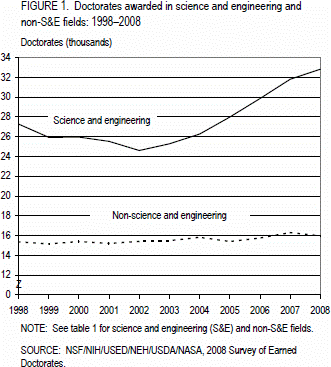
fig1

Like Marconi and La Bamba in a city built on rock and roll, you will inevitably end up in situations that conflict with your way of life. You will not receive a warning before you stumble upon these bumps, and you will be judged by how quickly you accept traditional standards (if you can).  I remember a conversation with traditional tenured and tenure-track scientists discussing proposals for a large grant scheme. One tenure-track scientist was lamenting the process of shopping for editors for his proposal. He talked about it freely, how there were two companies that charged different rates and he was in talks with one but that company felt a conflict of interest that he had worked with another rival editing company. The rest of the traditional scientists nodded in mutual understanding. Finding good, cheap editors to improve your work is hard. My working-class ethos was busy screaming inside my head.  How can hiring someone to edit and improve written works that you will ultimately be rewarded for be so blithely acceptable? You’re not allowed to hire editors for any task throughout your training. You learn how to write from earning disappointing grades (or failing grant applications). You read more, you study written works, you develop a voice, and you try again. The results get better until you are at an appropriate level to move up another notch on the ladder, right? Not for traditionals.

Here are some more bizarre “traditional” customs you should expect if you are biking down the academic street:

Read More “Trading blue collars for scarlet robes, my working-class experience of academic life” »
Fun Science FRIEDay – The worlds largest sponge.

Posted on June 3, 2016 By Kersey Sturdivant
Conservation, Science

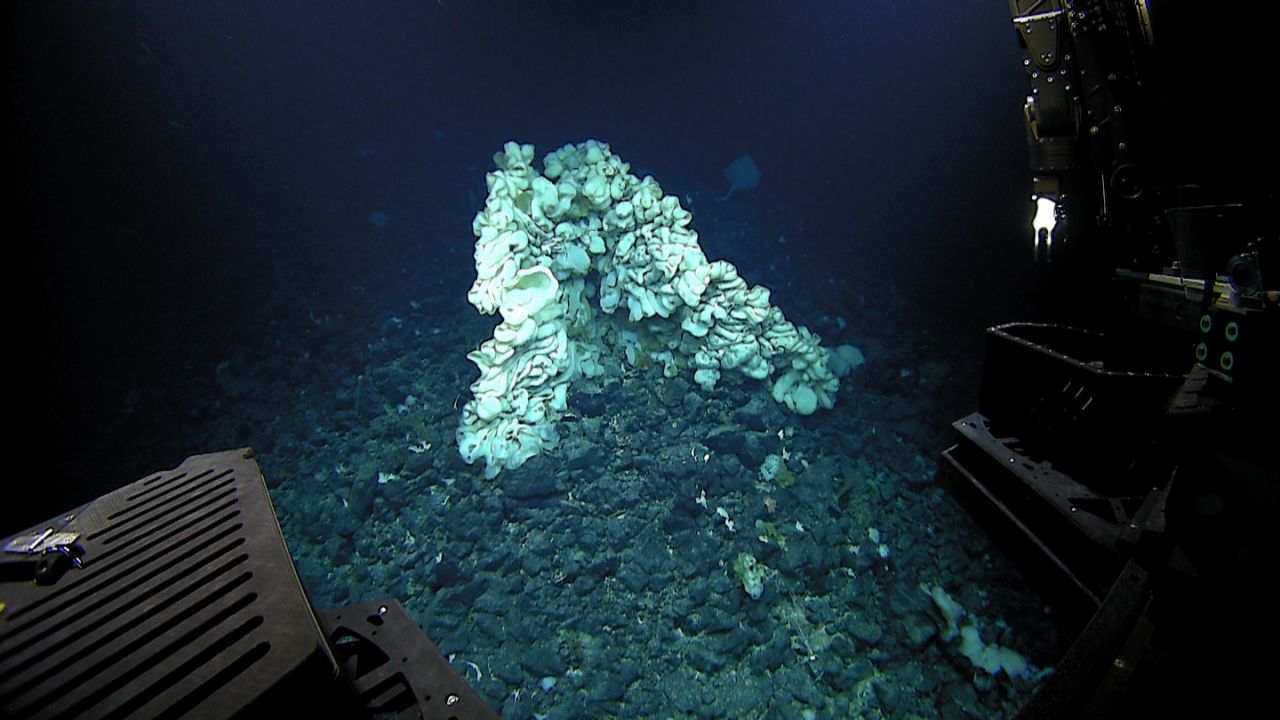
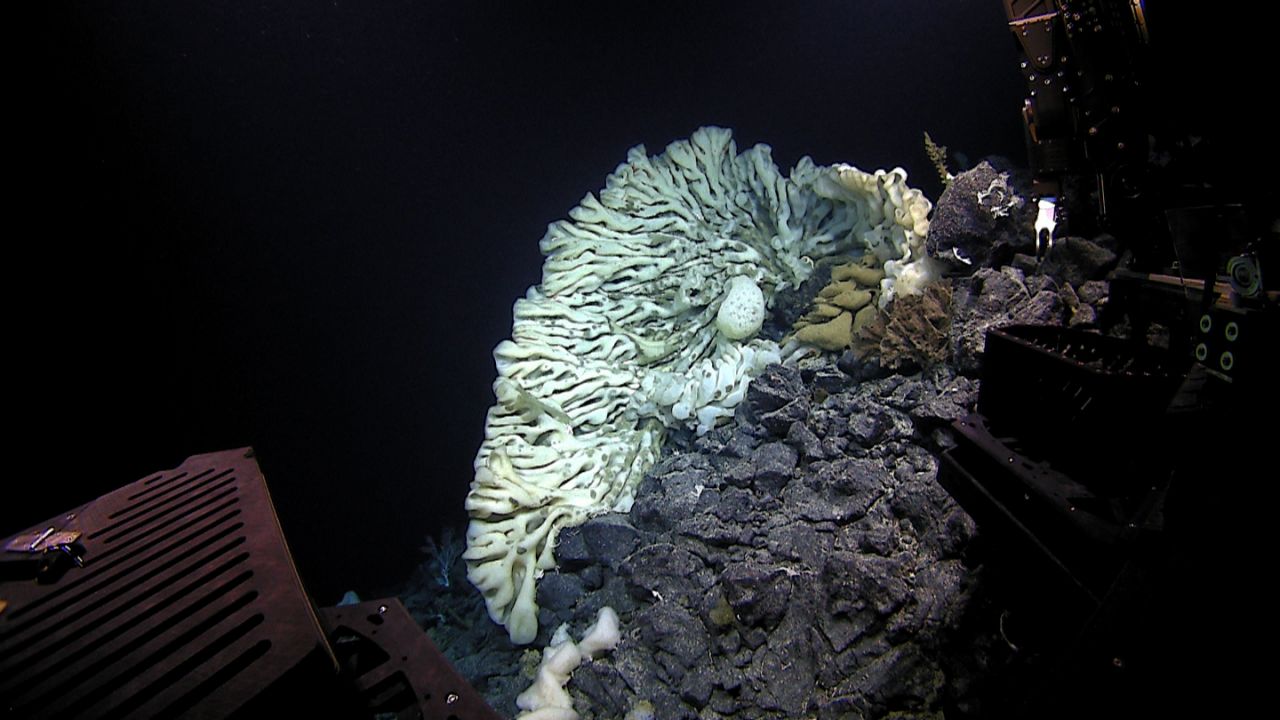
Recently a team of scientists on a deep sea expedition in the Northwestern Hawaiian Islands aboard the R/V Okeanos Explorer made a monumental discovery… pun intended. While exploring the depths of the seafloor in Papahānaumokuākea Marine National Monument, with their remotely operated vehicles (ROV) Seirios and Deep Discover, they discovered and documented the largest sponge ever observed on this planet… or any planet for that matter.

Large hexactinellid sponge found in Papahānaumokuākea Marine National Monument (Photo credit: NOAA's Office of Exploration and Research)
Large hexactinellid sponge found in Papahānaumokuākea Marine National Monument (Photo credit: NOAA’s Office of Exploration and Research)
Lateral view of a large hexactinellid sponge found in Papahānaumokuākea Marine National Monument (Photo credit: NOAA's Office of Exploration and Research)
Lateral view of a large hexactinellid sponge found in Papahānaumokuākea Marine National Monument
(Photo credit: NOAA’s Office of Exploration and Research)


Read More “Fun Science FRIEDay – The worlds largest sponge.” »

Six thoughts about Greenpeace’s attack on Ray Hilborn.

Posted on May 13, 2016June 2, 2016 By Andrew Thaler 6 Comments on Six thoughts about Greenpeace’s attack on Ray Hilborn.
Conservation, Science

Update: Both the University of Washington and the Proceedings of the National Academy of Sciences have reviewed Greenpeace’s claims and concluded that Hilborn did not violate their disclosure policy.

First, some background:

  • Fisheries Scientist Under Fire For Undisclosed Seafood Industry Funding
  • Ray Hilborn: Overfishing Denier
  • Hilborn’s Response to Greenpeace

Or, just read Trevor Branch’s timeline.

1. The idea that scientists should declare every source of funding over the history of their career on every scientific paper is impractical and wholly unnecessary in a connected world where anyone can effortlessly access a researcher’s CV. Non-profit NGOs only need to file one financial disclosure statement every year, not attach it to every press release, and that is also perfectly adequate.

2. Transparency in funding is important. Claiming that a researcher is failing to disclose funding information when that information clearly is available and accessible erodes public trust in science and makes everyone’s job harder. Greenpeace didn’t send a team of stealth lawyers on an o’dark thirty raid of the UW mainframe, they asked for the information and were given it.

Read More “Six thoughts about Greenpeace’s attack on Ray Hilborn.” »

Introducing Field School: A Resource for Marine Science Research and Education

Posted on May 9, 2016May 9, 2016 By Guest Writer
Conservation, Education, Science

julia_staffJulia Wester  is the Director of Program Development for Field School. She received her PhD from the Abess Center for Ecosystem Science and Policy at the University of Miami in 2016. Her dissertation studied the psychology of decision making about the environment, specifically with regard to limited water resources. She also received a Msc with Distinction in Biodiversity Conservation and Management from Oxford University and worked as a Legislative Aide in South Florida, focusing on environmental policy. She has consulted with nonprofit programs to evaluate their educational programs and assisted with training staff to conduct effective public outreach.

Field School logoThe folks at Southern Fried Science, as part of their commitment to research and education, have generously given us this platform to talk about our educational start-up, Field School. (Thanks, SFS!). They’ve also been kind enough to get excited about working with us to develop and test new research techniques, study awesome animals and ecosystems, and improve marine science field education—so stay tuned for some of those upcoming collaborations!

What is field school? 

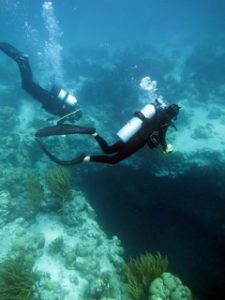
Field School is a hybrid company on a mission to support field research in marine and environmental science, and create high-quality educational and training opportunities for students and the public. We offer hands-on, research focused courses on a variety of topics, from corals to sharks, on our 55’ custom live-aboard research vessel.

Field School offers researchers and students opportunities to engage with and study tropical marine ecosystems. Photo credit: Kristine Stump

Part of what makes Field School special is the team we’ve brought together. Our captain and crew all have doctoral and/or masters degrees in marine or environmental science, have authored numerous scientific publications, and have a combined 25 years of experience in field education and outreach. We have developed short- and long-term training and mentoring opportunities for students, teach highly reviewed and award-winning university courses, and work with partner non-profits to create outreach programs for the public. We collaborate closely with our scientific advisory board and partner universities to develop the conservation and research projects our students work on, ensuring their time in our courses is professionally relevant and meaningful.

Read More “Introducing Field School: A Resource for Marine Science Research and Education” »

The BeagleBox 2: a dirt-cheap, tough-as-nails, 3D-printed, versatile field laptop.

Posted on May 9, 2016May 12, 2016 By Andrew Thaler
Science
The BeagleBox 2
The BeagleBox 2

Last year, as part of Oceanography for Everyone, we debuted the BeagleBox, a small, cheap, tough, basic field computer powered by a BeagleBone Black. The first BeagleBox didn’t promise much, it was designed for basic field work and, most importantly, to be cheap enough that researchers (particularly grad students) wouldn’t be too worried about damaging it. It wasn’t designed to be your only computer but to replace your more valuable computer when participating in fieldwork.

In the last year, the single board computer landscape has changed, with new systems running off tiny, powerful 64bit ARM chips. One of the first of this new breed of SCB to hit the market was the massively Kickstarted, and rocky-launching Pine64. I received my 1GB Pine64 late last week, and immediately set to work redesigning the BeagleBox to house this larger board (and correct for some other annoyances in the original design). So here it is, an even beefier, cheaper, tougher field machine.

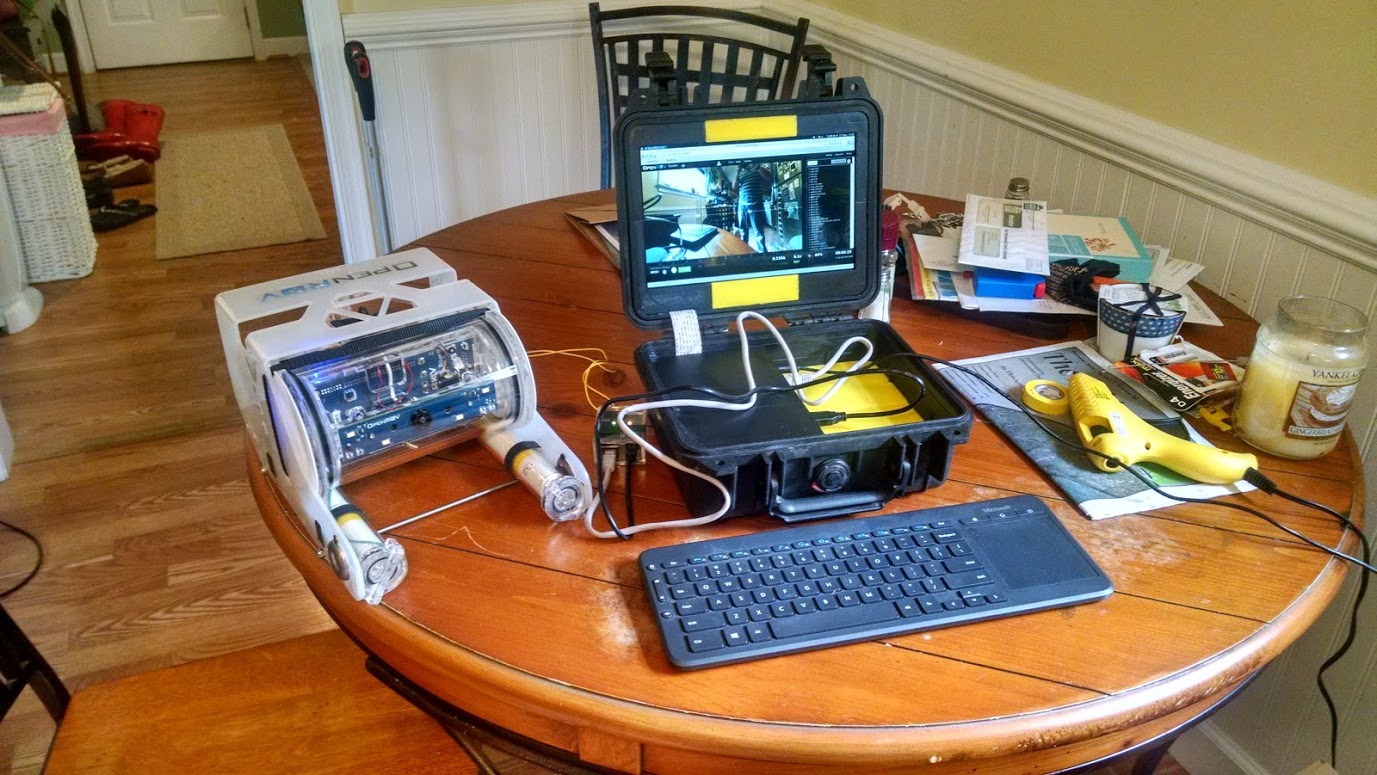
Yes, it will run an OpenROV. It will not run it well.

Read More “The BeagleBox 2: a dirt-cheap, tough-as-nails, 3D-printed, versatile field laptop.” »

Big ideas and little robots: Using the OpenROV in interdisciplinary STEM projects

Posted on May 4, 2016May 3, 2016 By Guest Writer 1 Comment on Big ideas and little robots: Using the OpenROV in interdisciplinary STEM projects
Conservation, Education, Science

portrait-joeyJoey Maier is a biology professor at Polk State College where he uses every possible opportunity to encourage his students to spend time in the water, play with technology, and do #CitizenScience. As an undergraduate, he did a stint as an intern for Mark Xitco and John Gory during their dolphin language experiments.  He then spent the years of his M.Sc. at the University of Oklahoma thawing out and playing with bits of decaying dolphin.  After discovering that computers lack that rotten-blubber smell, Joey became a UNIX sysadmin and later a CISSP security analyst.  
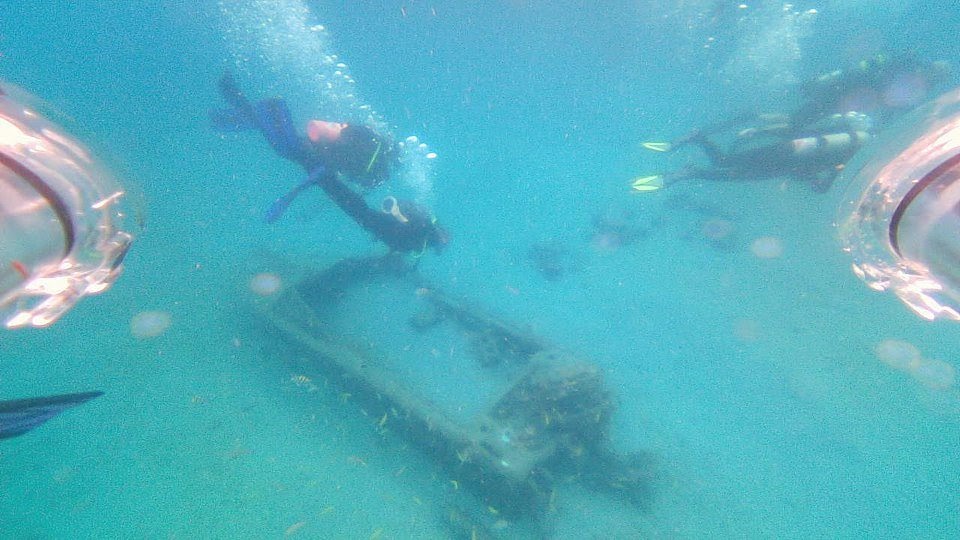
While his pirate game is weak, he is often seen with a miniature macaw on his shoulder. His spare time is spent SCUBA diving and trying to hang out with people who have submersibles.  You can follow him on Twitter or Facebook.


There’s a Klingon bird of prey hanging from the ceiling in my office.

I may teach biology, but at heart I’m a sci-fi nerd.  Naturally, I’m interested in futurism, robots, lasers and all manner of techy paraphernalia.  I’d been watching the OpenROV project for a while, but hadn’t gotten one yet.  They were obviously awesome little machines that gave me a serious case of gadget envy, and I knew that some of our students would love to pilot an ROV.  I needed a much better reason than that, however, to justify getting one.  There’s no line item in our budget for, “Wow, that’s cool!” and I was fairly certain that the college administration would tend to favor lower cost and more familiar forms of student engagement

Photo courtesy Joey Maier.

This tweet changed everything.  When I found out that Andrew had designed a mini-Niskin bottle, the wheels in my head started turning.  Assembling an OpenROV would, naturally, be a very STEM-oriented project.  The times our students piloted the ROV could become water sampling field trips, and the kids could analyze their samples back at school as a laboratory activity. If students recorded the process, they could make a short film. I mulled over the possibilities and bounced ideas off of my dive buddies during the hours we spent traveling to and from the coast.

Read More “Big ideas and little robots: Using the OpenROV in interdisciplinary STEM projects” »

The Science of Aquaman: Understanding Dead Water

Posted on April 22, 2016April 23, 2016 By Andrew Thaler
Popular Culture, Science

Update: legendary oceanographer Dr. Kim Martini stops by to set the record straight on the challenging subject of internal waves. Her comments in bold. 

It has been a long time since I’ve made an entry into our long-running, world-famous, Science of Aquaman series. The last few runs have been heavy on high adventure, but light on ocean tidbits for me to nerd out on. I don’t like to force ocean fact into comic fiction unless the opportunity presents itself.

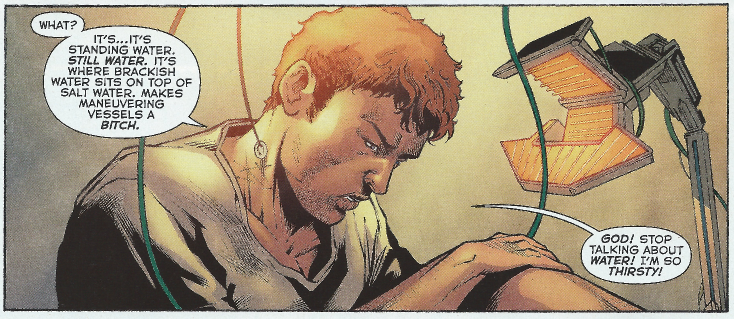
So, with the newest run of Aquaman, starting with issue #50, focusing around a villain named Dead Water, I thought it was the perfect moment to talk about some physical oceanography. And then…

Dead Water. From Aquaman #51.

My hat’s off to Dan Abnett, who beat me to the science punchline. If I had to explain the phenomenon of dead water in a single tweet, it would have been pretty close to this. Well played, sir. Well played.

So what is dead water and why does it make maneuvering a vessel so challenging?

Read More “The Science of Aquaman: Understanding Dead Water” »

Shark MOOC: There’s a big shark party, and you’re invited!

Posted on February 26, 2016February 26, 2016 By Guest Writer
Education, Science

BemisWilliam E Bemis is Professor of Ecology and Evolutionary Biology at Cornell and lead faculty member for the edX MOOC Sharks! Global Biodiversity, Biology, and Conservation. He studied at Cornell University, the University of Michigan, the University of California Berkeley, and the University of Chicago before serving 20 years as Professor of Biology at the University of Massachusetts Amherst. From 2005 to 2013, he served as Kingsbury Director of Shoals Marine Laboratory at Cornell. Bemis conducts research in comparative vertebrate anatomy, trains research students, and teaches courses in vertebrate anatomy and evolution.

A

How do you get thousands of people interested in basic biological concepts? By teaching a course on some of the most fascinating animals on Earth – sharks and their relatives.
This is a particularly exciting time to be a shark scientist. An explosion of new research methods and technologies are leading to a surprising world of discovery. Our new course, free and open to anyone in the world, explores discoveries in many areas, including:

Read More “Shark MOOC: There’s a big shark party, and you’re invited!” »

Fun Science FRIEDay – The Universe Sings a Song, and Humans Can Finally Listen

Posted on February 12, 2016February 12, 2016 By Kersey Sturdivant
Science
(Photo Credit: Underwood & Underwood / Corbis / Kara Gordon / The Atlantic)

The  interwebs have been going crazy the past few days with the recent announcement that scientists have for the first time detected gravitational waves, the ripples in the fabric of space-time that Einstein predicted a century ago. In terms of scientific advancement, to quote Joe Biden, “This is a big fucking deal!” Bigger than the discovery of the subatomic Higgs boson particle (i.e., the god particle), and it has been suggested this discovery is comparable only to “Galileo taking up the telescope and looking at the planets.” – Penn State physics theorist Abhay Ashtekar

Photo credit: The Laser Interferometer Gravitational-Wave Observatory

Read More “Fun Science FRIEDay – The Universe Sings a Song, and Humans Can Finally Listen” »

Ocean Kickstarter of the Month: Whale Science Double Feature

Posted on February 10, 2016 By Andrew Thaler
Science

whale1Comprehensive Conservation of Southern Resident Killer Whales in the Modern Ocean
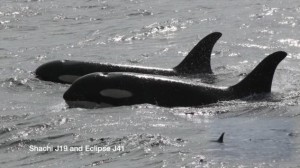
Southern Resident Killer Whales are endangered; only 85 remain. In today’s modern ocean they face many threats simultaneously. A holistic approach to addressing the cumulative impacts of all threats is needed. However, data are sparse, making it difficult to identify which threat(s) is causing the most harm. We are developing a new, comprehensive way to assess threats by having experts fill data gaps. With your help, we can pinpoint which protective actions will help Southern Residents recover.

blowWhale snot and blubber: Tools used to better understand basic physiology in free ranging cetaceans

Baseline indices for steroid hormone levels in humpback whales do not exist, and current monitoring techniques are invasive. Hormones can advise in management, and help in understanding climate change related population shifts. We want to test if whale snot is reliable in collecting sufficient data without disturbing them. By analyzing hormone levels in both blubber and snot, we can establish hormone level baselines from blubber, and see whether less invasive snot-collecting is just as telling.

We haven’t featured Experiment yet in this Ocean Kickstarter series. Experiment is a crowdfunding platform exclusively for scientific research. It helps practicing scientists connect with a community funding base. Because of its narrow focus, Experiment is a little bit different. There are no rewards, instead you get access to updates about the project as it progresses. There is an elevated focus on budget, and, because it’s more akin to a philanthropic donation, rather than an investment, there is often fund-matching from NGOs and larger foundations.

Since last month’s recommendation won’t launch for another 25 years, this month I’ve picked two excellent projects to support. 

Read More “Ocean Kickstarter of the Month: Whale Science Double Feature” »

Posts pagination

Previous 1 … 16 17 18 … 81 Next

Popular Posts

What Ocean Ramsey does is not shark science or conservation: some brief thoughts on "the Shark Whisperer" documentaryWhat Ocean Ramsey does is not shark science or conservation: some brief thoughts on "the Shark Whisperer" documentaryJuly 2, 2025David Shiffman
Tangier, an Island out of Time.Tangier, an Island out of Time.July 3, 2017Andrew Thaler
That's not a blobfish: Deep Sea Social Media is Flooded by AI SlopThat's not a blobfish: Deep Sea Social Media is Flooded by AI SlopDecember 19, 2025Andrew Thaler
Shark of Darkness: Wrath of Submarine is a fake documentaryShark of Darkness: Wrath of Submarine is a fake documentaryAugust 10, 2014Michelle Jewell
Join Me at Upwell: A Wave of Ocean Justice — Our Fourth Year!Join Me at Upwell: A Wave of Ocean Justice — Our Fourth Year!March 24, 2026Angelo Villagomez
Urea and Shark OsmoregulationUrea and Shark OsmoregulationNovember 15, 2010David Shiffman
What is a Sand Shark?What is a Sand Shark?November 12, 2017Chuck Bangley
Alberta, Canada is the proud owner of the largest man-made pyramid on the planetAlberta, Canada is the proud owner of the largest man-made pyramid on the planetOctober 16, 2012Andrew Thaler
I turned my woodshop into a personal solar farm.I turned my woodshop into a personal solar farm.June 21, 2021Andrew Thaler
How many nuclear weapons are at the bottom of the sea. An (almost certainly incomplete) census of broken arrows over water.How many nuclear weapons are at the bottom of the sea. An (almost certainly incomplete) census of broken arrows over water.July 26, 2018Andrew Thaler
Subscribe to our RSS Feed for updates whenever new articles are published.

We recommend Feedly for RSS management. It's like Google Reader, except it still exists.

Southern Fried Science

  • Home
  • About SFS
  • Authors
  • Support SFS


If you enjoy Southern Fried Science, consider contributing to our Patreon campaign.

Copyright © 2026 Southern Fried Science.

Theme: Oceanly Premium by ScriptsTown