

 Here at SFS, we seem to have an affinity for cyborgs. I recently had a dream in which I envisioned my future as such a creature. I had aged, achieved a professorship, and was teaching an introductory geography class. Contrary to the current classroom, however, there was not a learned scholar standing in front of pupils transferring information from my brain to theirs through lecture and leading discussions. Instead, there was a flurry of multimedia flying around the room and the “lecture” was really a snippet of a semester-long conversation involving the entire class intended to immerse them in geographic thinking, in and out of class. My thoughts and the in-person conversation was immediately digitized and encoded to be connected to parallel tweets, emails, blogs, and other online content.
 Science is a conversation, and in 2011, a significant portion of that conversation happened on twitter. 2011 saw some fascinating new discoveries, bizarre assertions, disheartening revelations, and brilliant discussions. Twitter, it seems, is both a petri dish for nuggets of insight and an autoclave for steaming piles. So, without any further ado, here are the top 11 science hastags of 2011.

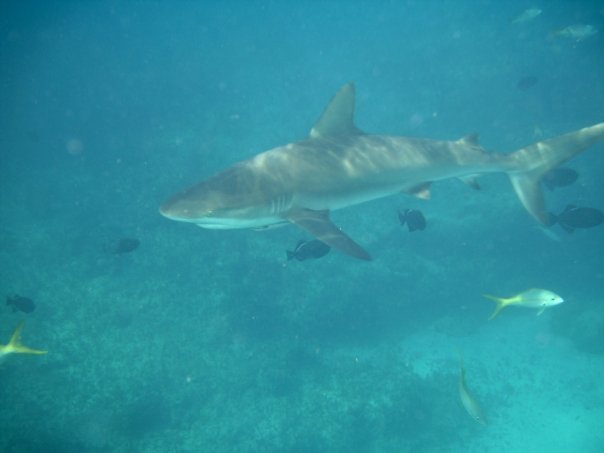
2011 was a relatively good year for sharks and rays. Presented below, in no particular order, are ten important shark conservation stories from the past year.
1. Shark sanctuaries. The world gained several new shark sanctuaries, areas where shark fishing is banned, in 2011. Nations creating new shark sanctuaries include Honduras (~92,000 square miles), the Bahamas (~240,000 square miles), Marshall Islands/Guam/Palau (a regional partnership protecting almost 2 million square miles). Numerous concerns about enforcing rules in these huge areas, as well as concerns about potential loopholes in the policies, exist among conservation scientists.
2. Fin bans. These laws ban the possession, trade, or sale of shark fins within the boundaries of a city, state/territory, or country. In 2011, Hawaii’s first-in-the-US fin ban took effect, and a few other US states (California, Washington, and Oregon) passed similar laws. There is an ongoing debate in the shark conservation community about whether blanket bans on finning are better than promoting best practices (i.e. more sustainable shark fishing techniques). Additionally, some are concerned that we aren’t focusing enough on other threats to sharks like bycatch and habitat destruction.

Last August, two petitions were sent to the National Marine Fisheries Service from three conservation organizations (the Animal Welfare Institute, WildEarth Guardians and Friends of Animals). The petitions (available in their entirety here) requested that four species of skate be listed as “threatened” or “endangered” under the Endangered Species Act, and requested that critical habitat for these species be designated and appropriately protected. These species are the thorny skate, barndoor skate, winter skate, and smooth skate.
Due to both a directed fishery (skate wings are used for lobster trap bait, and also for food for a primarily-overseas market that includes Europe) and bycatch in bottom fisheries , Northwest Atlantic populations of these species have experienced serious declines in recent years. While some skate species have rebounded (for reasons that are not entirely clear), The thorny skate remains particularly threatened- the IUCN Red List considers the subpopulation off the Northeastern U.S. coast to be Critically Endangered. It is illegal for U.S. fishermen to keep thorny skates they catch (and has been since 2004), but they are commonly taken as bycatch in fisheries for the other skates and groundfish.
Yesterday, the National Marine Fisheries Service formally responded to the petition (thorny skate and other skates), and the news isn’t good for skates:
“After reviewing the information contained in the petition and information readily available in our files, we conclude that the petition fails to present substantial scientific or commercial information indicating that the petitioned action concerning barndoor, smooth and/or winter skate may be warranted…We find that the petitions do not present substantial scientific information indicating the petitioned actions may be warranted. Accordingly, we will not initiate a review of the status of thorny skate at this time.”
The National Marine Fisheries Service listed several reasons why they believe these skates should not be listed under the Endangered Species Act.
While the Republican presidential candidates threaten to dissolve the Environmental Protection Agency at the federal level, struggles at the state and local levels show building blocks to such an action were stacking for years.
When asked who is primarily responsible for protecting water quality, many citizens in North Carolina respond “don’t we have a department of water quality for that?”. Those citizens are not wrong, but they are placing a large suite of issues on the shoulders of a single agency. And that agency is losing funding and staff.
Defining responsibility for water quality starts with defining the term. As anyone who has thought about water quality and habitat issues knows well, it’s not as simple as dipping a thermometer in a stream to determine water health. Aquatic ecosystems don’t run a fever when there’s something wrong; issues are far more subtle than that.
When asked to define water quality, a leader at the Division of Water Quality (DWQ) who does not want to be quoted by name, stated:
“We try to prevent pollution from affecting our streams and rivers so that we can enjoy them for recreation, we can enjoy them for drinking water purposes, the fish can survive in them … water quality is that which enables all the uses to be continued to be made of those water bodies.”
For the agency in charge of protecting water quality, traditional uses serve as indicators of the water’s health. Note the definition’s focus on pollution prevention as the means to protect these various uses.
Christopher Hitchens, author, intellectual, and atheist firebrand, passed away last night. While I’m sure the internet will be filled over the coming days with fitting remembrances from those who knew him well, I couldn’t help but take the time to reflect on my one meeting with the iconic author. Several years ago, when I was … Read More “A morning with Christopher Hitchens” »
My friends and family have always appreciated my obsession passion for sharks, because it makes me extremely easy to shop for. In the spirit of the holiday season mantra that it is better to give than to receive, here is a list of some shark-themed gifts, including some that actually benefit shark research and conservation. If you buy in the next few days, there’s still time to get many of them delivered by Christmas.
The gap between how humans treat dolphins and how humans treat sharks has gotten wider. Many ancient cultures worshiped sharks as gods. Now it’s hard to get people to agree to take basic steps to ensure that species of sharks don’t go extinct, while they’ll try to move heaven and Earth to save 16 dolphins. It’s hard to get people to care about the brutal, unsustainable, and wasteful practice of shark finning that’s wiping out whole species of sharks, but a movie about a single dolphin that loses a fin is considered a must-see family classic.

The success of “Dolphin Tale” got me thinking. Dolphins and sharks are both top predators, so dolphins are no more ecologically important than their elasmobranch counterparts. Dolphins have it much easier than sharks. The world isn’t fair to sharks, just because they were born with behaviors that makes it harder for them to benefit from a growing global concern about biodiversity. This is a fact, decades after the birth of the environmental movement.
I am not a shark. I’m not a dolphin either. I’m a human, and I was born into a completely different set of circumstances than either group of marine predators. Life wasn’t as hard for me as it is for a shark. This doesn’t mean that I’ve given up on sharks. I still believe that it’s possible for a group of sometimes-unpopular animals to get the legal protections they need to avoid extinction. Still, even decades after the birth of the environmental movement.

In Jules Verne’s 20,000 Leagues Under the Sea*, the iconic Captain Nemo announced that “in the depths of the ocean, there are mines of zinc, iron, silver and gold that would be quite easy to exploit” while predicting that the abundance of marine resources could satisfy human need. If the pace of development for deep-sea mining projects and the estimated value of deep-sea ores is any indicator, it seems as though our misanthropic mariner was wrong on both counts.
In The abundance of seafloor massive sulfide deposits, an international team of geologists attempts to quantify the total available copper and zinc contained in deep-sea massive sulfide mounds. Seafloor massive sulfide mounds are a byproduct of the processes that create deep-sea hydrothermal vents. As super-heated sea water emerges from the vent, it deposits heavy metals and other elements and minerals along the walls of the vent. Over thousands of years, an active vent field can build up a huge mound of metal and mineral rich ore – a massive sulfide mound. In addition to copper and zinc, these mounds can contain gold and silver. Generally, the ore is of much higher quality than its terrestrial counterpart. Over the last few decades, many exploration companies were eyeing these deposits, but it’s only recently that technological developments and economic incentives have aligned to permit potentially profitable deep-sea mining.

Like most marine biology geeks, I’m a huge fan of Disney/Pixar’s “Finding Nemo”. In addition to a heartwarming story of a father trying to bring his son home to their aneme…anemeneme… amenememe… anemone, the film showcases an enormous variety of beautiful real-life coral reef species. According to research published today in Conservation Letters, however, we may soon only be able to see some of these animals in the movies. The paper, titled “Extinction Risk and Bottlenecks in the Conservation of Charismatic Marine Species”, concluded that many of the stars of Finding Nemo are in deep trouble.