Every once in a while, with predictable regularity, I will encounter a call to be more interdisciplinary in order to fully understand the many aspects of a given issue. The world forgot to compartmentalize its problems for ease of solution. Solutions require scientists to think big and basic at the same time – recent estimates that 7 billion people will roam the planet by the end of this year – and that creates a big demand for resources such as food, water, fuel, and fiber. Ecologists clearly have something to say on the matter and designated 2011’s meeting theme “Earth Stewardship”, meant as a way to kick off new thinking on research process and connecting research to problem solving.
Yesterday the National Oceanic and Atmospheric Association (NOAA) released their new scientific integrity policy, which specifically states that: “To support a culture of openness, one of the policy’s key provisions affirms unequivocally that NOAA scientists may speak freely with the media and public about scientific and technical matters based on their official work without approval … Read More “Open thread for NOAA scientists to speak freely about scientific and technical matters based on their official work without approval from the public affairs office or their supervisors.” »

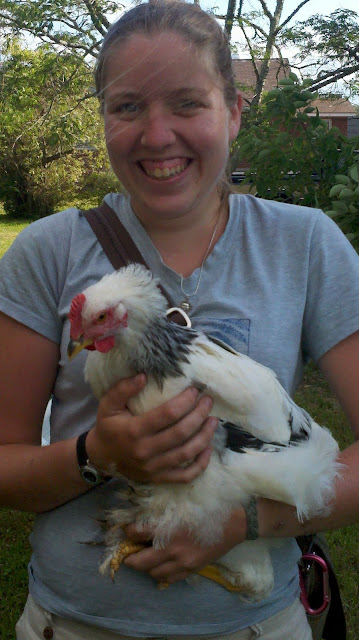
I awoke one morning early last spring to a noise I has been dreading for weeks, the first crow of a chicken that was not supposed to be a rooster. It took me several minutes to fully register what I was hearing. Rather that the classic cock-a-doodle-do we often associate with the rooster’s crow, the sound emanating from my hen house was an awkward, unstable noise not unlike a turkey squawking through a vat of molasses while being vigorously shaken. Over the next several months, two more cocks arrived crowing, in my flock. All three roosters, different breeds from different parents, made noises resembling nothing like a rooster’s crow. There was no pattern; some mornings they would crow off-and-on for a few hours, other mornings they would, for lack of a better word, gargle for half-an-hour straight.
I raise my chickens from day-old hatchlings. Those three roosters, from my very first flock, had never met an adult chicken. They imprinted on Amy and me and looked to us for guidance. When we introduced them to new food, new water dispensers, even small changes to their habitat (like a particularly terrifying log), we had to teach them. Instinctively, they would scratch for food, and if left to their own devices, they would attempt to eat everything, but for the most part, we had to show them how to eat, how to drink, how to roost. But we could not teach them how to crow.
Which is why Casey B. Mulligan’s Economix article in the New York Times – Species Protection and Technology – which argues that cloning could be an effective tool to restore extinct species (a topic I’ve been thinking about quite a bit in terms of population dynamics), is fatally flawed.
Read More “Better Conservation through Cloning: this cock doesn’t crow” »
The Beneath the Waves Film Festival is now accepting submissions for the 2012 meeting! This festival, now in it’s third year, is associated with the Benthic Ecology conference. It is one of the few film festivals in the world that brings the scientific and filmmaking communities directly together. This year, the festival will be in Norfolk, Virginia … Read More “Beneath the Waves Film Festival: Now accepting submissions!” »

The influence that Star Trek has had on our society, from cell phones to the name of the first space shuttle orbiter to providing hope of a better future to victims of ethnic cleansing, has been well documented. However, what does Star Trek have to do with saving the oceans? As it turns out, quite a lot, and I’m not just talking about the plot of Star Trek IV (in which Kirk and company have to go back in time to rescue a whale whose species was driven extinct by human exploitation).
Star Trek is fundamentally about curiosity, exploration, and respect for all forms of life. This can be found from the Enterprise’s stated mission (“to explore strange new worlds, to seek out new life and new civilizations, to boldly go where no one has gone before*) to the Vulcan code of IDIC (Infinite Diversity in Infinite Combinations), and you’d be hard-pressed to find a popular television series that portrays scientists better. The ideals of Star Trek have quite a bit to do with saving the oceans, and I’m not the only one who thinks so.
As you read this, I’ll be on a plane over the Pacific Ocean. I’m on my way to Auckland, New Zealand for the 25th annual International Congress for Conservation Biology! This meeting, organized by the Society for Conservation Biology, brings together conservation scientists from around the world. I will be live-Tweeting talks and plenary speeches … Read More “WhySharksMatter is headed to New Zealand for the International Congress for Conservation Biology” »
Thank you all for your support in the 2011 blogging scholarship! It really means a lot that so many of you voted for me and encouraged your friends and followers to do the same. All told, over two hundred of my Twitter followers Tweeted or re-Tweeted messages about the contest, many of them every day … Read More “Thanks for your support in the 2011 blogging scholarship!” »
Today is the last day to vote for the winner of the 2011 blogging scholarship, which provides $10,000 towards research and education expenses to the winner. The final decision comes down to votes, and I need your help for the last push! Please vote for me (my real name, as it’s entered on the voting … Read More “It’s the last day to vote for me to win $10,000 for shark conservation research!” »

Why are we still killing Bluefin Tuna? This question has resonated through the ocean blogosphere recently, as various experts weigh the issues surrounding overfishing and wonder why, when we know how limited the Bluefin Tuna populations are, and how precipitously they’ve declined in the last decade, do they demand record-breaking prices able to support an industry that must range further afield to chase that last, lonely fish? Other conservation writers discuss the recent extinction of not one, but two, rhinoceros species and ponder the fate of large terrestrial mammals. Knowing how rare these rhinoceroses were, why did they continue to be poached? Where does this demand come from?
Read More “Bluefin Tuna, Big Game Hunters, and the Conservation Vortex” »
There are still a few days left to vote for me to win the 2011 blogging scholarship, which provides $10,000 towards research and education expenses to the winner! If I win, some of the money will be used to support shark conservation research at my lab. It will help support our citizen science program, which … Read More “There’s still time to vote for me to win $10,000 for shark conservation research!” »