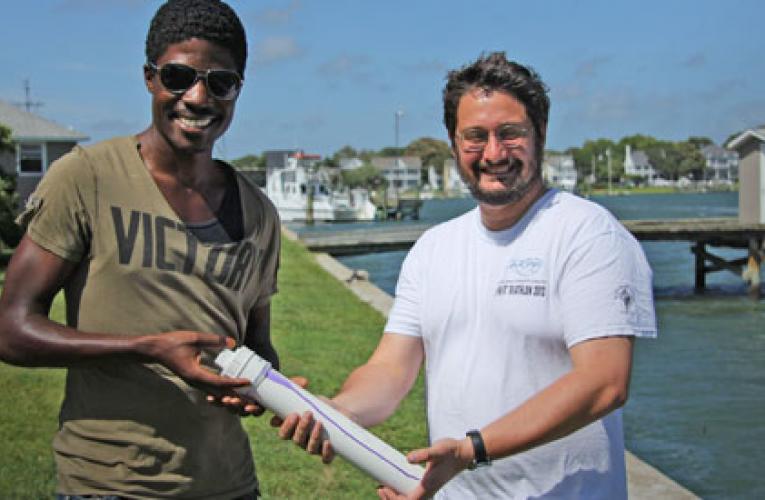


I’m in the Dutch Caribbean this week with a team of international researchers for an expedition to the Saba Bank to study sharks. This endeavor has been pulled together under the leadership of the Dutch Elasmobranch Society, the Saba Conservation Foundation, and the Nature Foundation Sint Maarten. I’m only here for five days, but the … Read More “Studying Sharks in the Dutch Caribbean” »

Foghorn (A Call to Action!)
Once again, delegates from around the world will gather in Kingston, Jamaica to negotiate the future of the deep sea. It’s Part II of the 25th Session of the International Seabed Authority. Watch, Live!
Need to catch upon the last 25 years of deep-sea mining, exploration, and policy? The Deep-sea Mining Observer has you covered! Read through archives and back-issues, here: Deep-sea Mining Observer.
Flotsam (what we’re obsessed with right now)
- It’s been over 15 years since we’ve had a new National Marine Sanctuary. Say hello to Mallows Bay-Potomac River National Marine Sanctuary.
- Russian nuclear submarine: Norway finds big radiation leak. Good thing we had our favorite nuclear anthropologist discuss what to do when you find a nuke in the ocean for last month’s Deep-sea Mining Observer.

Flotsam (what we’re obsessed with right now)
- The women fish sellers of West Africa, a great video from China Dialogue.
- How smart are octopuses? So smart! For Smart Animals, Octopuses Are Very Weird.
Confession: I have an Amazon Echo. I really like Amazon Echo. I use Amazon Echo almost every day.
Everything about the Amazon Echo is great, except for the primary feature of the Amazon Echo: it is always listening. When I received the Echo nearly five years ago, as a gift, Amazon was not quite the Surveillance Capitalism behemoth that it is now. They packaged their new smart speaker with lots of information about privacy and what Echo can and can’t and won’t do.
Of course, none of that turned out to be true. In just the last year, Echos have been turned into permanent recording devices, listened to a couple’s conversations and then inexplicably sent those conversations to the husband’s employer, and sent 1,700 voice recordings to a totally random stranger. Amazon hasn’t exactly done much to help the image of Echos as Bradburian household horrors, unveiling an Echo Dot for Kids, filling patents for true always-on recording, releasing recordings to outside contractors, and, perhaps most egregious of all, embedding Alexa into a Big Mouth Billy Bass.
It’s reached the point where no one should feel comfortable having an always-on speaker in their home, but damn if these little things aren’t just so convenient. On top of being useful for quick searches, playing Baby Shark on repeat 40 times, checking the weather, and dozens of other little things, the original Echo was a really good speaker. It seems a waste to throw the whole thing away just because one feature is unacceptable.
Can you remember how young you were when you were first taught stop, drop, and roll? How about turn around, don’t drown? Slogans are abridged stories that fulfill our human need to convey information quickly and memorably. Their uses range from social connection, cooperation, and informing cohorts of risk. Sayings like the above are effective … Read More “Worldwide SciComm Challenge: #SharkSafetySlogan” »

Foghorn (A Call to Action!)
In every issue of the Monday Morning Salvage, we try to highlight 2 to 5 papers from the scientific literature. In doing so, we attempt to provide a broad and diverse cross-section of the diversity of people conducting scientific research. However, our priority is in highlighting papers of particular interest to ocean science, and occasionally that means that we end up recommending papers that are exclusively authored by men. A new paper by Salerno and friends highlights the extreme extent to which papers led by men excludes women co-authors.
To do our small part to push back against this phenomenon, we are adopting a new style guide for paper citations. Conventionally, at Southern Fried Science, we use the colloquial “and friends” instead of “et al.” to make paper citations more approachable and less jargon-y. Going forward, in cases where a paper contains only male co-authors, we will instead replace “et al.” with “and some other dudes“.
Flotsam (what we’re obsessed with right now)
- It is the hero we deserve. Boaty McBoatface Just Helped Solve a Deep-Sea Mystery.

- Shark populations in NC coastal waters are down, despite uninformed opinions based on absolutely nothing.
- It may be formed from rock and plastic, but ‘plasticrust’ is by far the most Metal name they could have come up with. A Strange New Blend of Rock and Plastic Is Forming on a Portuguese Island.


Flotsam (what we’re obsessed with right now)
- What Makes Things Slimy? Now, I’m just a humble country deep-sea ecologist, but I reckon it’s probably the slime.
- I’m not not considering this: I Live Alone in an Island Paradise.

I have had the pleasure of working communications roles in several industries over the years. During this time, I’ve seen the rise of a dubious campaign metric commonly referred to as “Stop the Scroll” (or “Swipe”). This metric has conscientious roots. Online communications strategists have less than a second to grab a potential donor, stakeholder, or client’s attention. Good strategists have read Craig McClain’s paper, as a great visual will make your thumb quiver before scrolling on to a video of dogs doing literally anything. In this light, stop the scroll seems like a pretty good metric for individual post efficacy. Time is the currency of experience, after all.
Can we count the seconds people spend learning untrue facts as progress towards our campaign? Or change the campaign goals to justify a resource-heavy shit post?
Editors: Jeffrey C. Carrier, Michael R. Heithaus, Colin A. Simpfendorfer. CRC Press, available here.
I can’t imagine a more useful introductory reference guide for new or prospective graduate students starting their career in marine biology than “Shark Research: Emerging Technologies and Applications for the Field And Laboratory”. This book is designed for people who have little to no familiarity with a research discipline but are about to start working in that discipline, a large and important audience that is often ignored by books and review papers geared towards people who are already experts. So many graduate students are told to learn a new research method by reading technical literature that assumes they already know this stuff, resulting in stress and frustration.

Flotsam (what we’re obsessed with right now)
- This tune gives me so much anxiety. Scientist Composes Game of Thrones-Worthy Song From Climate Change Data.
- Huge if scalable: New plastic closes the recycling loop.
- Deep in the Ocean’s Trenches, The Legacy of Nuclear Testing Lives: The discovery of “bomb carbon” miles below the surface shows how deep human impact goes.