

Skip to content

Southern Fried Science

Over 15 years of ocean science and conservation online

  • Home
  • About SFS
  • Authors
  • Support SFS

Recent Posts

Isn’t ironic, don’t you think: dismantling the Ocean Observatories Initiative on World Oceans Day
June 9, 2026
“Why Sustainable Seafood Matters” is now available for preorder! Here’s what it’s about, and why I decided to write it.
June 8, 2026
Here’s how to join my IMCC8 symposium, “Ocean Science Communication: What’s New and What’s Next?”
April 22, 2026
Deep Sea Mining Symposium Announcement
April 21, 2026
Join Me at Upwell: A Wave of Ocean Justice — Our Fourth Year!
March 24, 2026
How close did the world’s first deep-sea mining come to the dredging the world’s largest cold-water coral reef?
March 17, 2026

The ‘Pluto Moment’ for Marine Protected Areas

Posted on April 16, 2018June 14, 2018 By Angelo Villagomez
Conservation

How much of the ocean is really protected?

When the International Astronomical Union changed its definition of what constitutes a planet in our solar system in 2006, demoting hapless Pluto to a dwarf planet, the decision sparked fierce scientific debate and an outcry from the public. But after all was said and done, we earthlings now have a better understanding of our celestial neighborhood, with eight perfectly nice authentic planets, and a greater appreciation of what it takes to be in that exclusive club.

Now, the ocean science community may be facing its own “Pluto Moment.”

The International Union for Conservation of Nature (IUCN)—keeper of the Red List, the most comprehensive source on the conservation status of life on Earth—also sets the global standard for marine protected areas (MPAs). The IUCN has numerous subcategories of MPAs, from fully protected areas to those that allow some fishing or other activity, but in the group’s eyes all MPAs must be created with the primary goal of conserving biodiversity.

Read More “The ‘Pluto Moment’ for Marine Protected Areas” »

Is a Changing Environment Bringing Baby Bull Sharks to North Carolina?

Posted on April 16, 2018April 16, 2018 By Chuck Bangley 4 Comments on Is a Changing Environment Bringing Baby Bull Sharks to North Carolina?
Climate change

Marine environments are typically considered more open than those on land when it comes to animal movement. On land, the range of a species can be limited by geographic features like mountain ranges, canyons, rivers, and anything else that might get in the way. In the ocean, however, actively swimming animals like, say, large sharks have few physical barriers and may instead be restricted by their own environmental preferences. This is why in unusually warm summers you might see tropical fishes in southern New England. Because of this, one of the anticipated consequences of warming ocean temperatures is shifting distributions of mobile and highly migratory species. Basically, changes in temperature are likely to allow marine animals to move into places they haven’t before, and if those temperature changes become consistent, these species might make regular visits or even just start staying there.

This kind of change is already happening and has been documented across a variety of marine species. Now, findings from a new paper in Scientific Reports by me and co-authors from the North Carolina Division of Marine Fisheries, Simon Fraser University, and East Carolina University show an apex predator may be joining the northward shift.

Juvenile Bull Shark captured in Pamlico Sound, North Carolina. Photo from the Smithsonian Environmental Research Center.

Read More “Is a Changing Environment Bringing Baby Bull Sharks to North Carolina?” »

America’s Second-Largest Estuary is a Lagoon Full of Sharks

Posted on April 12, 2018April 15, 2018 By Chuck Bangley 5 Comments on America’s Second-Largest Estuary is a Lagoon Full of Sharks
Uncategorized

I’ve defaced this colonial-era image of Native American fishing methods from Roanoke Island, NC to show that sharks have been observed in North Carolina’s estuaries for quite some time. Original art: “The Manner of Their Fishing” by John White.

It’s a bit of a cliché to reference the movie Jaws when talking about sharks, but I’m going to do it anyway. There’s a pivotal scene where the giant White Shark is spotted moving into a salt pond, where it proceeds to terrorize the children of protagonist Chief Martin Brody. While no sharks are in the business of regularly eating humans, at least part of this scene is realistic: sharks do make use of inshore, estuarine environments like lagoons, bays, and the lower portions of rivers. Despite the fact that sharks are generally thought to stay out in the ocean, many species are not only comfortable entering estuaries, they actually depend on them. Some species make extensive use of estuaries as shelter from predators and/or a place to grab a bite themselves.

So it should come as no surprise that North Carolina’s Pamlico Sound, part of the Albemarle-Pamlico estuary (the second-largest in the continental U.S. after Chesapeake Bay) offers a lot of potential real estate for sharks. Unlike Chesapeake Bay, Pamlico Sound is a lagoon, which means it’s wide, shallow, mostly water, and connected to the ocean via fairly small inlets between barrier islands. It straddles the transition zone marked by Cape Hatteras between temperate and subtropical marine ecosystems, and the amount of seagrass growth there is second only to Florida in sheer area. This estuary is already well-known for its importance as habitat for such varied (as well as tasty and/or fun to catch) species as Blue Crab, Penaeid shrimps, Flounder, and Red Drum. However, the sharks of Pamlico Sound have mostly been known by scattered reports and sightings from fishermen. That is, until my co-authors and I were able to look through a nice data set to get an idea of which sharks are present in the sound and where in the estuary they might like to be. The results are now published in PLOS One, and here’s a quick summary of how we got them.

Read More “America’s Second-Largest Estuary is a Lagoon Full of Sharks” »

Sea monsters and saving kelp: Thursday Afternoon Dredging, April 12, 2018

Posted on April 12, 2018April 11, 2018 By David Shiffman 1 Comment on Sea monsters and saving kelp: Thursday Afternoon Dredging, April 12, 2018
Uncategorized

Cuttings (short and sweet):  Follow graduate student Justine Hudson, who studies arctic marine mammals, on twitter. Prehistoric “sea monster” could be largest that ever lived. By John Pickrell, for National Geographic. Right whales think before they speak. By Jason Goldman, for Scientific American. UK could create 5,000 jobs by improving seafood sustainability. By Fiona Harvey, for … Read More “Sea monsters and saving kelp: Thursday Afternoon Dredging, April 12, 2018” »

Dear Shark Man, what’s the deal with those notches on shark tails?

Posted on April 11, 2018April 11, 2018 By David Shiffman
Uncategorized

Welcome to  Dear Shark Man, an advice column inspired by a ridiculous e-mail I received. You can send your questions to me via twitter (@WhySharksMatter) or e-mail (WhySharksMatter at gmail). Dear Shark Man, Why do sharks tend to have those little notches in their tail fin? Is it like an aerodynamic thing? If you were to fill … Read More “Dear Shark Man, what’s the deal with those notches on shark tails?” »

A scene-by-scene breakdown of the first trailer of “The Meg”

Posted on April 10, 2018April 10, 2018 By David Shiffman 1 Comment on A scene-by-scene breakdown of the first trailer of “The Meg”
Blogging, Popular Culture

Yesterday, the trailer for “the Meg” was released online.  This movie is based on a popular book series that claims that megalodon is actually not extinct, just hiding. (I’m in the 4th book).


I have a love-hate relationship with movies like this, by which I mean that I love them and I hate myself for loving them. While movies like “Jaws” had a measurable negative effect on public perception of sharks, I don’t believe that more obviously ridiculous movies like SharkNado have a similar effect.  Jason Statham playing a marine biologist in a movie that includes Rainn Wilson? Sign me up.

If not for the people who believe that these movies are real and therefore decide to yell at marine biologists on twitter about it, I’d be all for this.  Let’s be totally clear here- Carcharocles megalodon is extinct, and here’s how we know. Shark Week lied to you about it. Actresses from this movie asking about it are not experts. This movie is completely fictional. You can certainly watch it and enjoy it, but please don’t cite it as evidence that a 50 foot long whale-eating shark that used to live in shallow coastal waters near what are now populated areas is not extinct.

Anyway, here is a scene-by scene breakdown of what’s in the first trailer. From it, we can tell that this is an action-packed movie with a great cast that does not stick too closely to the books, and is also not particularly interested in scientific accuracy even with respect to issues unrelated to the “giant extinct animals are actually not extinct”central conceit.

Read More “A scene-by-scene breakdown of the first trailer of “The Meg”” »

Seven ways the heroes of the Marvel Cinematic Universe could stop runaway climate change.

Posted on April 9, 2018November 11, 2018 By Andrew Thaler
Popular Culture

One of the big ironies of superhero comics and movies is that these beings of immense power, though committed to saving the world, do so by punching things pretty hard. Even when far more obvious solutions to world shaking challenges are presented, the question is not “what will do the most good for the most people” but “can I punch at it really, really hard?” Superman could have done far more for his adoptive home world if he used his limitless strength to turn a crank on an alternator.

Weinersmith knows what’s up.

Heroes in the Marvel Cinematic Universe don’t fair much better. While off avenging, sorcering, and civil warring, they’ve managed to overlook some fairly self-evident solutions to the most pressing global crisis of our time. So how could Earth’s Mightiest Heroes bring an end to runaway climate change?

1. Tony Stark creates unlimited free energy.

We can get the obvious one out of the way, first. Stark’s Arc Reactor is, for all intents and purposes, a free energy machine. Miniaturization means Arc Reactors could be used to power anything, from cars to aircraft carriers to entire cities. Switching the world’s power grid and transportation network to Arc tech would result in an immediate reduction in CO2 emissions and halt the accumulating damage of continuous energy growth as demand for technology increases around the world.

Ok, that’s the obvious one that has to be mentioned in order to avoid insufferable Twitter comments. Now on the the good stuff.

2. Use Pym Particles to sequester CO2 in the Quantum Realm. 

Pym Particles are particles that “shrink the spaces between atoms” allowing an object bombarded with these particles to shrink continuously while maintaining its mass, unless it’s a tank on a key-chain, for some reason. Comic books are ridiculous, ok?

Unfortunately, the shrinking power of Pym Particles is limitless, and once an object shrinks to the point where it’s smaller than an atom, somehow, it enters the Quantum Realm, where the laws of Newtonian physics no longer apply, time is meaningless, and you can never escape (except when you can). Shrink into the Quantum Realm and you shrink forever. That really seems like the ideal place to sequester CO2 , doesn’t it?

The big problem with carbon sequestration is that it’s not always a permanent solution. Sequestered CO2 in trees is only sequestered so long as no one cuts those trees down and burns them. The carbon is still out there in the world, waiting to be re-mobilized into the environment. But! If we could sequester carbon by bombarding it with Pym Particles and sending it to the Quantum Realm, it would shrink forever, permanently locked away in a world of very poorly interpreted quantum physics. That seems safe.

Read More “Seven ways the heroes of the Marvel Cinematic Universe could stop runaway climate change.” »

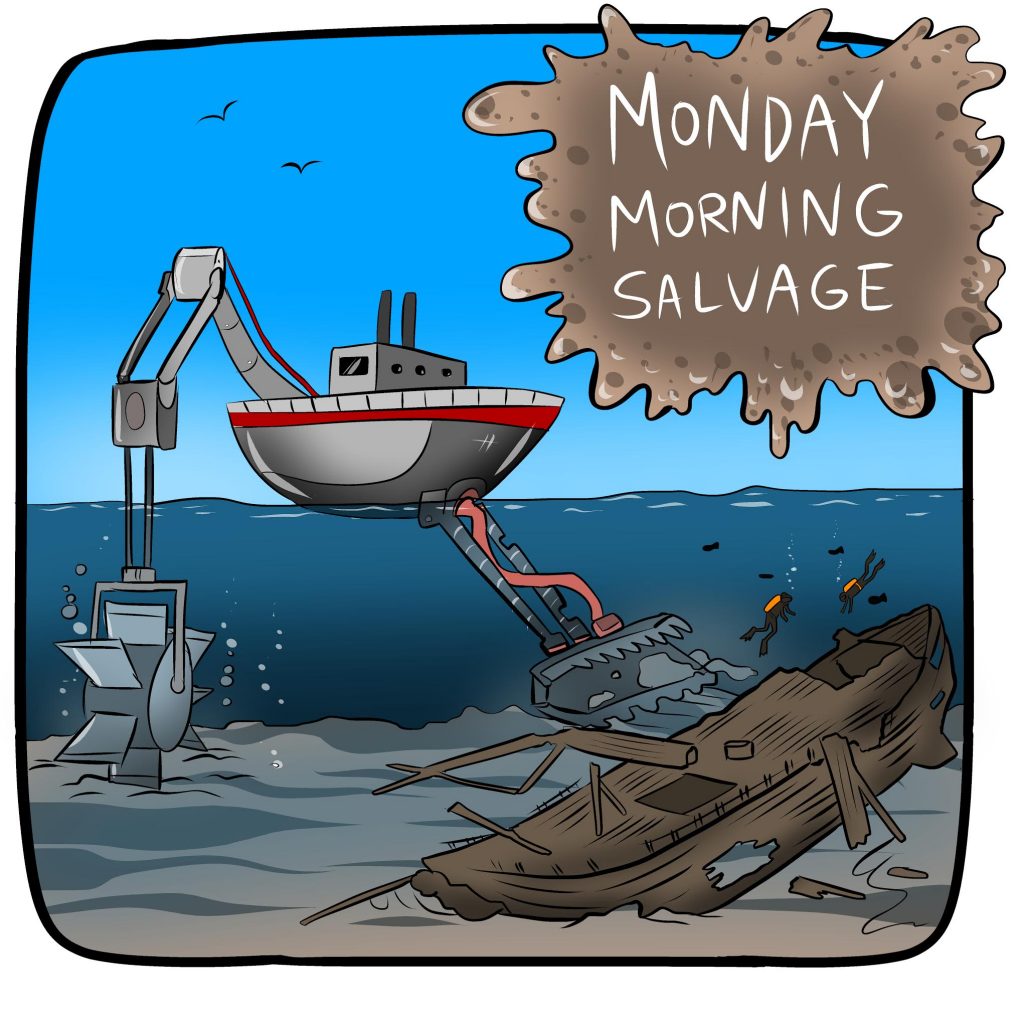
Smart phones are worse than you think, SeaWorld takes a dive, this week in deep-sea mining, and more! Monday Morning Salvage: April 9, 2018

Posted on April 9, 2018April 8, 2018 By Andrew Thaler
Weekly Salvage

Foghorn (A Call to Action!)

  • Stop raising awareness already (and start translating information into action).
  • Scott Pruitt still has a job [As of 16:59 on 4/8/2018 ~Ed.]. A Running List of Wild Shit Scott Pruitt Hasn’t Been Fired For (Yet).
  • What to up you outreach skills? Sign up for Andrew Lewin’s Podcasting for Environmental Communications course.

Flotsam (what we’re obsessed with right now)

  • Smart phones. As you know I have a love/hate relationship with tech and the resources needed to fuel our increasingly demanding hardware. Now, we’ve got the most clear picture yet of the impact of smartphones on the environment and it’s not pretty.
    • Smartphones Are Killing The Planet Faster Than Anyone Expected.
    • Smartphones are warming the planet far more than you think.

GIF by Anthony Antonellis

The Levee (A featured project that emerged from Oceandotcomm)

  • Knitting *and* environmental justice? Sign me up! Stitching Hope for the Coast: Creative pieces that celebrate coastal optimism for Louisiana.

Read More “Smart phones are worse than you think, SeaWorld takes a dive, this week in deep-sea mining, and more! Monday Morning Salvage: April 9, 2018” »

Thoughts on the Sustainable Shark Fisheries and Trade Act

Posted on April 5, 2018 By David Shiffman
Conservation, Science

A few weeks ago, H.R. 5248, The Sustainable Shark Fisheries and Trade Act, was introduced into Congress. The purpose of this bill is to “encourage a science-based approach to significantly reduce the overfishing and unsustainable trade of sharks, rays and skates around the world and prevent shark finning,” according to a press release from Mote Marine Lab. 

Though the devil is always in the details, and I’ll get into those below, here is a general overview of how this would work. The Sustainable Shark Fisheries and Trade Act would direct NOAA Fisheries to evaluate the fisheries management practices of other shark and ray fishing nations. This is similar in principle to other things NOAA is already doing, and a similar role for NOAA was included in the 2010 Shark Conservation Act (but has yet to be implemented).

Nations that have sustainable fisheries management practices comparable to ours (or certain fisheries associated with those nations, even if other fisheries are less well managed) will get a formal certification of their sustainable management practices, and nothing will change for them. Nations (or fisheries) that are found to not have sustainable fisheries management practices comparable to ours will not be allowed to have those products imported into the US and sold in our markets until their management practices improve. In the meantime, they’ll have access to NOAA’s existing capacity building resources and expertise to improve their own practices.

I support much of what this bill is trying to do, but I have some significant concerns about some of the current phrasing and plan for implementation.

Read More “Thoughts on the Sustainable Shark Fisheries and Trade Act” »

Invisible squid and fish with glowing eye spikes: Thursday Afternoon Dredging, April 5th, 2018

Posted on April 5, 2018April 2, 2018 By David Shiffman
Uncategorized

Cuttings (short and sweet):  Follow Louise Chavarie, an Arctic aquatic ecologist, on twitter! A squid-skin inspired invisibility cloak. From Nature News research updates. Underwater noise pollution disturbs fish, too. From CBC News. NOAA publishes list of global fisheries and their risks to marine mammals. By John Cannon, for MongaBay Antarctic ice melting faster than thought. By … Read More “Invisible squid and fish with glowing eye spikes: Thursday Afternoon Dredging, April 5th, 2018” »

Posts pagination

Previous 1 … 45 46 47 … 273 Next

Popular Posts

The story of the pride flag made from NASA imagery: Bluesky's most-liked imageThe story of the pride flag made from NASA imagery: Bluesky's most-liked imageSeptember 27, 2024David Shiffman
"Why Sustainable Seafood Matters" is now available for preorder! Here's what it's about, and why I decided to write it."Why Sustainable Seafood Matters" is now available for preorder! Here's what it's about, and why I decided to write it.June 8, 2026David Shiffman
What Ocean Ramsey does is not shark science or conservation: some brief thoughts on "the Shark Whisperer" documentaryWhat Ocean Ramsey does is not shark science or conservation: some brief thoughts on "the Shark Whisperer" documentaryJuly 2, 2025David Shiffman
Tackling the least important debate in deep-sea mining: the desultory hyphenTackling the least important debate in deep-sea mining: the desultory hyphenJune 8, 2026Andrew Thaler
Shark of Darkness: Wrath of Submarine is a fake documentaryShark of Darkness: Wrath of Submarine is a fake documentaryAugust 10, 2014Michelle Jewell
Deep-sea Mining, Domestic Cats, Star Trek, and Ocean Exploration: Andrew's mid-year podcast round-up.Deep-sea Mining, Domestic Cats, Star Trek, and Ocean Exploration: Andrew's mid-year podcast round-up.June 6, 2026Andrew Thaler
What is a Sand Shark?What is a Sand Shark?November 12, 2017Chuck Bangley
I just told 850 shark scientists a hard truth: We’re not communicating shark conservation correctly.I just told 850 shark scientists a hard truth: We’re not communicating shark conservation correctly.June 1, 2026David Shiffman
That's not a blobfish: Deep Sea Social Media is Flooded by AI SlopThat's not a blobfish: Deep Sea Social Media is Flooded by AI SlopDecember 19, 2025Andrew Thaler
Why ocean science is still one of the worst-funded scientific fields worldwideWhy ocean science is still one of the worst-funded scientific fields worldwideJune 3, 2026Chris Parsons

squishy

Subscribe to our RSS Feed for updates whenever new articles are published.

We recommend Feedly for RSS management. It's like Google Reader, except it still exists.

Southern Fried Science

  • Home
  • About SFS
  • Authors
  • Support SFS


If you enjoy Southern Fried Science, consider contributing to our Patreon campaign.

Copyright © 2026 Southern Fried Science.

Theme: Oceanly Premium by ScriptsTown