

Skip to content

Southern Fried Science

Over 15 years of ocean science and conservation online

  • Home
  • About SFS
  • Authors
  • Support SFS

Recent Posts

Isn’t ironic, don’t you think: dismantling the Ocean Observatories Initiative on World Oceans Day
June 9, 2026
“Why Sustainable Seafood Matters” is now available for preorder! Here’s what it’s about, and why I decided to write it.
June 8, 2026
Here’s how to join my IMCC8 symposium, “Ocean Science Communication: What’s New and What’s Next?”
April 22, 2026
Deep Sea Mining Symposium Announcement
April 21, 2026
Join Me at Upwell: A Wave of Ocean Justice — Our Fourth Year!
March 24, 2026
How close did the world’s first deep-sea mining come to the dredging the world’s largest cold-water coral reef?
March 17, 2026

Shiver me whiskers! What would it cost to fund the Octonauts’ undersea adventures?

Posted on March 11, 2018March 12, 2018 By Andrew Thaler 1 Comment on Shiver me whiskers! What would it cost to fund the Octonauts’ undersea adventures?
Popular Culture

Octonauts live in the sea. Hardware’s their specialty. While ocean grants are a struggle… their source of funding, it really is a puzzle!

Explore! Rescue! Protect! The Octonauts have an ambitious undersea mission and an equally ambitious fleet of marine vehicles. How they pay for it is a mystery. Are they backed by the federal government? The UN? Is Professor Inkling financing this venture by selling genetically engineered vegetable-fish hybrids? Is a billionaire film-maker backing the venture? One thing’s for certain, an Octonaut-level research program does not come cheap. So how much does this operation actually cost?

Actuaries! To your stations!

The Octopod

With 4 housing/laboratory units and a central command bay, the Octopod would be the largest and most sophisticated underwater research station ever operated. There’s nothing in the marine research world the even comes close. Aquarius Reef Base is currently the only working undersea research laboratory. I can’t find the initial budget to build and install Reef Base, but a modern (albeit unrealized) aquatic residential habitat comes with a $10 million startup costs. Reef Base itself has a wildly variable annual budget, with a baseline around $1 million per year. The Octopod, on the other hand, has four Octo… Pods? each of which is similar in function to Reef Base (though the whole structure more closely resembles the extremely French Galathée Underwater Laboratory).

Galathée Underwater Laboratory

The central command bay is both the core of the Octopod and its power supply. Not much is known about where the Octopod gets its seemingly limitless power, but if the Octonauts are anything like the US Navy, there’s a nuclear reactor in the, somewhere. Meet Nerwin. NR-1 was the USA’s only nuclear-powered, deep-diving research submarine. With room for 16 crew and scientists and a multi-month endurance, Nerwin could hand both covert and scientific missions. The NR-1 was equipped with a wheeled base, allowing it to roll across the sea floor. Unfortunately, NR-1 was a strictly off-book asset for most of its life, so we don’t really know what it cost, but the initial build estimate was $58.3 million. As the military is not often known for bringing projects in under budget, that seems like a reasonable baseline. For annual operating costs, we might as well assume the upper end of Reef Base at $3 million to start. It’s almost certainly much *much* higher.

Cost to build: $98.3 million.

Annual operating cost: $7 million.

Read More “Shiver me whiskers! What would it cost to fund the Octonauts’ undersea adventures?” »

Announcing new Patreon rewards: 3D printed shark and ray models!

Posted on March 9, 2018March 9, 2018 By David Shiffman
Science

Want to support public education about sharks and rays while getting some one-of-a-kind elasmoswag? Sign up for my latest tier of Patreon rewards! Each month, you’ll receive a 3D printed educational model highlighting various aspects of shark and ray biology in the mail. These models will include: Shark teeth Components of shark jaws Stingray spines … Read More “Announcing new Patreon rewards: 3D printed shark and ray models!” »

Giant penguin colonies and tiny squid: Thursday Afternoon Dredging, March 8th, 2018

Posted on March 8, 2018 By David Shiffman
Uncategorized

Cuttings (short and sweet):  Follow Travis Tai, a graduate student studying climate change and fisheries, on twitter! Thumbnail-sized pygmy squid discovered in Australia. By Shreya Dasgupta, for MongaBay. This octopus is 40,000 times heavier than its mate. By Liz Langley, for National Geographic. Seal poo reveals plastic’s path in the sea. Nature research highlights. Grass is … Read More “Giant penguin colonies and tiny squid: Thursday Afternoon Dredging, March 8th, 2018” »

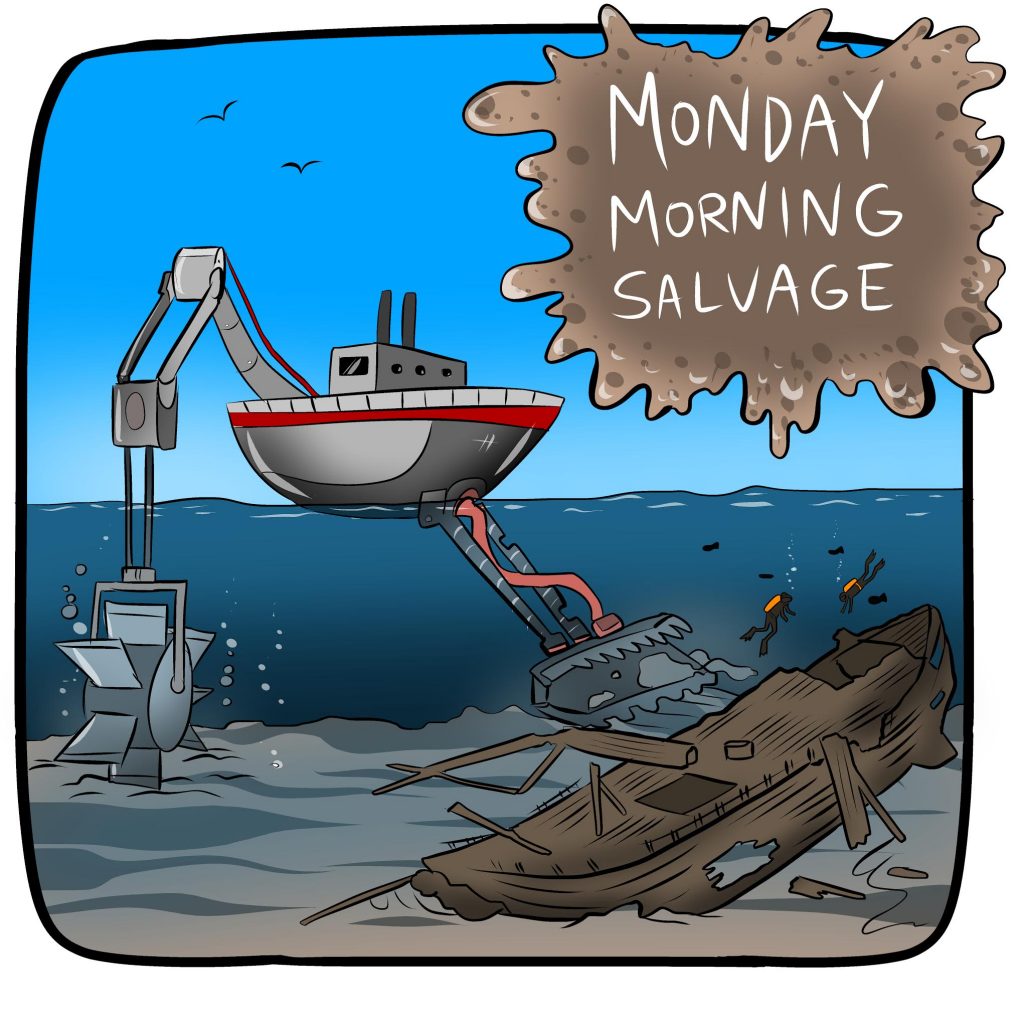
The hunt for Soviet submarines, a 5-foot-long shipworm, the impossibilities of deep-sea mining, and more! Massive Monday Morning Salvage: March 5, 2018.

Posted on March 5, 2018March 4, 2018 By Andrew Thaler
Weekly Salvage

Foghorn (A Call to Action!)

  • Subscribe to the Chesapeake Bay Journal (it’s free)! The venerable grey lady of the Bay survived the EPA’s attempt to defund them. Consider sending a few dollars to the journal, too. If you’re filing MD taxes this year, you can earmark some of you return to Chesapeake Bay programs.

Flotsam (what we’re obsessed with right now)

  • The secret on the ocean floor: the wild, weird origin of the modern deep-sea mining industry, complete with spies, Soviet submarines, and Howard Hughes. How much is real? How much is emergent from this first fake venture? If you only read one thing about deep-sea mining, read this.

We really misled a lot of people and it’s surprising that the story held together for so long”

source.

  • As biodiversity declines, so does public attention. We need to push back against this trend.
  • After Centuries of Searching, Scientists Finally Find the Mysterious Giant Shipworm Alive!

Read More “The hunt for Soviet submarines, a 5-foot-long shipworm, the impossibilities of deep-sea mining, and more! Massive Monday Morning Salvage: March 5, 2018.” »

Floridian flamingos and fishing in the twilight zone: Thursday Afternoon Dredging, March 1st, 2018

Posted on March 1, 2018 By David Shiffman
Uncategorized

Cuttings (short and sweet):  Follow Kristina Tietjen, a marine conservation biologist working in Kiribati, on twitter! A case for wild flamingos calling Florida their home. By Joann Klein, for the New York Times. The underwater damage left behind by hurricanes. From NPR’s Weekend Edition. Even corals have microbiomes. By Jason Goldman, for Hakai. Life of an albatross. … Read More “Floridian flamingos and fishing in the twilight zone: Thursday Afternoon Dredging, March 1st, 2018” »

Have you heard the good news about shark populations? Shark population increases are cause for #OceanOptimism

Posted on February 28, 2018February 28, 2018 By David Shiffman
Conservation, Science

Did you know that some shark populations have declined due to overfishing? Did you know that some once-declined shark populations have recovered? If you’re like my twitter followers, it’s likely that you’ve heard the bad news, but have not heard the good news.

Why does this matter?
It’s important to share bad news so that people know there’s a problem, and that we need to act to solve that problem. However, it’s also important to share good news so that people know that a problem is solvable! This idea was behind the birth of the #OceanOptimism online outreach campaign.

Read More “Have you heard the good news about shark populations? Shark population increases are cause for #OceanOptimism” »

Intertidal spiders and starfish night vision: Thursday Afternoon Dredging, February 22nd, 2018

Posted on February 22, 2018February 22, 2018 By David Shiffman
Uncategorized

Cuttings (short and sweet):  Follow Jessica Meeuwig, the Director of the UWA Centre for Marine Futures, on twitter. Check out #WowScienceFact, a science communication hashtag game that I started!  Ocean tides could have driven ancient fish to walk. By Alexandra Witze, for Nature News. Spoils (long reads and deep dives): Webs under water: the bizarre lives … Read More “Intertidal spiders and starfish night vision: Thursday Afternoon Dredging, February 22nd, 2018” »

Open Science in Africa, defend the ADA, the value of the outdoors, Minke whale rides, and more! Monday Morning Salvage: February 19, 2018.

Posted on February 19, 2018February 19, 2018 By Andrew Thaler
Weekly Salvage

Foghorn (A Call to Action!)

  • Sign up for AfricaOSH: The Africa Open Science Hardware Gathering and meet some of the most incredible, innovative technologists in the world!
  • Remember when the disability community put their bodies on the line to defend the Affordable Care Act? Remember the videos of people in wheelchairs being handcuffed outside Mitch McConnell’s office? Last week, the House voted to gut the Americans with Disabilities Act. There’s no bill in the Senate yet, but the time to mobilize is now. Call your Senators and defend the ADA.

Flotsam (what we’re obsessed with right now)

  • In the annuals of obvious thing that still need to be said: protecting wild places is better for Americans and better for the economy than strip mining them. Outdoor Recreation Is a Bigger Economic Booster Than Mining.
  • The Cousteau Society shares a great little clip of all the great Cousteau tech.

Read More “Open Science in Africa, defend the ADA, the value of the outdoors, Minke whale rides, and more! Monday Morning Salvage: February 19, 2018.” »

A precautionary approach to health and safety while using awesome, awesome laser cutters in the home.

Posted on February 15, 2018March 11, 2018 By Andrew Thaler
Uncategorized

Holy Mola, Laser Cutters! If you follow me on Instagram, you’ve probably seem some pretty cool projects coming out of my freshly arrived Glowforge laser cutter.

But laser cutters are not all sunshine and cool, wooden hinges. Laser cutters were, until very recently, the domain of industrial fabrication shops with extensive safety systems. As a new generation of low(er) cost, hobby and household cutters enter the market, we need to step back an think critically about the potential health and safety impacts of these incredible machines.

Like I did with 3D printers a few years back, I’m taking a deep dive into the hazards of laser cutters in the home and how to avoid them.

First, the issues of least concern (not because they aren’t bad, just that they’re far less likely to occur).

Fire. Lots of materials can catch fire, including, to no one’s surprise, wood. A fire safety plan will go a long way, but you can avoid ruining your laser cutter by being aware of what materials frequently catch fire. ABS, HDPE, polystyrene and polypropylene, and anything with poor thermal properties is going to ignite rather than cut cleanly. And then you’re going to have a bad day.

Beam escape. If your machine is not well taken care of and well shielded, there’s a small chance the wrong materials or loose connections can result in a beam escape, which can injure the user, bystanders, pets, or anything else that gets in the laser’s path. Most hobby grade lasers have good safety features to prevent this (although cheap knock-off machines are starting to hit the markets that may not be up to par), but monitoring you equipment and keeping it properly maintained will go a long way to avoiding this.

But those aren’t the biggest concerns. Th biggest concern with laser cutters is the byproduct that happens every time you cut, no mater what. That’s right, I’m talking about:

Fumes! 

This is the big one and the issue that I’m most concerned about. Laser cutters haven’t really left industrial settings until now, so we don’t have very good data on chronic exposures of laser cutting fumes, especially on young children and pregnant people. What we do know is that the fumes produced by laser cutter depend heavily on the materials you choose to cut.

All materials will produce fumes when cut, which is why it’s essential that your set-up is well-ventilated. Most hobby cutters have a vent port that you can connect to a dryer vent or to the outside. I actually don’t recommend using a dryer vent. In all the rental houses I’ve lived in, not one has ever had the dryer properly vented, and hooking up to your dryer port might mean that you’re just venting into the crawlspace or the wall, rather than out of you house. Go for the window. There’s no hard and fast rule for how much ventilation you need, other than as much as possible. For 3D printers we recommended that your ventilation system moves 3 times as much air as the volume of the room per hour. For laser cutters, it should probably be more.

Everything you cut is going to release volatile organic compounds (VOCs), which is why ventilation is essential. For things like hardwoods and paper products, the VOCs released are comparable to a woodburning stove, frying too much bacon, or sitting around a campfire (though sitting around a campfire will give you a much higher dose). Prolonged exposure can cause respiratory problems and asthma. More complex materials like plywoods and plastics can have some pretty nasty compounds, so you want to make absolutely sure you know what’s going into your laser cutter, be aware of what materials should never, ever go into you household cutter, and always ventilate, ventilate, ventilate.

Read More “A precautionary approach to health and safety while using awesome, awesome laser cutters in the home.” »

Walking fish and microbe warfare: Thursday Afternoon Dredging, February 15, 2018

Posted on February 15, 2018 By David Shiffman
Uncategorized

Cuttings (short and sweet):  Follow Katelyn Heman, a marine conservation biologist working at the Georgia Aquarium, on twitter! What this walking fish can teach us about evolution. By Sarah Gibbens, for National Geographic Fish forego sleep thanks to this molecule in their brain. From Nature’s Animal Behavior news. Microplastics pollute even the most remote parts of … Read More “Walking fish and microbe warfare: Thursday Afternoon Dredging, February 15, 2018” »

Posts pagination

Previous 1 … 47 48 49 … 273 Next

Popular Posts

The story of the pride flag made from NASA imagery: Bluesky's most-liked imageThe story of the pride flag made from NASA imagery: Bluesky's most-liked imageSeptember 27, 2024David Shiffman
"Why Sustainable Seafood Matters" is now available for preorder! Here's what it's about, and why I decided to write it."Why Sustainable Seafood Matters" is now available for preorder! Here's what it's about, and why I decided to write it.June 8, 2026David Shiffman
What Ocean Ramsey does is not shark science or conservation: some brief thoughts on "the Shark Whisperer" documentaryWhat Ocean Ramsey does is not shark science or conservation: some brief thoughts on "the Shark Whisperer" documentaryJuly 2, 2025David Shiffman
Tackling the least important debate in deep-sea mining: the desultory hyphenTackling the least important debate in deep-sea mining: the desultory hyphenJune 8, 2026Andrew Thaler
Shark of Darkness: Wrath of Submarine is a fake documentaryShark of Darkness: Wrath of Submarine is a fake documentaryAugust 10, 2014Michelle Jewell
Deep-sea Mining, Domestic Cats, Star Trek, and Ocean Exploration: Andrew's mid-year podcast round-up.Deep-sea Mining, Domestic Cats, Star Trek, and Ocean Exploration: Andrew's mid-year podcast round-up.June 6, 2026Andrew Thaler
What is a Sand Shark?What is a Sand Shark?November 12, 2017Chuck Bangley
I just told 850 shark scientists a hard truth: We’re not communicating shark conservation correctly.I just told 850 shark scientists a hard truth: We’re not communicating shark conservation correctly.June 1, 2026David Shiffman
That's not a blobfish: Deep Sea Social Media is Flooded by AI SlopThat's not a blobfish: Deep Sea Social Media is Flooded by AI SlopDecember 19, 2025Andrew Thaler
Why ocean science is still one of the worst-funded scientific fields worldwideWhy ocean science is still one of the worst-funded scientific fields worldwideJune 3, 2026Chris Parsons

squishy

Subscribe to our RSS Feed for updates whenever new articles are published.

We recommend Feedly for RSS management. It's like Google Reader, except it still exists.

Southern Fried Science

  • Home
  • About SFS
  • Authors
  • Support SFS


If you enjoy Southern Fried Science, consider contributing to our Patreon campaign.

Copyright © 2026 Southern Fried Science.

Theme: Oceanly Premium by ScriptsTown