
Skip to content

Southern Fried Science

Over 15 years of ocean science and conservation online

  • Home
  • About SFS
  • Authors
  • Support SFS

Recent Posts

Here’s how to join my IMCC8 symposium, “Ocean Science Communication: What’s New and What’s Next?”
April 22, 2026
Deep Sea Mining Symposium Announcement
April 21, 2026
Join Me at Upwell: A Wave of Ocean Justice — Our Fourth Year!
March 24, 2026
How close did the world’s first deep-sea mining come to the dredging the world’s largest cold-water coral reef?
March 17, 2026
Here are some ocean conservation technologies that I’m excited about
February 19, 2026
Walking Backwards Into the Future: Applying Indigenous Knowledge to Deep Sea Mining
February 5, 2026

From Sea and Sky: Hacking the Chesapeake with #BayBots

Posted on April 27, 2015April 29, 2015 By Andrew Thaler
Conservation, Science

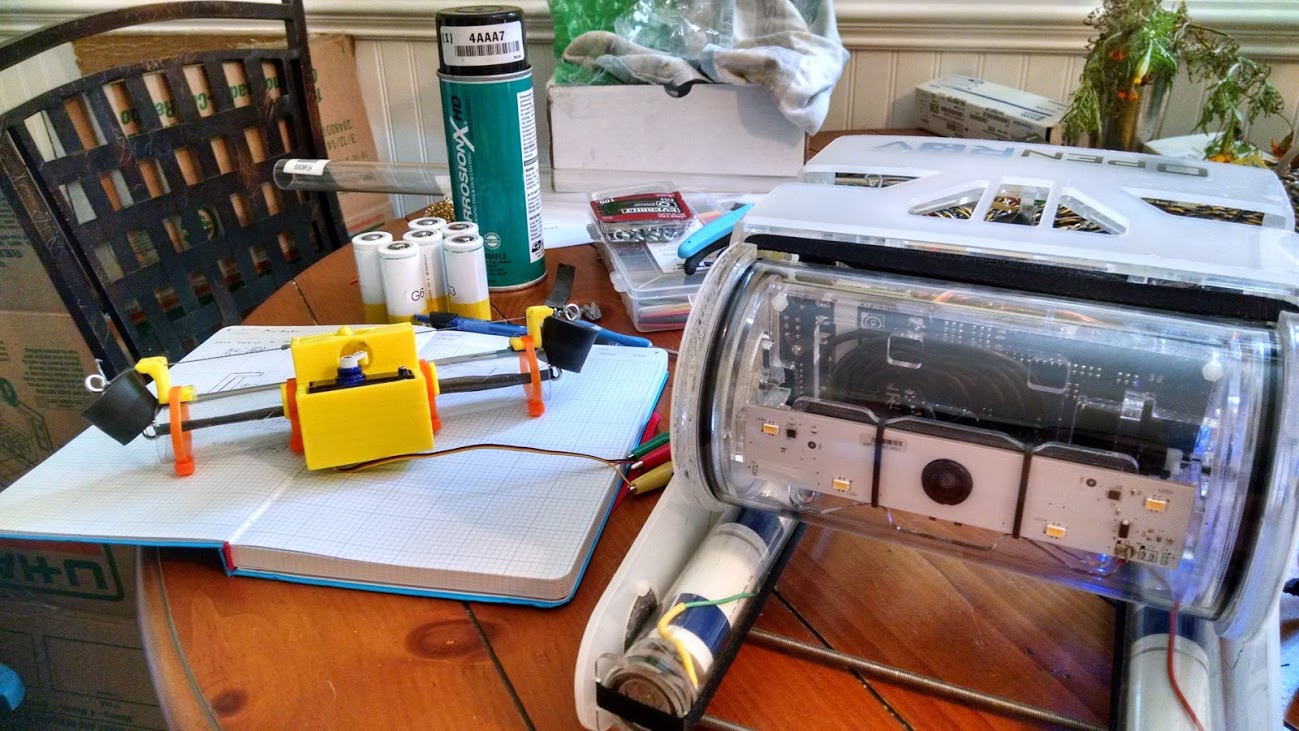
IMG_20150417_180905259 (2)Two years ago, I moved to San Francisco. It was… an experience. I had the opportunity to meet some incredible technologists, leaders in the emerging world of citizen exploration, and developers, coders, and makers using their skills and expertise to help save the environment. I met some amazing drone builders developing platforms and tools to measure the world. I also learned that West Coast living was not for me. The southern Atlantic coast called me back. But before I left, I led a small team across the Pacific to Papua New Guinea, where we taught undergraduates from the University of Papua New Guinea and the University of the South Pacific how to build and operate OpenROVs and incorporate them into marine ecology research.

The West Coast was good to me. It helped refine my vision for bringing low-cost, open-source technologies into the marine science and conservation world. Citizen science is becoming increasingly important, and the need for both democratizing and decolonizing science will drive much of the evolution of the scientific community in the 21st century. Tools that are effective, cheap, and open-source will play a major role in this transition. I returned east and began planning the next phase of this vision.

The Chesapeake Bay (San Franciscans take heed, you can keep your “Area” but “The Bay” will always be the Chesapeake) is the largest estuary in the United States, is economically important for shipping, fisheries, and tourism, and also happens to be the body of water that I grew up on. I learned to swim, fish, sail, and motor in one of the Bay’s many tributaries. It’s also home to more than a dozen research institutes, which work, sometimes in coordination and sometimes not, on studying and protecting the Bay.

Read More “From Sea and Sky: Hacking the Chesapeake with #BayBots” »

Fun Science FRIEDay – Snap, Crack, Pop

Posted on April 24, 2015April 17, 2015 By Kersey Sturdivant
Uncategorized

You’ve been there before. You are sitting or standing around and get a mental sensation that you need to “pop your knuckles”.  A swift squeeze of your fingers and the tension is relieved. Crisis averted. But why do knuckles make that popping sound when you crack them? If questions like this keep you up at night… maybe you need to reevaluate your priorities. But, if the start of this article has piqued your interest, you will be pleased to know that a a team of researchers, led by the University of Alberta Faculty of Rehabilitation Medicine, have confirmed the reasons for knuckle popping.

Pull My Finger experiment.  The radiofrequency coil inside the clear housing (left). The metocarpophaangeal (MCP) joint of interest centred over the bore of the radiofrequency coil (middle). The participant’s hand within the imaging magnet (right).  (Photo credit: Kawchuck et al. 2015, PLoS ONE)
Pull My Finger experiment. The radiofrequency coil inside the clear housing (left).
The metocarpophaangeal (MCP) joint of interest centred over the bore of the radiofrequency coil (middle). The participant’s hand within the imaging magnet (right). (Photo credit: Kawchuck et al. 2015, PLoS ONE)

Read More “Fun Science FRIEDay – Snap, Crack, Pop” »

What happens when we punch a hole in the seafloor?

Posted on April 23, 2015April 24, 2015 By Andrew Thaler 1 Comment on What happens when we punch a hole in the seafloor?
Science

Fig 3. Temporal sequence of landscape at/around Hole D/E. From Nakajima et al. 2015.

A longtime submariner I know tells the story of a most unusual dive. On this particular plunge, they went down into the briny deep to place what can best be described as a giant manhole cover on the seafloor. There was a hole, and, by all accounts, the sea was draining in to it.

For more than half-a-century, we’ve been drilling holes in the bottom of the sea. Some reveal the buried history of the evolution of our oceans. Others uncover vast wells of crude oil. Science, exploration, and exploitation have all benefited from ocean drilling programs. But what happens to the seafloor when you punch a hole in the ocean? In my friend’s case, the drilling program opened a sub-sea cavern, resulting in changes to local current regimes, potentially disturbing the surrounding benthic community. The most practical solution was to simply plug the hole.

We’ve punched a lot of holes in the seafloor, but despite a few anecdotes and scant research, we know precious little about how these holes actually alter the marine environment. This is particularly worrying, as deep-sea mining at hydrothermal vents, manganese nodule fields, and oceanic crusts are slowly creeping out of the realm of science fiction and into our oceans. Ocean drilling in the deep sea is perhaps the closest analog to industrial-scale deep-sea mining. Understanding the potential impacts is critical to designing management and mitigation regimes that protect the delicate deep seafloor.

Read More “What happens when we punch a hole in the seafloor?” »

This is the worst academic presentation in the world … tribute

Posted on April 23, 2015 By Chris Parsons
Uncategorized

Conference season is fast approaching, and around the hallowed halls of academia frantic graduate students are rushing around trying to cat herd committee members for thesis drafts and preparing the capstone to all of their recent study and research: the thesis defense. For the past two weeks my life has largely been back to back student presentations, and on the whole they were excellent. a couple of moments when nerves got the better of presenters, but generally high quality.

Then I went to an academic meeting, and I was reminded again why we are struggling to communicate environmental issues to the general public. I had forgotten quite how excruciatingly dull and painfully constructed academic presentations can be.

The presenters were completely unaware of the effect of their talks on the audience, who were checking email, napping and in one case just staring blankly at a wall, which was obviously more entertaining than the presentation at hand.

It really was a master class in how to ensure that your presentation was as dull, dense, and obtuse as possible. So for the benefit of those who what to ensure that they can give the most perfectly dull academic presentation, here are some tips:

Read More “This is the worst academic presentation in the world … tribute” »

You say you need to incorporate the social sciences? Which kind?

Posted on April 22, 2015 By Bluegrass Blue Crab 2 Comments on You say you need to incorporate the social sciences? Which kind?
Conservation, Science

This post in the second of a series entitled “The Basics of the Human Dimensions”, which gives the most basic tips for how to work with social scientists and social questions in marine conservation efforts. Whether you are the stakeholder, the collaborating natural scientist, or both, this series will hopefully make the journey into the human dimensions easier. 

A common adage in fisheries management is that “you’re managing the fishermen, not the fish” – and this is emblematic of many conservation issues. Conservation efforts rely upon good information (which also requires diverse inputs, but that’s a story for another day) but perhaps most importantly, understanding how decision-makers will use that information and how communities will integrate that information into their daily practices. Conservation is a lived experience, not theory in a textbook.

As a response to an awakening in the ecological sciences to this paradigm, there are frequent calls for integrating the social sciences into their analyses. A program within the National Science Foundation directs research dollars to “Coupled Human and Natural Systems”, the Resilience Alliance is pushing the theory of socioecological systems, and out of geologists comes the term “anthropocene” – all efforts to formally incorporate social scientists into traditionally natural science research efforts. But not all social sciences are created equal. Which one you need depends upon your subject matter, but also the kind of data that will mesh best with your natural science methods. Here’s a quick review of the disciplinary divides within the social scientist, so you have an idea of who best to reach out to in putting together your next proposal:

Read More “You say you need to incorporate the social sciences? Which kind?” »

Fun Science FRIEDay – The Moby Dick of Sperm Whale Encounters

Posted on April 17, 2015 By Kersey Sturdivant
Uncategorized

Happy FSF Folks!

So this news has been making the rounds, and it is too amazing not to include for FSF. So if you missed it, you are in luck because we highlight it again here. A giant sperm whale was captured by a remotely operated vehicle (ROV) piloted as part of Bob Ballard and the Corps of Exploration’s Nautilus cruise. The whale was captured by the ROV Hercules at 598 meter (1,962 ft) below the sea surface in the Gulf of Mexico off the coast of Louisiana.

Sperm whale captured at 598 meter (1,962 ft) depth by the ROV Hercules. (Photo Credit: Ocean Exploration Trust)

Read More “Fun Science FRIEDay – The Moby Dick of Sperm Whale Encounters” »

Watch James Cameron’s Deepsea Challenge and tweet along with us Tuesday at 8 p.m.!

Posted on April 13, 2015 By David Shiffman 1 Comment on Watch James Cameron’s Deepsea Challenge and tweet along with us Tuesday at 8 p.m.!
Blogging

There are still a couple of days left to donate to the most important marine science and outreach crowdfunding campaign of our time, “buy David Shiffman a less ugly pair of sunglasses.” In the meantime, new rewards have been unlocked! For a $30 donation, you’ll receive a small 3D printed megalodon tooth, one of the first of … Read More “Watch James Cameron’s Deepsea Challenge and tweet along with us Tuesday at 8 p.m.!” »

Become a Citizen Scientist with SharkBase

Posted on April 13, 2015 By Guest Writer
Science

KempDr. Ryan Kempster is a shark biologist in the Neuroecology Group at the University of Western Australia.  Ryan founded the shark conservation group Support Our Sharks to inform the world about the plight of the most vulnerable shark species. His research focuses on the sensory biology and conservation of sharks and rays.  Sharks have always been his passion, and protecting them his goal.  To do this, Ryan has embarked on a career in research to better understand sharks. He takes every opportunity to communicate his findings to the general public in the hope that he can inspire others to follow in his passion for protecting these amazing animals.

Effective management of sharks starts with an understanding of their population status, which ultimately instructs their future conservation. Unfortunately, many shark species are at significant risk of unrecoverable decline, with some species having declined to near extinction in recent years. We believe that Citizen Science could hold the key to improving our understanding and management of shark populations, whilst also advancing community education. This is why we have developed SharkBase, a global shark encounter database helping to map the distribution and population structure of sharks worldwide (you can also record ray and skate sightings).

Read More “Become a Citizen Scientist with SharkBase” »

How a 10 Million Year old fossil, a smart phone, and a 3D printer recharged my #OceanOptimism.

Posted on April 10, 2015 By Andrew Thaler
Popular Culture, Science

3dtootLast week, we launched a novel little experiment in crowdfunding marine science and conservation – Buy David Shiffman a Less Ugly Pair of Sunglasses – ostensibly about replacing David’s legendarily hideous sunglasses with something a bit more aesthetic. Of course, anyone digging into the stretch goals quickly realized that this was less about sunglasses and more about funding some cool research and outreach projects we’re currently working on; projects like a hammerhead conservation genetics analysis, building a marine ecology drone, and sending students from underserved schools of a shark tagging trip. This was made more explicit when we hit our first goal in the first 36 hours of funding.

With the first funding goal achieved, I decided we needed a cool perk, something not particularly expensive to produce but completely novel and cool enough to justify making a heftier donation. And, of course, it needed to be thematically related to the spirit of the project.

Enter the Megalodon.

Read More “How a 10 Million Year old fossil, a smart phone, and a 3D printer recharged my #OceanOptimism.” »

Science Flyers: My comment to the FAA regarding proposed new drone regulations.

Posted on April 8, 2015April 8, 2015 By Andrew Thaler
Science

I submitted the following to the FAA regarding docket number FAA-2015-0150: Operation and Certification of Small Unmanned Aircraft Systems. Comments can be filed online, but I also sent an actual, physical letter. If you care about the regulation of drone in US airspace, you have until April 24, 2015 to submit you own.


I am a marine ecologist based in Virginia, with plans to operate small Unmanned Aircraft Systems in the conduct of marine ecologic research.

With regards to the FAA’s recently proposed regulations for the Operation and Certification of Small Unmanned Aircraft Systems, I find that the vast majority of suggested restrictions and requirements to be both reasonable and not particularly onerous for those wishing to operate UAS’s for commercial purposes. I commend the FAA for taking a pragmatic approach to UAS regulation. In particular, I support the requirement for a comprehensive knowledge test, which will be separate from and less expensive than a full pilot’s license. I also appreciate the recognition that UAS technology is advancing so quickly that a certification of airworthiness for specific airframes will place an undue burden on commercial pilots and force them to operate vehicles several generation behind the state of the art. I also approve of a special exemption for “microdrones”, which have significantly a lower safety risk and allow UAS pilots additional freedom in their use of very small vehicles.

I approve of the requirement that operators maintain visual line-of-sight, however, in the proposed regulations, there are make no provisions for autonomous flight. Autonomous flight dramatically changes the relationship between the aircraft and the operator and is an essential component of ecological surveys, allowing drones to fly straight transects and pinpoint sampling sites. This points to a more specific problem with the proposed regulations: in current form, there is little clarity regarding the role of scientists and other researcher in relation to UAS use. Will ecologists fall under the same restrictions as commercial drone pilots, or will they be treated more similar to hobbyist?

I urge the FAA to adopt a “Science Flyer” certification, similar to the American Association of Underwater Scientists “Science Diver” program. To wit, science divers have enhanced training requirements over recreational SCUBA divers, but less than professional commercial divers. A Science Flyer program could span a similar gap, with more training requirements than a hobbyist but fewer restrictions than a commercial UAS operator and could also provide additional training and certification to allow for autonomous operation.

Read More “Science Flyers: My comment to the FAA regarding proposed new drone regulations.” »

Posts pagination

Previous 1 … 92 93 94 … 272 Next

Popular Posts

Playing God - How the ESA "God Squad" just voted for the extinction of a uniquely American whalePlaying God - How the ESA "God Squad" just voted for the extinction of a uniquely American whaleApril 9, 2026Southern Fried Science
The story of the pride flag made from NASA imagery: Bluesky's most-liked imageThe story of the pride flag made from NASA imagery: Bluesky's most-liked imageSeptember 27, 2024David Shiffman
What Ocean Ramsey does is not shark science or conservation: some brief thoughts on "the Shark Whisperer" documentaryWhat Ocean Ramsey does is not shark science or conservation: some brief thoughts on "the Shark Whisperer" documentaryJuly 2, 2025David Shiffman
Here's how to join my IMCC8 symposium, "Ocean Science Communication: What's New and What's Next?"Here's how to join my IMCC8 symposium, "Ocean Science Communication: What's New and What's Next?"April 22, 2026David Shiffman
Our favorite sea monsters – Ningen (#4)Our favorite sea monsters – Ningen (#4)September 7, 2010Andrew Thaler
Shark of Darkness: Wrath of Submarine is a fake documentaryShark of Darkness: Wrath of Submarine is a fake documentaryAugust 10, 2014Michelle Jewell
Join Me at Upwell: A Wave of Ocean Justice — Our Fourth Year!Join Me at Upwell: A Wave of Ocean Justice — Our Fourth Year!March 24, 2026Angelo Villagomez
On the clarity of animals: the art and science of clearing and stainingOn the clarity of animals: the art and science of clearing and stainingDecember 17, 2013Guest Writer
That's not a blobfish: Deep Sea Social Media is Flooded by AI SlopThat's not a blobfish: Deep Sea Social Media is Flooded by AI SlopDecember 19, 2025Andrew Thaler
What can the funniest shark memes on the internetz teach us about ocean science and conservation?What can the funniest shark memes on the internetz teach us about ocean science and conservation?November 8, 2013David Shiffman

squishy

Subscribe to our RSS Feed for updates whenever new articles are published.

We recommend Feedly for RSS management. It's like Google Reader, except it still exists.

Southern Fried Science

  • Home
  • About SFS
  • Authors
  • Support SFS


If you enjoy Southern Fried Science, consider contributing to our Patreon campaign.

Copyright © 2026 Southern Fried Science.

Theme: Oceanly Premium by ScriptsTown