Skip to content

Southern Fried Science

Over 15 years of ocean science and conservation online

  • Home
  • About SFS
  • Authors
  • Support SFS

Recent Posts

humpback whale in Antarctica
The evolution of the International Whaling Commission – from  whaling quotas to whale conservation
June 10, 2026
Isn’t ironic, don’t you think: dismantling the Ocean Observatories Initiative on World Oceans Day
June 9, 2026
“Why Sustainable Seafood Matters” is now available for preorder! Here’s what it’s about, and why I decided to write it.
June 8, 2026
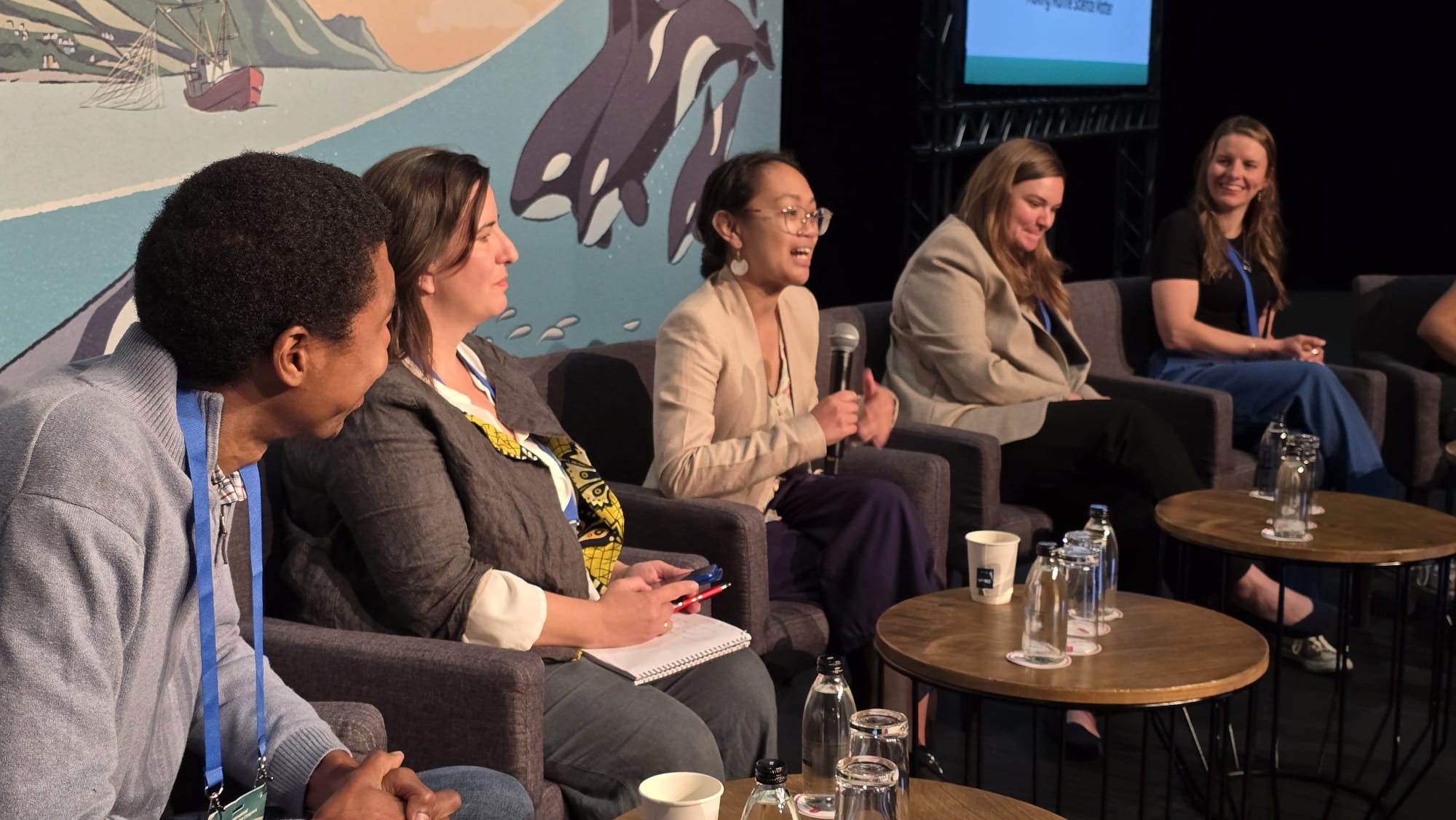
Here’s how to join my IMCC8 symposium, “Ocean Science Communication: What’s New and What’s Next?”
April 22, 2026
Deep Sea Mining Symposium Announcement
April 21, 2026
Join Me at Upwell: A Wave of Ocean Justice — Our Fourth Year!
March 24, 2026

How will the FAA’s proposed rules impact drone use for research and conservation?

Posted on February 16, 2015 By Andrew Thaler
Conservation

This weekend, the FAA released its proposed rules regulating the use of small Unmanned Aircraft Systems (drones). Today, I worked through the full, 200-page document, so that you don’t have to. These regulations, which are 3 years in the making and soon to be open for public comment, would determine who could fly, what licensing is required, and what limits would be imposed on drone flights. The regulations are pretty fair and leave open plenty of room for amateur enthusiasts while charting a way forward for commercial operators, but there are some glaring oversights and some unnecessary (and ineffective) security steps. I’ve written extensively on the used of drones for marine science, so my big question is: How will these rules impact drone use for research and conservation?
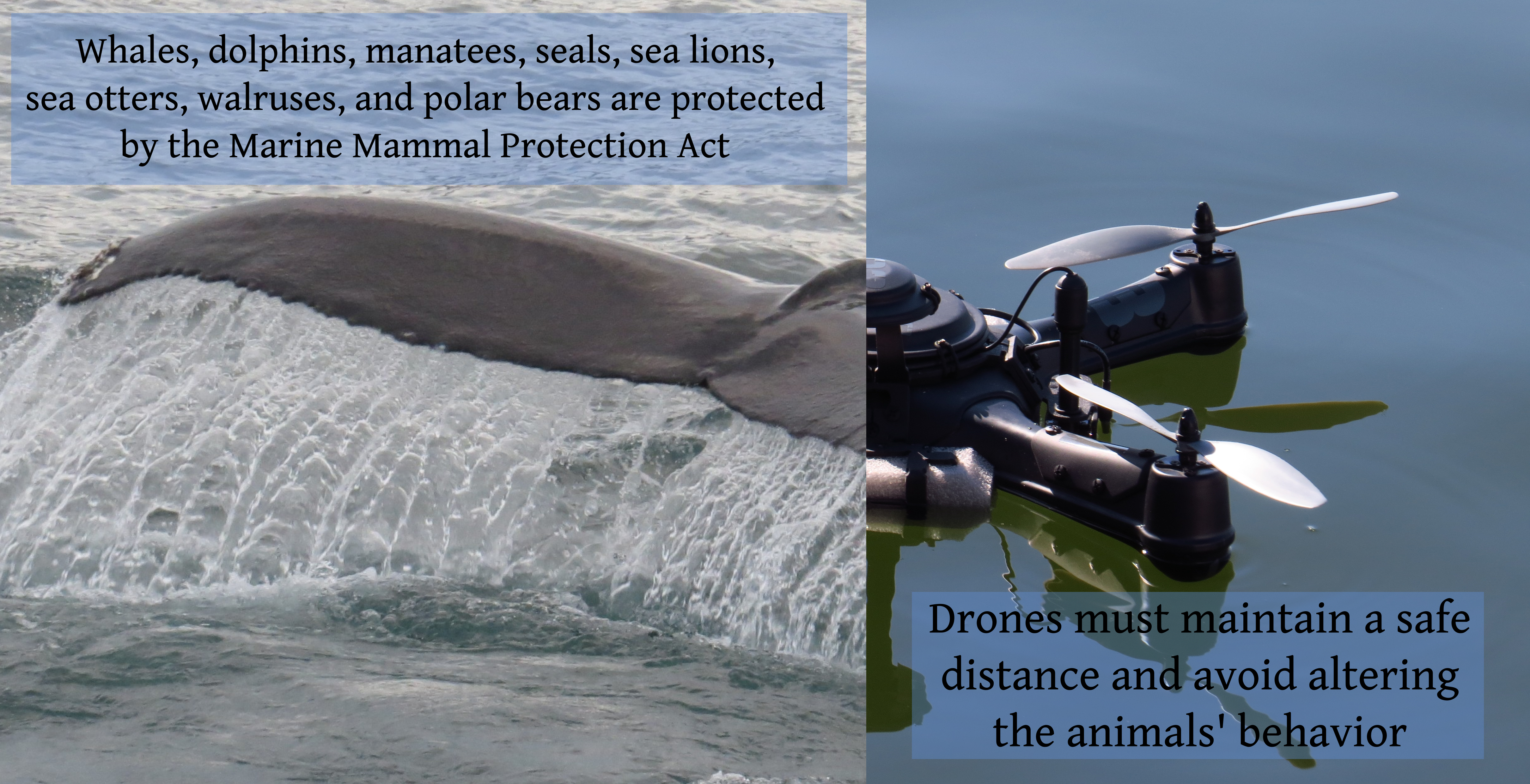
How many times are you going to use this image, Andrew?

Before I get into specific research and conservation applications, here is my general impression of this proposal. Overall, I think it’s good. Most of the suggestions are reasonable and not unnecessarily onerous. I particularly like that there could be a special exemption for microdrones, so your tiny Hubsan x4 wouldn’t be treated like the massive and mighty Aerotestra IVAN. I’m a big proponent of ensuring drone operators have the proper knowledge base, so I actually like the requirement for a comprehensive knowledge test, which will be separate from and less expensive than a full pilot’s license. I like that there’s no requirement to certify the “airworthiness” of drones as if they were 6000+ pound aircraft (the certification process take 3 to 5 years and drone tech moves so fast that by the time one was certified, it would be several generations obsolete).

Read More “How will the FAA’s proposed rules impact drone use for research and conservation?” »
To co-author or not to co-author?

Posted on February 13, 2015February 14, 2015 By Chris Parsons
Uncategorized

Writing an academic paper with multiple authors can be problematic at times (for examples see this article and comments on the article), but when do you even make people a co-author?

There are problems across scientific fields with co-authors being added who did not contribute significantly to papers, for example heads of labs or departments, or prestigious individuals (so- called “honorary authors”). Some laboratories even have a policy of adding everyone in the lab who even passed by a manuscript, in order to bulk out resumes.

Individuals who warrant co-authorship, but who are left off the publication (so called “ghost authors”)  are also an issue. One of the most common examples of this is when an ambitious faculty member leaves off a student who conducted majority of the work (or who possibly even came up with the idea) because they want first (or possibly sole) authorship for the paper so that they can further their academic career. In the biomedical field ghost authors are often pharmaceutical industry representatives who may rewrite sections of manuscripts to show their product in the best light, but exclude themselves from authorship and thus obfuscating conflicts of interest. Such conflicted ghost authors are not unique to the biomedical field though, and industry, military or governmental ghost authors have frequently been known to substantially rewrite (and change the conclusions of) marine environmental science papers, especially when they deal with controversial topics.

Read More “To co-author or not to co-author?” »

Fun Science FRIEDay – I can SEE what you’re thinking!

Posted on February 13, 2015February 6, 2015 By Kersey Sturdivant
Uncategorized

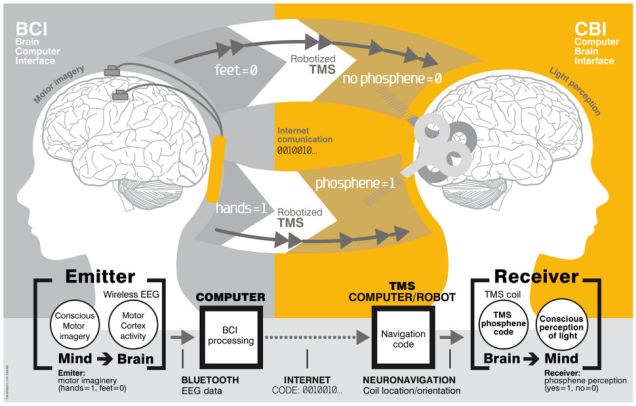
Humans are edging closer and closer to telepathic communication where one human communicates with another purely from thinking. Wait… what’s that you say? We are already there?! Like something out of a sci-fi thriller neuroscientists in Europe and America demonstrated the viability of direct brain-to-brain communications in humans.

"Brain-to-brain (B2B) communication system overview. On the left, the BCI subsystem is shown schematically, including electrodes over the motor cortex and the EEG amplifier/transmitter wireless box in the cap. Motor imagery of the feet codes the bit value 0, of the hands codes bit value 1. On the right, the CBI system is illustrated, highlighting the role of coil orientation for encoding the two bit values. Communication between the BCI and CBI components is mediated by the internet." (Photo credit: Grau et al. 2014)
“Brain-to-brain (B2B) communication system overview.
On the left, the BCI subsystem is shown schematically, including electrodes over the motor cortex and the EEG amplifier/transmitter wireless box in the cap. Motor imagery of the feet codes the bit value 0, of the hands codes bit value 1. On the right, the CBI system is illustrated, highlighting the role of coil orientation for encoding the two bit values. Communication between the BCI and CBI components is mediated by the internet.” (Photo credit: Grau et al. 2014)

Read More “Fun Science FRIEDay – I can SEE what you’re thinking!” »

Bioshock Oceanographic: How deep is Rapture?

Posted on February 11, 2015February 17, 2015 By Andrew Thaler 5 Comments on Bioshock Oceanographic: How deep is Rapture?
Popular Culture, Science

“To build a city at the bottom of the sea! Insanity. But where else could we be free from the clutching hand of the Parasites? Where else could we build an economy that they would not try to control, a society that they would not try to destroy? It was not impossible to build Rapture at the bottom of the sea. It was impossible to build it anywhere else.”

Andrew Ryan, Bioshock

Rapture, a city beneath the sea, the crowning achievement of Randian industrialist Andrew Ryan. This atmospheric world of technological wonder and urban decay serves as the setting for one of the greatest video games of all time, Bioshock. The player, finding themselves stranded at sea in a fiery plane crash, makes their way towards a lonely lighthouse, descends into the sunken, desolate city, and unlocks the mysteries surrounding the creation and destruction of a most unusual city.

Rapture. From Bioshock.

Though many questions are answered as the player journeys into the heart of Rapture, collecting audio diaries of its residents along the way, one question still eludes: How deep is Rapture and where, exactly, is it?

Read More “Bioshock Oceanographic: How deep is Rapture?” »

Fun Science FRIEDay – Those Genes Look Tasty

Posted on February 6, 2015February 6, 2015 By Kersey Sturdivant
Uncategorized

In a very basic sense there is a general dichotomy in the grouping of organisms on this planet as either a plant or as an animal. Myself, like most of the rest of you, belong to the animal group, but there are those organisms out there that exists on the boundary; one in particular is the sea slug, Elysia chlorotica.


The sea slug Elysia chlorotica (Photo credit: Patrick Krug)

Read More “Fun Science FRIEDay – Those Genes Look Tasty” »

Happy Fun Science FRIEDay – Change you DNA… One Step at a Time!

Posted on January 31, 2015 By Kersey Sturdivant
Science

It’s around about this time of year when people begin to question their New Year’s resolutions to commit to better health. You know what I am talking about. Right after NYE the number of people at the gym swells to an unholy number of hopeful fitness do-gooders. Yet without fail, by the end of the month the gym population begins to stabilize back to its pre New Year’s resolution numbers. But maybe, just maybe, this article will convince you to stick with your commitment to better health, change your DNA regarding your approach to fitness, and keep on exercising! Because exercise, as a new study has found, does just that. Exercise changes the shape and functioning of our genes, an important step on the way to improved health and fitness!

Photo credit: precisionnutrition.com

Read More “Happy Fun Science FRIEDay – Change you DNA… One Step at a Time!” »

Fun Science FRIEDay – Darwin Says Survival of the… empathetic?!

Posted on January 23, 2015 By Kersey Sturdivant
Blogging, Science

Dacher Keltner, professor of psychology and founding faculty director of the Greater Good Science Center at UC Berkeley has been pushing an idea – Humans are built to be good, because it aids in human survival.

Photo credit:  ThinkGeek @ shirtoid.com
Photo credit: Berkeley Social Interaction Lab, UC Berkley

Read More “Fun Science FRIEDay – Darwin Says Survival of the… empathetic?!” »

To dyke, or not to dyke: A debate coming to a town near you

Posted on January 23, 2015 By Michelle Jewell
#DrownYourTown, Conservation

Finally, President Obama’s state of the union called out Congress’s problem with climate change. Their denial is merely a symptom of overall scientific ignorance, a simply medieval issue that has temporarily stalled many great nations’ progress throughout history. Yet, President Obama’s points about climate change and it’s relevance to the nation gives one hope that there is a small smoldering ember of collaborative-driven leadership buried under piles of Benghazi reports, and it couldn’t come a moment too soon. The USA has stalled its scientific and technological growth at a key time in global history and is already generations behind the modern world in technological advancements to protect its people against a rising threat – the ocean.

Let me present you with a case study. I live in Zeeland in the Netherlands, and this area is protected by the world-famous Oosterschelde surge barrier; a 9km system of dams, movable concrete slabs, and artificial islands.  The Oosterschelde is one of many ocean barriers strategically placed along the Dutch coast and has been deemed one of the Seven Wonders of the Modern World by the American Society of Civil Engineers.  During storm events, the Oosterschelde’s massive concrete slabs shut and cut off Zeeland’s waterways from the surge of the North Sea.

By Nils van der Burg from Madrid, Spain (IMG_7446) [CC BY-SA 2.0 (http://creativecommons.org/licenses/by-sa/2.0)], via Wikimedia Commons
The Oosterschelde Delta Works – 9km long: By Nils van der Burg from Madrid, Spain (IMG_7446) [CC BY-SA 2.0 (http://creativecommons.org/licenses/by-sa/2.0)], via Wikimedia Commons

Read More “To dyke, or not to dyke: A debate coming to a town near you” »

Unhappy feet – why we need more than a day of penguin awareness

Posted on January 22, 2015February 13, 2015 By Chris Parsons 1 Comment on Unhappy feet – why we need more than a day of penguin awareness
Conservation, Science

A couple of days ago (20th January) was penguin awareness day1. But do we really need to be more aware of penguins?  Well, actually yes.

RSCN8435

 Photo by Chris Parsons

 We conducted a study a couple of years ago  (pdf also available) to look at public awareness of penguins (using university students as a sample) and found that nearly half (43%) of those questioned though that  penguins were protected under the US Endangered Species Act (ESA) and were thus listed as  “endangered.” At the time only one penguin was listed on the ESA (the Galapagos penguin, Spheniscus mendiculus). The IUCN currently classifies five species of penguin as “endangered” 2 and six as “vulnerable” 3. The biggest threat to penguins generally is, unsurprisingly, climate change. The chicks of Magellanic penguins (S. magellanicus) in Argentina have experienced increasing mortality because of increasing numbers and severity of storms, and will continue to experience mortality as these further increase, in addition to additional mortality  from increasing rainfall and temperatures. Changing patterns of sea ice cover are impacting Adelie penguin (Pygoscelis adeliae) foraging at Ross Island, Antarctica. In various locations in the Antarctic Penninsula in particular, Adelie colonies are expected to be impacted by warming temperatures and changes in sea ice with perhaps as many as 75% of colonies decreasing or declining. Although in some locales, melting ice has increased potential Adelie habitat.  Chinstrap colonies have been reported to be in decline as well, despite this being a more open water species, that was previously being thought of as potential benefactors from melting sea ice – penguin nest occupation on Deception Island declined by more than third between 2002/2003 and 2009/10. These chinstrap penguins are likely being impacted by declining krill stocks, as will their  Adelie penguin cousins, in addition to ice loss which so affects this latter species. Overall, across the Antarctic Pennisula, there has been a decline in both Adelie and chinstrap penguin numbers.

Read More “Unhappy feet – why we need more than a day of penguin awareness” »

Many scientists, conservationists and fishermen support our trophy fishing paper recommendations

Posted on January 21, 2015January 21, 2015 By David Shiffman
Science

Last month, a team of marine scientists (which included Andrew and I) published a paper pointing out that intentionally killing the largest and most fecund members of IUCN Red List Threatened species is not a good thing and could be easily stopped (by stopping record awards entirely for these species or moving to a catch and release model)

Our recommendations were not universally supported by scientists, and we received criticism from respected colleagues largely in the form of “this isn’t a particularly big problem, no serious people care about it.” There was also an official response from the IGFA to this effect, which we issued an official response to. Sure. It isn’t the biggest problem in the world, but it is a problem. And you’d be hard-pressed to find a conservation problem that’s easier to solve.

A petition created by the Blue Planet Society based on our recommendations has, as of this writing, surpassed 6,000 signatures from all over the world, including many from scientists, fisherman and professional conservation activists. The paper has also been widely discussed on social media

Presented here are some quotes from scientists, fishermen and conservationists supporting our recommendations. While this support does not inherently mean that the issues we raise are important, it certainly shows that lots of serious people care about it.

Read More “Many scientists, conservationists and fishermen support our trophy fishing paper recommendations” »

Posts pagination

Previous 1 … 96 97 98 … 273 Next

Popular Posts

That's not a blobfish: Deep Sea Social Media is Flooded by AI SlopThat's not a blobfish: Deep Sea Social Media is Flooded by AI SlopDecember 19, 2025Andrew Thaler
What Ocean Ramsey does is not shark science or conservation: some brief thoughts on "the Shark Whisperer" documentaryWhat Ocean Ramsey does is not shark science or conservation: some brief thoughts on "the Shark Whisperer" documentaryJuly 2, 2025David Shiffman
Screaming into the void - Why your scientific paper doesn’t matterScreaming into the void - Why your scientific paper doesn’t matterJune 18, 2026Chris Parsons
The story of the pride flag made from NASA imagery: Bluesky's most-liked imageThe story of the pride flag made from NASA imagery: Bluesky's most-liked imageSeptember 27, 2024David Shiffman
I can serve on your graduate thesis committee. Here’s what you can expect of me, and what I expect in return.I can serve on your graduate thesis committee. Here’s what you can expect of me, and what I expect in return.October 16, 2025David Shiffman
Shark of Darkness: Wrath of Submarine is a fake documentaryShark of Darkness: Wrath of Submarine is a fake documentaryAugust 10, 2014Michelle Jewell
What is a Sand Shark?What is a Sand Shark?November 12, 2017Chuck Bangley
The plague-busting, prairie-dog-vaccinating, ferret-saving droneThe plague-busting, prairie-dog-vaccinating, ferret-saving droneNovember 1, 2016Andrew Thaler
Our favorite sea monsters – Ningen (#4)Our favorite sea monsters – Ningen (#4)September 7, 2010Andrew Thaler
Fun facts and FAQs about Megalodon, Maryland's new (and definitely extinct) official state sharkFun facts and FAQs about Megalodon, Maryland's new (and definitely extinct) official state sharkApril 15, 2026David Shiffman

squishy

Subscribe to our RSS Feed for updates whenever new articles are published.

We recommend Feedly for RSS management. It's like Google Reader, except it still exists.

Southern Fried Science

  • Home
  • About SFS
  • Authors
  • Support SFS


If you enjoy Southern Fried Science, consider contributing to our Patreon campaign.

Copyright © 2026 Southern Fried Science.

Theme: Oceanly Premium by ScriptsTown