


While my illustrious co-blogger has taken over running the Donor’s Choose challenge for Southern Fried Science this year, I decided to take up a single, worthy project to focus on. One of the challenges with Donor’s Choose is that it’s hard to fund the most expensive projects. People like to see the results of their … Read More “What if you’ve never seen the ocean? Donor’s Choose Project – In Search of Marine Diversity” »
Uncategorized
The 2012 DonorsChoose Science Bloggers for Students Challenge is shaping up to be another big success! As of this morning, 132 people had donated a total of nearly $10,000 to help support science education in public schools, and Team Surf and Turf (Ocean and Geology Bloggers) is in the lead with over $3,000 donated. 14 Southern … Read More “DonorsChoose Update: Over $700 raised so far, 4 new projects added, 12 days to go!” »
Uncategorized
 Since the outing of one of reddit’s most notorious trolls last week, the internet has been buzzing with issues of anonymity, pseudonymity, and privacy. Joe Scalzi’s discussion of the larger issues of privacy is the best I’ve seen, so rather than rehash, I’ll just point you there. What I would like to do, is take a moment to review Southern Fried Science’s policy as it applies to our own community. We welcome both anonymous and pseudonymous commenters, and, of course, we post under pseudonyms (granted, our real identities are literally one click away). Our pseudonyms are a matter of convenience, consistency, and tradition, but we recognize that our commenters may have other reasons to use a pseudonym, including, but by no means limited to, protecting themselves from physical, social, and emotional harm as a result of voicing their opinions. Southern Fried Science strives to create a safe space for people to discuss science, politics, conservation, and any of a thousand issues related to our oceans, our planet, and our future.
Read More “Anonymity, Pseudonymity, and a Reasonable Expectation of Privacy” »
Science

Pharaoh Khufu must be rolling in his monumental grave. Since its construction in 2560 BC, the Great Pyramid of Giza stood as the largest man-made pyramid ever built*. For 3800 years, it held the title of the tallest man-made structure of any kind. It wasn’t until the Industrial Revolution that our buildings began dwarfing this wonder of the ancient world. Even still, the Great Pyramid is massive, with a volume of 2,580,000 cubic meters. But there is another pyramid, more massive than Giza, and it wasn’t built to entomb a mighty king. It’s not a monument of any kind. The largest (by volume) pyramid in the world resides in Alberta, Canada and it’s made entirely of sulfur.
Wait, what?
Read More “Alberta, Canada is the proud owner of the largest man-made pyramid on the planet” »
Uncategorized
I’m pleased to announce that Southern Fried Science has once again joined the DonorsChoose Science Bloggers for Students Challenge! For those of you unfamiliar with DonorsChoose, they are an online charity that allows public school teachers to describe projects, and allows anyone to donate to these projects. In the past, the Science Bloggers Challenge has … Read More “Help students in need with the DonorsChoose Science Bloggers Challenge!” »
Popular Culture, Science
I adore Here Comes Honey Boo Boo. That’s right, I said it. There’s a soft spot in my brittle old heart for that whole family, Sugar Bear, Mamma June, and all. Especially Glitzy.
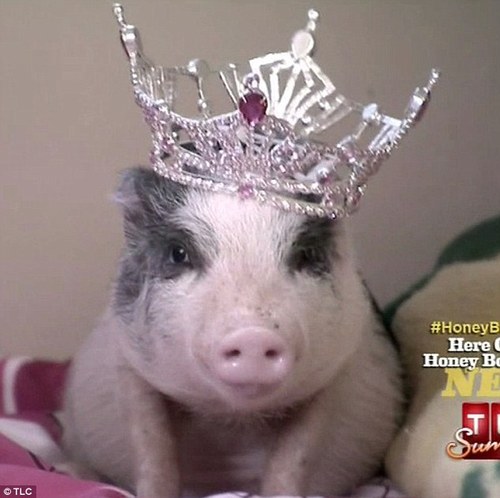
Glitzy, for those of you who don’t know, is a “Teacup” Pig (as you can tell from the video, pigs don’t like to be held). Pigs are cute. Piglets are super cute. Pigs are very intelligent, highly social, and make surprisingly good, house-trainable pets. Unfortunately, 800-lb hogs are not cute. Over the years, various breeders have tried to create pigs that retain all of the adorableness of a piglet without reaching the potential half ton plus mass of a full grown adult hog. Among the most popular “miniature” is the Vietnamese pot-bellied pig, a delightfully spry porcine that tops the scales at a manageable 300 pounds. When legitimate breeders talk about miniature pigs, they’re talking about these 300-lb cuties. Pot-bellied pigs are surprisingly diverse, and, although extremely rare, adults have been reported as small as 20 pounds (most breeders would regard an adult pig that size to be extremely malnourished). This huge size range prompted many breeders to attempt to create even smaller pig breeds, selecting from only the smallest stock. Enter the teacup pig.
A teacup pig (or a micro pig, nano pig, or any of a half dozen variations of “small”) is supposedly a tiny pig breed. Some breeders claim that their pigs only reach up to 30 pounds in weight. Combined with the intelligence and sociability that pigs possess, it would seem that teacup pigs should make a perfect pet. There is only one problem: there’s no such thing as a teacup pig.
Uncategorized
We’ve updated the ever-evolving, often changing comments policy and added a link to John Scalzi’s excellent “How to be a good commenter” article. As an experiment, I cleared the moderation queue giving previously banned commenters a second chance. Here is the current policy in its entirety: Commenters (including blog authors) are asked to adhere to the philosophy … Read More “Brief Blog Notice: Changes to the Comment Policy” »
Conservation, Science
A newly-released list of proposed amendments for the upcoming CITES Conference of the Parties includes proposals to protect ten species of sharks and rays, a record-breaking number. These include three species of hammerheads, oceanic whitetip sharks, porbeagle sharks, three species of freshwater stingray, and both species of manta ray. In total, 37 countries are involved in … Read More “Breaking news: CITES protections for hammerheads, manta rays, and oceanic whitetips proposed” »
Conservation, Science

The government of Western Australia recently announced a plan to kill great white sharks that come close to popular swimming beaches, resulting in justifiable outrage from the scientific and conservation communities. I’ve written before (here and here) about why this is a bad idea that will harm a species in need of protection without making the ocean significantly safer for humans, and won’t rehash the details here. Instead, I want to focus on a claim recently made in support of this plan by Paul Mulshine, best known for taunting environmentalists by stating that shark fin dumplings would taste better if only more sharks were killed.
In a recent blog post on the subject, provocatively titled “Aussie’s common-sense approach to great white sharks has shark huggers’ jaws flapping” , Mulshine makes a lot of wildly inaccurate claims about great whites, shark attacks, and shark conservation.
Uncategorized

Say your local Lions Club wants to hold a focus group to determine what the community thinks would be the best way to direct community service efforts? What if you, as a blog writer, want to survey your readership about their demographics? What if the local food group wants to stand in front of a grocery store surveying people where they get their food from? What if an independent scholar wants to interview people for their next book? These are all real-world applications of social science that may have significant positive impacts to the community involved. But are they responsible to anyone for ethical behavior? Should they be? If they were University scholars, they’d be subject Institutional Review Board oversight. No IRB approval means no publishing and no funding.
Even in the university setting, what if a scholar decides to cross disciplines and use some social science methods? Are they subject ot IRB review? Say fisheries biologists want to interview fishers about their knowledge of fish stocks and aggregations or an agricultural extension agent wants to survey local farmers where they get their seed? The what-if’s could go on forever. And they are all in the ethical grey area.
Read More “Ethics, Interdisciplinarity, and the Institutional Review Board” »