
Skip to content

Southern Fried Science

Over 15 years of ocean science and conservation online

  • Home
  • About SFS
  • Authors
  • Support SFS

Recent Posts

Here’s how to join my IMCC8 symposium, “Ocean Science Communication: What’s New and What’s Next?”
April 22, 2026
Deep Sea Mining Symposium Announcement
April 21, 2026
Join Me at Upwell: A Wave of Ocean Justice — Our Fourth Year!
March 24, 2026
How close did the world’s first deep-sea mining come to the dredging the world’s largest cold-water coral reef?
March 17, 2026
Here are some ocean conservation technologies that I’m excited about
February 19, 2026
Walking Backwards Into the Future: Applying Indigenous Knowledge to Deep Sea Mining
February 5, 2026

Probing the submerged caves of Bermuda with Trident

Posted on January 28, 2020January 28, 2020 By Andrew Thaler
Science
Dr. Blanco-Bercial pilots the Trident ROV in one of Bermuda’s submerged caves.

Conservation research in submarine caves is among the clearest and most compelling use-cases for a small observation-class ROV like Trident, which is why, last week, we delivered the very first ROV for Good Sofar Ocean Trident to Dr. Leocadio Blanco-Bercial at the Bermuda Institute of Ocean Sciences to study the hidden biodiversity in Bermuda’s Anchialine Caves.

Dr. Blanco-Bercial is a marine biologist who studies the diversity and evolution in invertebrates, especially those in marine cave ecosystems. Bermuda is home to a network of anchialine caves (caves connected to the sea through underwater passageways) which are home to a diverse array of rare and ancient arthropod lineages, many of which are unique to Bermuda. These species are under threat from land development and other human activities.

“From the science standpoint,” says Dr.  Blanco-Bercial, “the Trident will give us independence from specialized divers availability, and will simplify the logistics associated with the sampling process – the Trident is easy to carry even by a single person – and sampling attachments and other gear is easily transportable by another colleague.”

Read More “Probing the submerged caves of Bermuda with Trident” »

Fun Science FRIEDay – The Emperor of all Maladies

Posted on January 24, 2020January 24, 2020 By Kersey Sturdivant
Uncategorized

The Emperor of all Maladies is how Siddhartha Mukherjee, an Indian-born American physician and oncologist, aptly described cancer. Cancer, this scourge of mankind going back as far as 4,600 years ago when it was identified by the Egyptian physician Imhotep (the first in recorded history). Cancer takes one of the most successful traits of complex eukaryotes, cell division, and weaponizes it in unchecked cellular growth; some even consider cancer to be a more evolved form of cell division. This ailment has plagued humanity, and baffled physicians for centuries as they attempt to tackle the seemingly impossible, discover a cure for cancer.

Scanning electron micrograph of a human T cell. (NIAID/Flickr/CC BY 2.0)

Read More “Fun Science FRIEDay – The Emperor of all Maladies” »

What the hell is the DC Metro’s “climate change will increase shark bites” ad talking about? An investigation

Posted on January 14, 2020January 14, 2020 By David Shiffman
Blogging, Climate change

Ever since I moved to Washington, DC last summer, I’ve been fascinated by an ad campaign for the DC Metro. The premise of the campaign is simple: taking public transit reduces your carbon footprint compared with driving yourself. It highlights various negative consequences of climate change, and points out how riding the Metro can help fight them.

Many of these ads highlight well-known consequences of climate change:

Photos by David Shiffman

Others highlight less well-known consequences of climate change, but are still on solid scientific ground:

Photo via DC Metro twitter account

But one ad in particular has been perplexing me for months:

Read More “What the hell is the DC Metro’s “climate change will increase shark bites” ad talking about? An investigation” »

We want to give you an ROV!

Posted on January 13, 2020January 13, 2020 By Andrew Thaler 1 Comment on We want to give you an ROV!
Open Science, Science

If you have access to a small, observation-class remotely operated vehicle to explore the ocean, where would you go? Would you use it to discover something new about marine ecosystems? Would you give students the opportunity to journey beneath the waves and learn about their local waterways? Would you hunt for lost lobster traps, track … Read More “We want to give you an ROV!” »

The next generation of low-cost, open-source oceanographic instruments is here! Meet the OpenCTD rev 2!

Posted on January 7, 2020January 7, 2020 By Andrew Thaler 1 Comment on The next generation of low-cost, open-source oceanographic instruments is here! Meet the OpenCTD rev 2!
Oceanography for Everyone, Open Science, Science
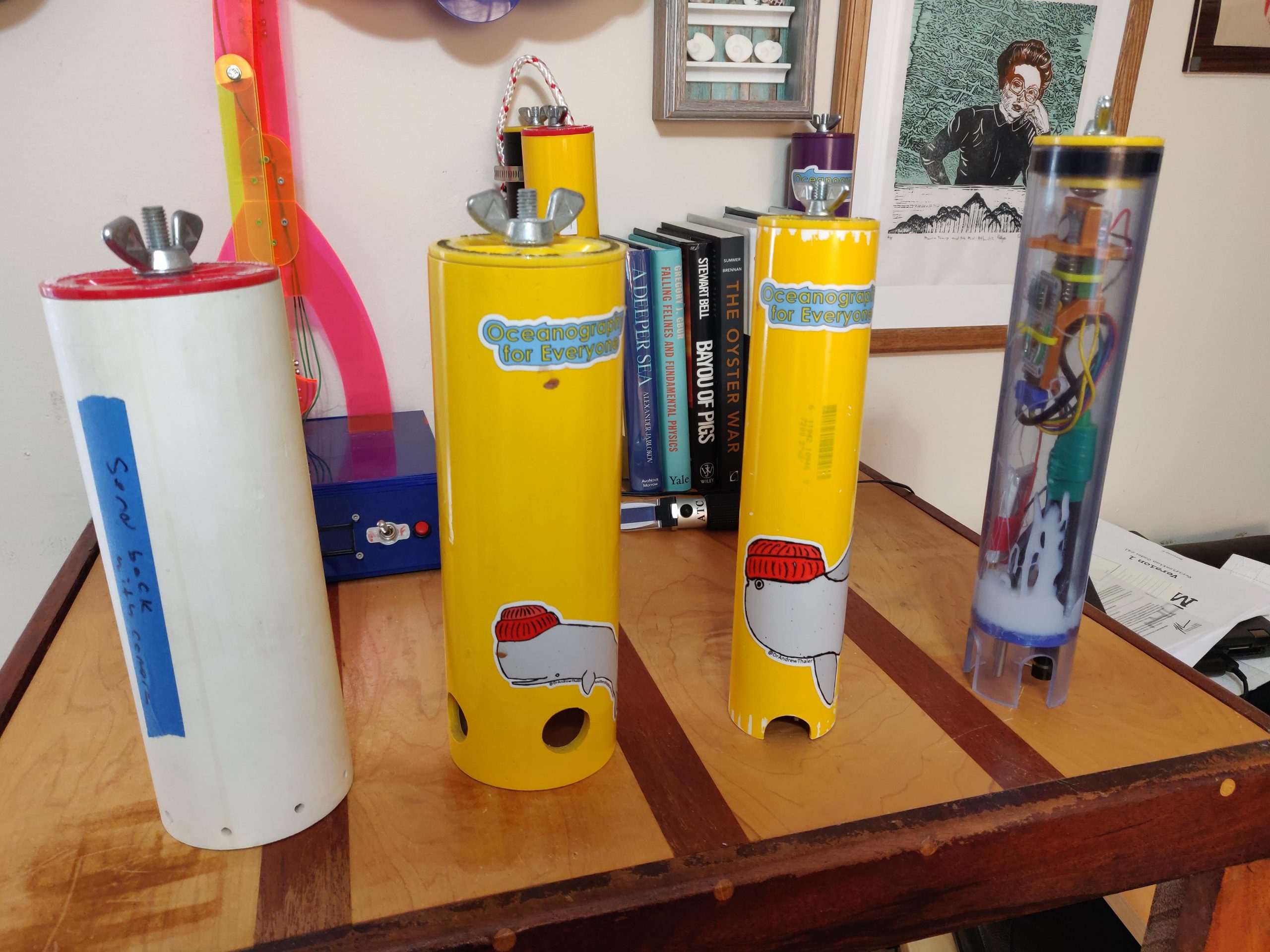
Four generations of OpenCTD. Left to Right: Prototype 2, which went through sea trials in Lake Superior, rev 1, rev 1 in the smaller form factor (this one was deployed in Alaska), and OpenCTD rev 2.

In 2013, Kersey Sturdivant and I embarked upon a quixotic quest to create an open-source CTD — the core tool of all oceanographic research that measures the baseline parameters of salinity, temperature, and depth. We weren’t engineers; neither of us had any formal training in electronics or sensing. And, full confession, we weren’t (and still aren’t) even oceanographers! What we were were post-doc marine ecologists working with tight budgets who saw a desperate need among our peers and colleagues for low-cost alternatives to insurmountably expensive equipment. And we had ties to the growing Maker and DIY electronics movements: Kersey through his work developing Wormcam and me through my involvement with OpenROV. 

We had no idea what we were getting ourselves into. 

The very first OpenCTD prototype.

Seven years and five iterations later, we are releasing the long anticipated OpenCTD rev 2 as well as the comprehensive Construction and Operation Manual! OpenCTD rev 2 builds on over half a decade of iteration and testing, consultation with oceanographers, engineers, developers, and makers around the world, extensive coastal and sea trials, and a series of workshops designed to test and validate the assembly process. 

Read More “The next generation of low-cost, open-source oceanographic instruments is here! Meet the OpenCTD rev 2!” »

Shark Week 2019 reviews and thoughts

Posted on December 24, 2019December 24, 2019 By David Shiffman
Popular Culture, Reviews and Interviews, Science

I wasn’t able to watch live this year, but I DVR-ed all 18 specials and watched them eventually! Here are my reviews, ratings, and thoughts. I did not watch the feature-length movie, which they claim is the first fictional entertainment content they’ve ever produced… causing me to stare in megalodon. Overall, this was not a strong year for science, facts, or diversity (of either sharks or shark researchers).

As a reminder, I grade on the following aspects of a show: is there actual science or natural history educational content / is there made up nonsense, are actual credentialed experts with relevant expertise featured or are they self-proclaimed “shark experts” who say wrong nonsense all the time, what species are featured (with bonus points for species we rarely or never see), and do they feature diverse experts or just the same white men (reminder: my field is more than 50% women)? It’s not a perfect rubric, but it’s better than this actual system for ranking shark news introduced this year in “sharks gone wild 2:”

Rankings appear in no particular order, if you care about the order the shows actually aired in please see this Discovery press release.

Read More “Shark Week 2019 reviews and thoughts” »

10 sharks that mattered in the 2010’s

Posted on December 19, 2019December 19, 2019 By David Shiffman
Blogging, Popular Culture, Science, Uncategorized

Just when you thought it was safe to read another decade-in-review listicle…

You can buy this on a tshirt

As the 2010’s come to an end, it’s a time to reflect on the often-problematic decade that was as we plan for a hopeful future. I am a sucker for year-in-review and decade-in-review listicles, and was devastated to learn that no one had yet written a decade-in-review listicle for sharks! Please enjoy my official, scientific list of the most important science, conservation, and pop culture sharks from the past decade.

Read More “10 sharks that mattered in the 2010’s” »

SciComm Infuses Science with Soul

Posted on November 26, 2019November 25, 2019 By Michelle Jewell
Blogging

Every scientist I work with spends most of the day communicating, whether that’s preparing grants, manuscripts, theses, outreach talks, emails to colleagues/students… the list goes on.  However, most of these outlets share fairly strict formatting rules. Grants comes with pages of guidelines. Talks have defined who I am, what I did, found, next, thank you slide.  While this sterile approach is arguably fundamental to science’s critical tenant of replication, it makes for terrible communication.

Read More “SciComm Infuses Science with Soul” »

Meet the newest Southern Fried Science contributor, Dr. Catherine Macdonald

Posted on November 25, 2019November 27, 2019 By Catherine Macdonald
Conservation, Science

Hello, world of Southern Fried Science.

The Field School team restrains a blacktip shark for a quick work-up during a female-scientist-led trip with the amazing non-profit Terranaut Club.

I’m Catherine—if we’re being official about it, Dr. Catherine Macdonald—and I’m the newest contributing writer around here. Before we get into science, I thought it might be helpful to get better acquainted.  

Read More “Meet the newest Southern Fried Science contributor, Dr. Catherine Macdonald” »

Vanishing Islands, nuclear leaks, oceans of plastic, and one feisty Beluga. Weekly Salvage: November 18, 2019

Posted on November 18, 2019November 17, 2019 By Andrew Thaler
Weekly Salvage

Transcript available below.

Read More “Vanishing Islands, nuclear leaks, oceans of plastic, and one feisty Beluga. Weekly Salvage: November 18, 2019” »

Posts pagination

Previous 1 … 27 28 29 … 272 Next

Popular Posts

Playing God - How the ESA "God Squad" just voted for the extinction of a uniquely American whalePlaying God - How the ESA "God Squad" just voted for the extinction of a uniquely American whaleApril 9, 2026Southern Fried Science
The story of the pride flag made from NASA imagery: Bluesky's most-liked imageThe story of the pride flag made from NASA imagery: Bluesky's most-liked imageSeptember 27, 2024David Shiffman
Here's how to join my IMCC8 symposium, "Ocean Science Communication: What's New and What's Next?"Here's how to join my IMCC8 symposium, "Ocean Science Communication: What's New and What's Next?"April 22, 2026David Shiffman
What Ocean Ramsey does is not shark science or conservation: some brief thoughts on "the Shark Whisperer" documentaryWhat Ocean Ramsey does is not shark science or conservation: some brief thoughts on "the Shark Whisperer" documentaryJuly 2, 2025David Shiffman
Our favorite sea monsters – Ningen (#4)Our favorite sea monsters – Ningen (#4)September 7, 2010Andrew Thaler
Join Me at Upwell: A Wave of Ocean Justice — Our Fourth Year!Join Me at Upwell: A Wave of Ocean Justice — Our Fourth Year!March 24, 2026Angelo Villagomez
On the clarity of animals: the art and science of clearing and stainingOn the clarity of animals: the art and science of clearing and stainingDecember 17, 2013Guest Writer
Shark of Darkness: Wrath of Submarine is a fake documentaryShark of Darkness: Wrath of Submarine is a fake documentaryAugust 10, 2014Michelle Jewell
What can the funniest shark memes on the internetz teach us about ocean science and conservation?What can the funniest shark memes on the internetz teach us about ocean science and conservation?November 8, 2013David Shiffman
That's not a blobfish: Deep Sea Social Media is Flooded by AI SlopThat's not a blobfish: Deep Sea Social Media is Flooded by AI SlopDecember 19, 2025Andrew Thaler

squishy

Subscribe to our RSS Feed for updates whenever new articles are published.

We recommend Feedly for RSS management. It's like Google Reader, except it still exists.

Southern Fried Science

  • Home
  • About SFS
  • Authors
  • Support SFS


If you enjoy Southern Fried Science, consider contributing to our Patreon campaign.

Copyright © 2026 Southern Fried Science.

Theme: Oceanly Premium by ScriptsTown