
Skip to content

Southern Fried Science

Over 15 years of ocean science and conservation online

  • Home
  • About SFS
  • Authors
  • Support SFS

Recent Posts

The next OpenCTD is here!
June 22, 2026
humpback whale in Antarctica
The evolution of the International Whaling Commission – from  whaling quotas to whale conservation
June 10, 2026
Isn’t ironic, don’t you think: dismantling the Ocean Observatories Initiative on World Oceans Day
June 9, 2026
“Why Sustainable Seafood Matters” is now available for preorder! Here’s what it’s about, and why I decided to write it.
June 8, 2026
Here’s how to join my IMCC8 symposium, “Ocean Science Communication: What’s New and What’s Next?”
April 22, 2026
Deep Sea Mining Symposium Announcement
April 21, 2026

The Case for Shark Fin Trade Bans

Posted on May 12, 2017May 12, 2017 By Guest Writer
Conservation, Science

Mariah Pfleger is a marine scientist at Oceana, an international marine conservation non-profit, advising both the responsible fishing and sharks campaigns. She graduated from Florida State University in 2012 where she studied coastal sharks and their relatives. In 2016 she earned her Master’s degree from the University of West Florida where she researched both coastal and deep-water sharks and rays. Mariah worked for 3 years as a field assistant, and during her Master’s an additional 3 years as a field manager, on the Gulf of Mexico Shark Pupping and Nursery Program. She has also conducted research using environmental DNA to detect rare and endangered sturgeon. Her twitter handle is @MariahPfleger.


The demand for shark fins is widely recognized as one of the major contributors to shark mortality around the world. However, solutions to decrease this demand are hotly debated, especially in the scientific community. Southern Fried Science and other websites have published opinions that debate the effectiveness of shark fin bans, but as a shark scientist working to implement this policy I would like to present the case for shark fin trade bans.

The conversation is newly relevant with the introduction of the Shark Fin Trade Elimination Act in the Senate on March 30th by Senators Cory Booker (D-NJ) and Shelly Moore-Capito (R-WV) and in the House on March 9th by Representatives Ed Royce (R-CA) and Gregorio Kilili Camacho Sablan (I-MP). If passed, the bill would ban the buying and selling of shark fins in the United States – thereby removing the United States from the global shark fin trade altogether. The bill is championed by Oceana, where I work as the scientist on the sharks campaign.

The demand for fins fuels finning – the act of slicing off a shark’s fins and dumping the body back into the ocean. The United States recognized this practice was a problem and implemented the Shark Finning Prohibition Act of 2000 followed by the  Shark Conservation Act (SCA) in 2010, which required that all sharks must be landed with their fins naturally attached (except for smooth dogfish, which can be landed under a fin-to-carcass ratio). However, according to the National Marine Fisheries Service, the United States is still importing fins from places like Hong Kong, China, New Zealand, the Netherlands, Spain, South Africa and Indonesia, to name a few. Not all of these countries have anti-finning laws, which means that the United States may be, and likely is, purchasing fins from finned sharks. Once in the United States market, there is no way to tell whether a fin came from a finned shark or not. By purchasing these fins, the United States is sustaining the demand for this unsustainable practice.

Read More “The Case for Shark Fin Trade Bans” »

The Old Man and the Deep Sea

Posted on May 9, 2017May 9, 2017 By Andrew Thaler
Uncategorized

Torben Wolff, legendary deep-sea scientist and last surviving member of the Galathea II expedition, which plumbed the Philippine Trench and recovered biological material from more than 10,000 meters for the first time in history, died in his sleep on May 2, 2017. He was 97. Torben will be remembered for his monumental contributions to deep-sea oceanography, … Read More “The Old Man and the Deep Sea” »

Terraforming Mars on Earth, giant larvaceans, conservation jobs, and more! Monday Morning Salvage: May 8, 2017

Posted on May 8, 2017May 8, 2017 By Andrew Thaler
Weekly Salvage

Fog Horn (A Call to Action)

  • The time to save the EPA is now! The EPA is seeking public input on the new administrations approach to environmental regulations. They are required to seek public input. They are required to respond to public input. Go tell them how you feel. Public comments close May 15. Here’s the docket with instructions on how to comment: Evaluation of Existing Regulations. We’ve even prepared a script for you.

Flotsam (what we’re obsessed with right now)

  •  On a tiny island in the middle of the Atlantic, a terraforming project a century-and-a-half in the making is underway. A 150-year-old experiment on the remote Ascension Island may help us green Mars. Can it also help us save Earth?

Seabirds on Ascension Island. Photo by Clare Fieseler.

  • It also happens to be longtime friend of Southern Fried Science Clare Fieseler’s first major story for National Geographic, so go follow her on twitter.

Jetsam (what we’re enjoying from around the web)

  • Women have a crucial—yet often overlooked—role in fisheries. The Invisible Fishing Fleet by Ilima Loomis at Hakai Magazine.
  • “What do you do when you’re a graduate student and you’ve been sexually assaulted by the PI of a very exciting paleoanthropological site?” An incredibly powerful piece by Holly Dunsworth: In case this helps you: This happened to me while I was trying to become a paleoanthropologist.
  • The general theme of this site appears to be ‘humans are terrible, robots are awesome’. Staying on brand: In a first, deep sea robots get a close look at giant larvaceans, a key player in the biological carbon pump.
  • Deep-sea mining is really heating up. Locals threaten armed campaign against PNG seabed mine.
  • In the Pacific Northwest, the diligence of citizen scientists is shedding light on the lives, and deaths, of seabirds. Drawing Meaning from Death, One Seabird at a Time by Larry Pynn at Hakai.
  • This is a pretty great demonstration of how statistics can be used to mislead: Generating Datasets with Varied Appearance and Identical Statistics through Simulated Annealing.

Read More “Terraforming Mars on Earth, giant larvaceans, conservation jobs, and more! Monday Morning Salvage: May 8, 2017” »

Thursday Afternoon Dredging: May 4th, 2017

Posted on May 4, 2017 By David Shiffman
Uncategorized

After a month hiatus for packing, moving, and unpacking, we’re back!

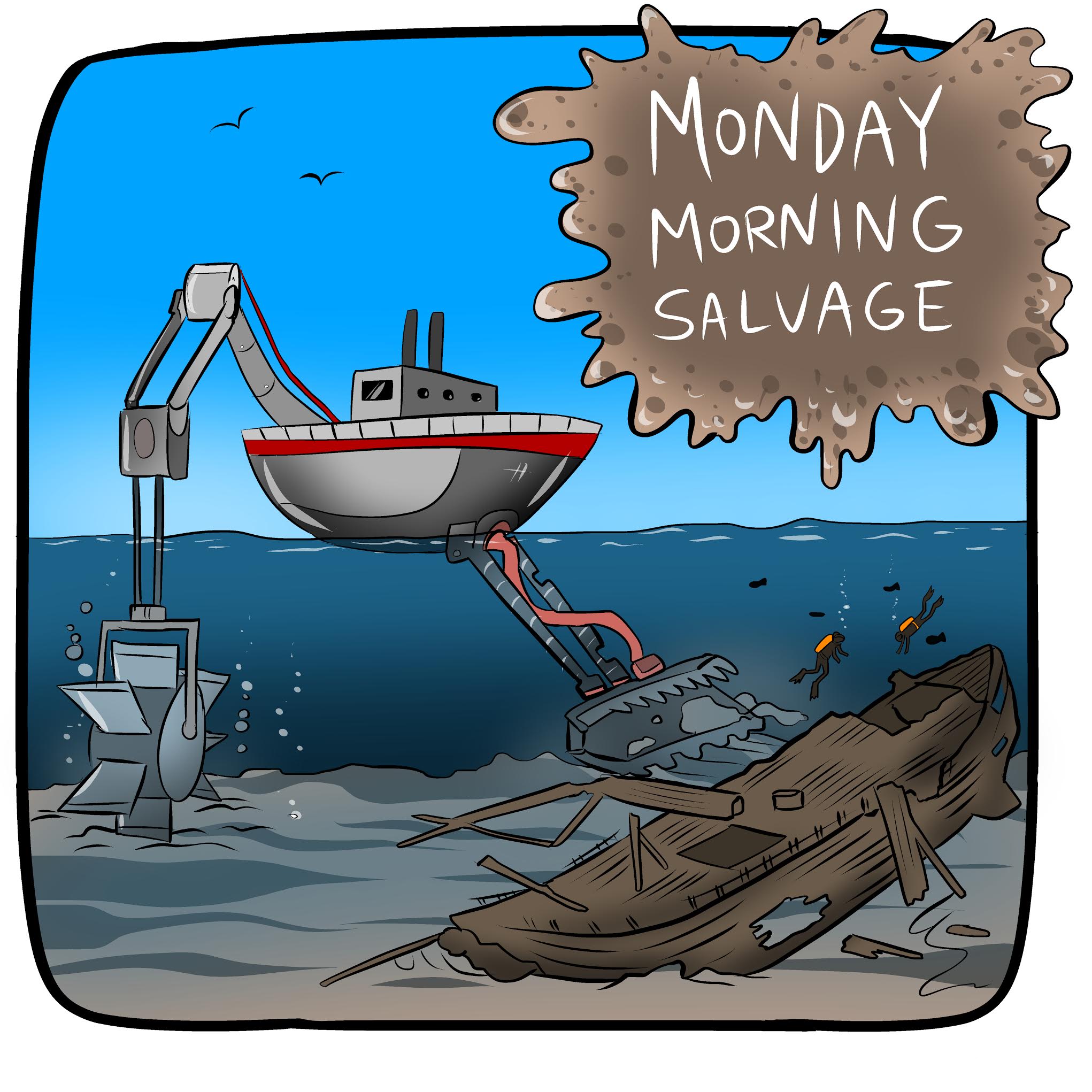
Logo by Ethan Kocak

Cuttings (short and sweet):

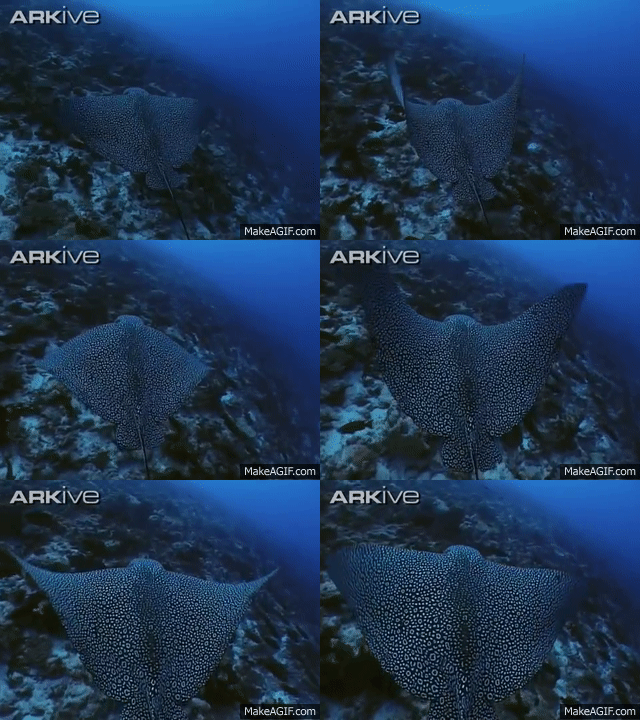
  • Watch a dogfish swim around British Columbia, video by GEERG.

Video by GEERG

  • Follow Dr. Andrea Kroetz, a postdoc studying sawfish, on twitter!
  • What to look for in canned tuna, a new update from Seafood Watch.
  • 13 facts about mola mola, the ocean sunfish. By Richard Smith, for Sport Diver.

Read More “Thursday Afternoon Dredging: May 4th, 2017” »

The time to defend the EPA is now!

Posted on May 1, 2017May 6, 2017 By Andrew Thaler
Conservation

Executive Order 13777 created a Regulatory Reform Task Force to oversee the evaluation of existing regulations to make recommendations about potential repeal, replacement, or modification to the Environmental Protection Agency. The dissolution of the EPA would be catastrophic for this country. Fortunately, the wheels of bureaucracy turn slowly, and before any recommendations are formally issued, … Read More “The time to defend the EPA is now!” »

Climate change denial, open-science hardware, some missing pink dolphins, and more! Monday Morning Salvage: May 1, 2017

Posted on May 1, 2017April 30, 2017 By Andrew Thaler
Weekly Salvage

Fog Horn (A Call to Action)

  • Are you represented by a climate change denier? Motherboard has put together this amazing guide to every climate change denier in congress. Check your state and give your congressperson a piece of your mind. Congressman Andy Harris may be sick of hearing from me, but I guarantee he’ll be gone from my district long before I am.

Flotsam (what we’re obsessed with right now)

Read More “Climate change denial, open-science hardware, some missing pink dolphins, and more! Monday Morning Salvage: May 1, 2017” »

Fun Science FRIEDay – Immune System Amnesia

Posted on April 28, 2017May 8, 2017 By Kersey Sturdivant 2 Comments on Fun Science FRIEDay – Immune System Amnesia
Uncategorized

Ah the measles, a childhood illness that most of my generation has never experienced; due in large part to the success of measles vaccination. A lot of people think the measles isn’t that big of a deal, its just some combination of a rash and fever that goes away in due time. While this is true in most people, in about 1 in 1,000 cases the infection becomes systemic and moves to the brain resulting in death, in what is known as  measles encephalitis.  The measles vaccination resolved this issue but also had an unexpected secondary effect.

16th-century Aztec drawing of someone with measles (Photo credit: Unknown – (2009) Viruses, Plagues, and History: Past, Present and Future, Oxford University Press, USA, p. 144)

When the measles vaccine was first introduced in America in the 1960s, scientists were perplexed why childhood deaths from all infectious diseases plummeted along w/ the measles; even deaths from diseases like pneumonia and diarrhea were cut in half.  An obvious assumption was the drop in childhood deaths was just a result of our advances in modern medicine. While there is undoubtedly truth in the assertion that modern medicine was advancing rapidly in the mid-20th century, whenever the measles vaccine was introduced to Europe a few years later, and even now as its being introduced to third world countries, the same phenomena has been observed. Places that have the measles vaccine see a steep decline in deaths from all other childhood diseases. So whats going on?

Read More “Fun Science FRIEDay – Immune System Amnesia” »

The Holy Grail of the portable hardware-hacking lab: A cordless soldering iron that actually works.

Posted on April 25, 2017April 25, 2017 By Andrew Thaler
Reviews and Interviews

This is a mess. This isn’t even everything I brought for Make for the Planet.

All electronics kits are not created equal. Between the OpenROV, Oceanography for Everyone, and hack-a-thons around the world, my work has taken me out of the lab and into the field, fantail, and classroom to build instruments, hack oceanographic equipment, and train next generation of open-science oceanographers. This has placed a huge new demand on my standard kit, a collection of electronics and hardware tools and components that allow a creative maker to build anything, anywhere. Portability is key, but portability comes with it’s own challenges, especially for that most vital of electronics tools, the humble, powerful soldering iron.

A good soldering iron is absolutely critical to the kinds of projects and workshops I run. Without it, we can to the delicate electronics work necessary for getting a piece of equipment working in the field. But traveling with soldering irons is a nightmare. These high-wattage devices don’t always play nice with local electrical infrastructure. Even using the *right* power converters we’ve blown fuses and burned out power supplies. In the best case scenarios, the irons just don’t produce enough heat to get the job done. In remote regions, local options are often non-existent. When we go, we bring everything with us.

There are portable soldering irons, but they have their own problems. Gas-powered irons require a fuel source that may not be easily obtained and are not always welcome on flights. They also lack the fine control we need. Electric options tend to be of the “cold heat” variety, which is a poor tool for circuit board work and can generate a current that burns out components and shorts your project. Heat-based electric soldering irons are weak, short-lived, and often utterly ineffective. I resigned myself to lugging large soldering stations around the world, hoping for the best when it comes to finding an adequate power supply.

And then I discovered the Hakko FX-901. 

Read More “The Holy Grail of the portable hardware-hacking lab: A cordless soldering iron that actually works.” »

The impact of the March for Science

Posted on April 24, 2017April 25, 2017 By Chris Parsons 1 Comment on The impact of the March for Science
Science

Along with an estimated forty thousand other scientists, I braved the rains to attend the March for science in Washington DC. I went with a bit of trepidation, as I was wondering if anyone would attend, but the staging post at the based of the Washington Monument was absolutely packed.

Donald Trump blamed rain (a brief smattering of drizzle) for poor numbers at his inauguration, but pouring rain and cold did not deter the masses of scientists who attended the March. Although we be derided as “snowflakes” for protesting the current administration, clearly scientists are snowflakes made of Titanium.

Read More “The impact of the March for Science” »

Deep-sea Disco, Giant Icebergs, Pokémon Go, and more! Monday Morning Salvage: April 24, 2017

Posted on April 24, 2017 By Andrew Thaler
Weekly Salvage

Fog Horn (A Call to Action)

  • Still time! The EPA is seeking public input on the new administrations approach to environmental regulations. They are required to seek public input. They are required to respond to public input. Go tell them how you feel. Public comments close May 15. Here’s the docket with instructions on how to comment: Evaluation of Existing Regulations.

Flotsam (what we’re obsessed with right now)

  • This deep-sea mining Disco video is something.

Jetsam (what we’re enjoying from around the web)

Read More “Deep-sea Disco, Giant Icebergs, Pokémon Go, and more! Monday Morning Salvage: April 24, 2017” »

Posts pagination

Previous 1 … 62 63 64 … 273 Next

Popular Posts

What Ocean Ramsey does is not shark science or conservation: some brief thoughts on "the Shark Whisperer" documentaryWhat Ocean Ramsey does is not shark science or conservation: some brief thoughts on "the Shark Whisperer" documentaryJuly 2, 2025David Shiffman
What is a Sand Shark?What is a Sand Shark?November 12, 2017Chuck Bangley
The next OpenCTD is here!The next OpenCTD is here!June 22, 2026Andrew Thaler
Undermining the Law of the Sea. Some additional thoughts following my OpEd in the Hill.Undermining the Law of the Sea. Some additional thoughts following my OpEd in the Hill.June 22, 2026Andrew Thaler
The story of the pride flag made from NASA imagery: Bluesky's most-liked imageThe story of the pride flag made from NASA imagery: Bluesky's most-liked imageSeptember 27, 2024David Shiffman
Tagging Bull Sharks in the Neuse RiverTagging Bull Sharks in the Neuse RiverAugust 4, 2011Guest Writer
Some upcoming public talks on shark science and conservationSome upcoming public talks on shark science and conservationJune 29, 2026David Shiffman
That's not a blobfish: Deep Sea Social Media is Flooded by AI SlopThat's not a blobfish: Deep Sea Social Media is Flooded by AI SlopDecember 19, 2025Andrew Thaler
Rice’s whale and the curious case of the disappearing species.Rice’s whale and the curious case of the disappearing species.June 25, 2026Southern Fried Science
Shark of Darkness: Wrath of Submarine is a fake documentaryShark of Darkness: Wrath of Submarine is a fake documentaryAugust 10, 2014Michelle Jewell

squishy

Subscribe to our RSS Feed for updates whenever new articles are published.

We recommend Feedly for RSS management. It's like Google Reader, except it still exists.

Southern Fried Science

  • Home
  • About SFS
  • Authors
  • Support SFS


If you enjoy Southern Fried Science, consider contributing to our Patreon campaign.

Copyright © 2026 Southern Fried Science.

Theme: Oceanly Premium by ScriptsTown